 English
Che168, Dongchedi, Guazi: China's used car websites for exporters
Chinese used car websites for exporters: Che168, Dongchedi and Guazi explained, how to read 万 prices, 万公里 mileage and 国六, and how China’s car export works.
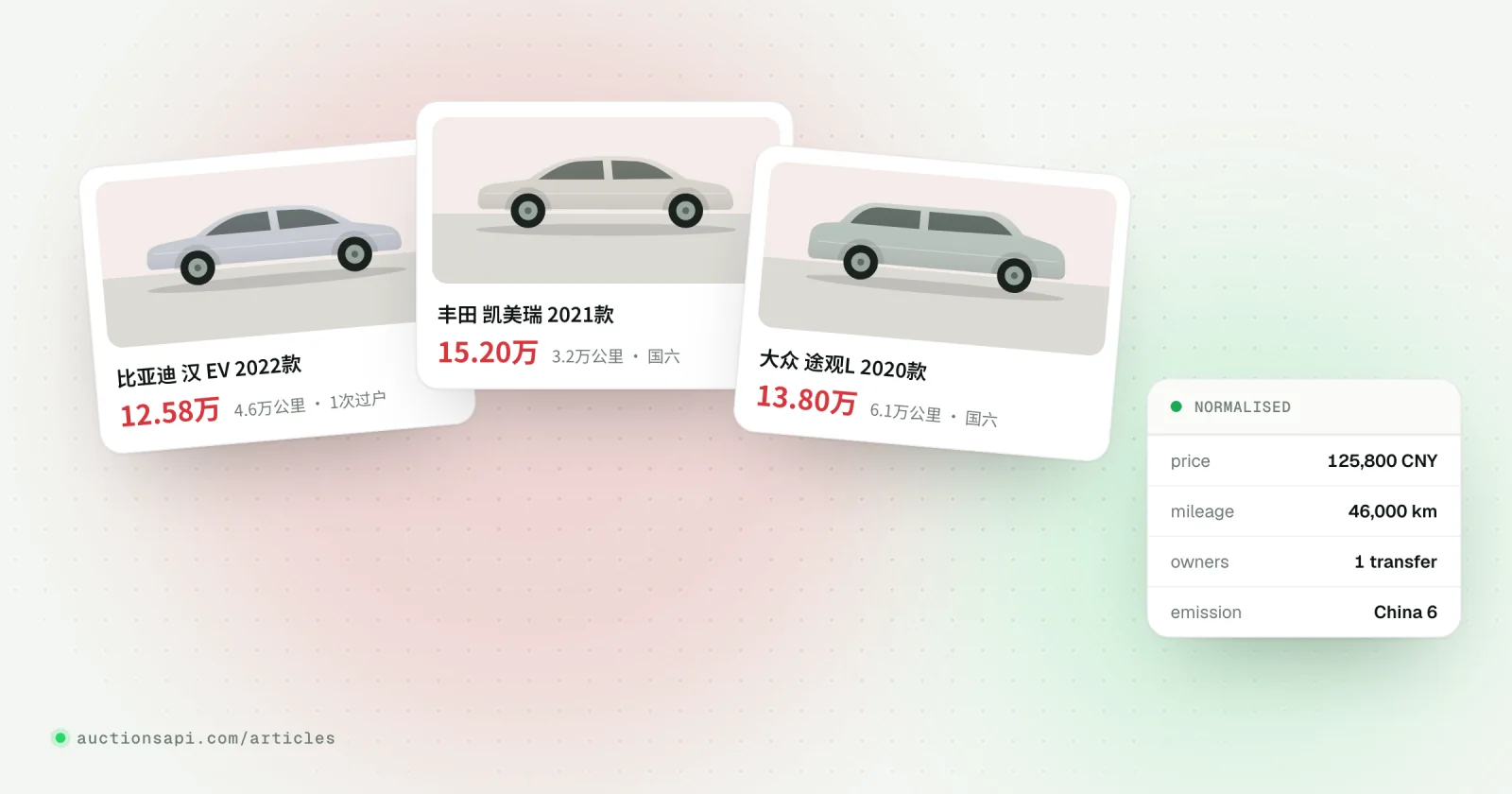
The Chinese used car websites exporters check first are Che168 (二手车之家, Autohome's used-car marketplace), Dongchedi (懂车帝, ByteDance's car platform with a large used-car section) and Guazi (瓜子二手车), whose export catalog en.guazi.com lists cars in US dollars. Che168 and Dongchedi are domestic sites in Chinese with prices in yuan; Guazi's export site is in English and written for buyers abroad.
Reading the domestic sites takes some vocabulary. Prices are written in 万 (ten thousands), mileage in 万公里, the emission class as 国六 and the car's past as a count of ownership transfers. This guide explains what each site is, what a listing contains, how China's used-car export works in broad terms, and how to turn the listings into clean data you can filter.
Key takeaways
- Che168 belongs to Autohome and Dongchedi to ByteDance; both are domestic marketplaces with dealer and private listings priced in CNY.
- en.guazi.com is Guazi's export catalog with prices in US dollars; the domestic guazi.com is a separate site.
- 12.58万 means 125,800 yuan and 4.6万公里 means 46,000 km; stored as text, they break every filter.
- A label like 2020款 is the maker's model-year label, not the registration date.
- Used cars leave China through approved exporters, and the rules have tightened for electric cars and for cars registered shortly before export.
Chinese used car websites at a glance
| Site | Chinese name | What it is | Language, currency | Typical use |
|---|---|---|---|---|
| Che168 | 二手车之家 | Autohome's used-car marketplace, dealers and private sellers | Chinese, CNY | Wide domestic choice and price checks |
| Dongchedi | 懂车帝 | ByteDance's car platform: news, reviews and used cars | Chinese, CNY | Dealer stock with reports, video and seller details |
| Guazi export | 瓜子二手车 (en.guazi.com) | Guazi's export catalog | English, USD | Cars already offered abroad, many of them electric |
Che168 (二手车之家)
che168.com is the used-car marketplace of Autohome (汽车之家), one of China's largest car websites. Dealers and private sellers list cars of every Chinese and imported brand. A listing usually has the price, the registration date, the mileage shown on the dash, photos, battery and power data for new-energy cars, and on many cars a condition check (车况检测). The VIN (车架号) is shown on some listings and sometimes partly masked.
Dongchedi (懂车帝)
Dongchedi started as a car news and review platform from ByteDance, the company behind Douyin and TikTok, and grew a used-car marketplace next to its reviews. Listings carry the price, mileage, registration date, photos and often video, options, inspection and history reports where available, the number of keys, the seller type (商家 dealer or 个人 private) and the city.
Guazi (瓜子二手车) and en.guazi.com
Guazi is one of the best-known used-car platforms in China. Its export catalog, en.guazi.com, offers Chinese cars to buyers abroad, with prices in US dollars, inspection and history reports, options and battery capacity for electric cars. Some cars there are sold at auction and show a current bid. For an exporter it is the shortest path: the text is already in English and the price is already in dollars. The domestic guazi.com is a different site, in Chinese and in yuan.
What a Chinese used-car listing contains
Che168 and Dongchedi use much the same labels. These are the ones that matter for an export decision:
| Label | Pinyin | English | Example | Note |
|---|---|---|---|---|
| 售价 / 价格 | shòujià / jiàgé | Price | 12.58万 | 125,800 CNY |
| 新车含税价 | xīnchē hán shuì jià | New price incl. tax | 18.98万 | What the car cost new, not the asking price |
| 上牌时间 | shàngpái shíjiān | First registration | 2021年06月 | June 2021 |
| 表显里程 | biǎoxiǎn lǐchéng | Displayed mileage | 4.6万公里 | 46,000 km, as read from the dash |
| 排放标准 | páifàng biāozhǔn | Emission standard | 国六 | China 6 |
| 过户次数 | guòhù cìshù | Ownership transfers | 1次 | One transfer, so two owners |
| 车架号 | chējià hào | VIN | LSVAX6BR8MN123456 | Sometimes partly masked |
| 年检到期 | niánjiǎn dàoqī | Annual inspection due | 2027年06月 | Domestic, matters little for export |
| 变速箱 | biànsùxiāng | Gearbox | 自动 | Automatic |
| 检测报告 | jiǎncè bàogào | Inspection report | 已检测 | Inspected |
Two of these trip people up. 款 (kuǎn) marks the maker's model-year label: a 2020款 car is the 2020 version of the model, which may have been built and registered in 2019 or 2021. And 过户次数 counts transfers, not owners: zero transfers means one owner since new.
表显 (biǎoxiǎn) literally means “as displayed”. The site reports what the dashboard says; it does not certify it. Where a history report exists, compare the mileage at service visits with the figure on the listing.
Normalising Chinese listings: from 万 to numbers
万 (wàn) is ten thousand. Chinese sites write prices in 万 yuan and mileage in 万 kilometres, which keeps numbers short on a phone screen and makes them useless in a database until you convert them. The rules are simple; the volume is what hurts.
One trap if you write your own parser: floating-point maths. In JavaScript, 10.88 * 10000 gives 108800.00000000001 and 19.99 * 10000 gives 199899.99999999997. Round the result, or better, parse the digits as text:
Brand and model names
Brands are written in Chinese: 大众 is Volkswagen, 丰田 Toyota, 本田 Honda, 奔驰 Mercedes-Benz, 宝马 BMW, 比亚迪 BYD, 吉利 Geely. Foreign brands are often built by joint ventures, and the venture's name comes first: 上汽大众 (SAIC Volkswagen) and 一汽-大众 (FAW-Volkswagen) are both Volkswagen, but each builds its own models. The Lavida (朗逸) is a China-market model that a buyer abroad may never have heard of, so a catalog should show the brand, the model in Latin letters and, where useful, the venture that built it. Keep the original Chinese next to it for anyone checking the car by hand.
Emission labels need the same care. 国六 is China 6, and you will also see 国六b and 国五 (China 5). China's standards are close to the Euro ones in spirit but are not the same certificate, so if your destination asks for a Euro class, check with your broker which Chinese label it accepts rather than mapping 国六 to Euro 6 yourself.
Checking a Chinese used car before you buy
The words that should make you look twice are the same on every Chinese site. Search the listing and its report for them before you look at the price:
| Term | Pinyin | Meaning | What to do |
|---|---|---|---|
| 事故车 | shìgù chē | Accident car | Ask which structural parts were repaired; price it as an accident car abroad too |
| 泡水车 | pàoshuǐ chē | Flood car | Walk away unless the price reflects it and your market accepts it |
| 火烧车 | huǒshāo chē | Fire-damaged car | Walk away for export |
| 调表 | tiáo biǎo | Odometer rolled back | Compare service records (维保记录) with the displayed mileage |
| 营运 / 非营运 | yíngyùn / fēi yíngyùn | Commercial / private use | Former taxis and ride-hailing cars wear faster |
| 抵押 | dǐyā | Car under a loan or pledge | The loan must be cleared before transfer and deregistration |
| 出险记录 | chūxiǎn jìlù | Insurance claim record | Large claims should match the repairs in the report |
A clean-looking listing with 一手车 (one owner), 非营运 (private use) and a full set of service records is what export buyers pay more for. A 准新车 (nearly new car) with a few thousand kilometres is attractive too, but for those the export rules below matter more than the condition.
Photos tell you the rest. Chinese dealers often post dozens of pictures, including the engine bay and the boot floor; uneven panel gaps, overspray on rubber seals and new bolts on the wings show up there long before any report mentions them.
How exporting a used car from China works
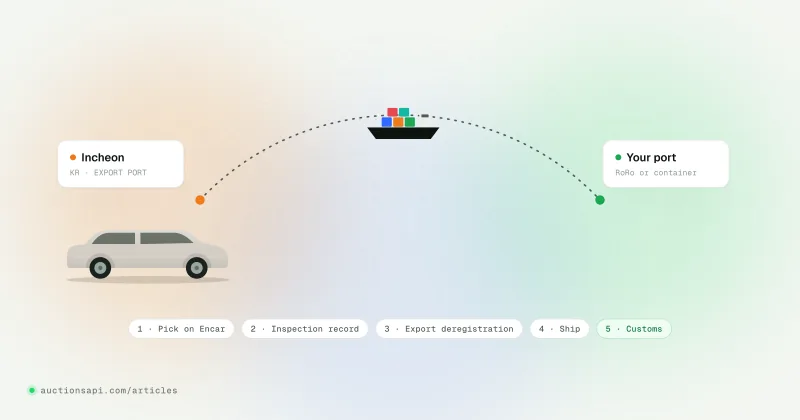
For years China had no formal channel for exporting used cars. In 2019 the Ministry of Commerce and other agencies began allowing used-car exports through approved companies in pilot regions, and the list of regions and companies has been widened several times since. The broad sequence looks like this:
- 1Buy in ChinaThe exporter buys the car from a dealer or private seller, often found on Che168, Dongchedi or Guazi.
- 2DeregisterThe Chinese registration is cancelled for export (注销) and the plates are returned.
- 3Licence and customsThe approved exporter obtains the export licence and files the customs declaration.
- 4ShipBy sea, or by rail and truck to Central Asia and Russia.
- 5Clear at homeDuties, homologation and registration under your country’s rules.
Common destinations have included Central Asia, Russia and the Middle East, with land routes as important as the sea for the first two.
Zero-mileage used cars (零公里二手车)
A large part of China's “used” car exports in recent years were cars that were registered and then exported almost at once, with little or nothing on the odometer. Registering them made them used cars on paper, which opened markets where the maker had no official dealer. Chinese authorities criticised the practice in 2025, and reports from late 2025 describe tighter controls on exporting cars registered within roughly 180 days, including requirements tied to the maker's authorisation and after-sales service. Check the current rules with your exporter before you buy a nearly new car for export.
Electric cars
Since 1 January 2026, exports of pure electric passenger cars from China need an export licence, according to an announcement by the Ministry of Commerce and other agencies in September 2025. For a buyer, this mostly means working with an exporter that holds the right licence and asking how it applies to the exact car.
Which site fits which job
- Price research on a model: Che168 and Dongchedi, for domestic prices in yuan and a wide choice.
- Cars already set up for export: en.guazi.com, with prices in dollars and English descriptions.
- Reports: Dongchedi and Guazi often carry inspection and history reports; Che168 has condition checks on many cars.
- Electric cars: battery capacity in kWh is the first field buyers ask about; Guazi export records carry it, and Che168 shows battery and power data.
Comparing a domestic price with an export price needs one adjustment: the domestic price is the car standing in China, the export price already covers the exporter's work. In the example below the same car is listed on three sites, and the dollar price is higher than the yuan prices converted, as you would expect.
- en.guazi.com
- US$ 14,900 (export price)
- che168.com
- ¥108,800
- dongchedi.com
- ¥106,500
- Battery
- 76.9 kWh
- Location
- Changzhou
Getting Che168, Dongchedi and Guazi as one feed
AuctionsAPI collects all three through its marketplace API, in the same schema as Encar and the Korean sites: prices as whole numbers with their currency, mileage in kilometres, dates as year and month, fuel and gearbox as clean values, and reports as structured data. This request asks for electric cars from 2021 onward, priced up to 150,000 yuan, cheapest first:
A car listed on several of these sites arrives as one record with every listing and its price, which is how the comparison above is built. Each site has its own page with an example record and a request builder: Che168, Dongchedi and Guazi.
Where to go from here
If you are pricing cars for export, start with en.guazi.com for ready export prices and use Che168 and Dongchedi to check what the same model costs in China. If you are building a catalog, look through the full list of Chinese, Korean and other sites on the sources page. Korean cars follow different conventions, explained in our Encar API article, and the shipping side of an Asian import is covered step by step in the guide to importing a car from Korea.
Questions people ask
What are the main used car websites in China?
Che168 (二手车之家), run by Autohome, Dongchedi (懂车帝), run by ByteDance, and Guazi (瓜子二手车) are among the best known. Che168 and Dongchedi are domestic marketplaces in Chinese with prices in yuan. Guazi also runs an English export catalog at en.guazi.com with prices in US dollars, aimed at buyers outside China.
Is Che168 the same as Autohome?
Che168 is the used-car marketplace of Autohome (汽车之家), one of the largest car websites in China. Autohome focuses on new cars, reviews and prices; Che168, also known as 二手车之家, is where dealers and private sellers list used cars. Listings are in Chinese with prices in yuan, usually written in 万.
What does 万 mean in Chinese car prices?
万 (wàn) means ten thousand. A price of 12.58万 is 12.58 × 10,000 = 125,800 yuan, and a mileage of 4.6万公里 is 46,000 kilometres. Convert both to whole numbers before you store them, and round or parse the digits as text to avoid floating-point errors in code.
What is 国六 on a Chinese car listing?
国六 (guó liù) is China 6, the national emission standard for new vehicles, with stages 6a and 6b. 国五 is the earlier China 5. It is China’s own standard, so if your country asks for a Euro emission class, check with your customs broker which Chinese label it accepts instead of assuming 国六 equals Euro 6.
Can foreigners buy cars from Guazi?
Guazi’s export catalog en.guazi.com is written for buyers outside China, in English with prices in US dollars. Purchase terms, payment and shipping are set by Guazi and its partners and can change, so read the terms on the site. The domestic guazi.com is aimed at buyers in China.
Can I export a used car from China myself?
Usually not as a private person. Used-car exports from China go through approved exporters that handle deregistration, the export licence and customs. Rules tightened in 2025 and 2026 for electric cars and for cars registered shortly before export, so work with an exporter who can explain the current requirements for your car.