 English
Encar API: Korean used-car listings in English, in one schema
Is there an official Encar API? What exporters need from Encar listings, why 만원 prices and Korean model names are hard to parse, and a working request.
There is no public, documented Encar API that outside companies can sign up for. Encar's website and apps load their data from internal endpoints that are not offered as a product, change without notice and come with no terms for reuse. If you need Encar listings in your own catalog, you either collect them yourself or use a third-party Encar API that delivers them as clean, translated JSON.
This article is for car exporters and the developers who build their catalogs. It covers what an Encar listing really contains, why the raw data takes more work than it looks, how a request is made and what a normalised record looks like: prices in won as whole numbers, model names in English, and the inspection report and insurance history as structured data.
We collect Encar every day next to K Car, KB Chachacha and the other Korean sites, so the examples below are the problems we actually deal with.
Key takeaways
- Encar does not publish an open API for third parties; anything sold as an Encar API is either a scraper you run or a service that runs one for you.
- Encar is a marketplace with fixed asking prices, so a record has a price and its history, never bids.
- Prices are written in 만원 (units of 10,000 won): 2,790만원 is 27,900,000 KRW, about $19,930 at an example rate of 1,400 won to the dollar.
- The listing, the performance check record and the insurance history sit in three different places on Encar, and an exporter needs all three.
- A normalised record gives you numbers, year-month dates and English values, so one filter works across Encar, K Car and KB Chachacha.
Is there an official Encar API?
Not one you can sign up for. Encar (encar.com) is South Korea's largest used-car sales site, and like most large marketplaces it runs on internal APIs: open the browser's developer tools on a listing and you will see JSON coming back from Encar's own servers. Those endpoints exist to feed Encar's site and apps. They have no public documentation, no developer keys and no terms that allow reuse, and their shape changes whenever Encar ships a new version of a page.
We are not aware of a self-service Encar API with documentation and a sign-up page. If that ever changes, Encar's own site is where it would appear. Until then, an “Encar API” in search results means one of two things:
- A scraper you build. You request Encar's pages or internal JSON yourself, handle blocks and layout changes, translate the Korean and store the result.
- A third-party data API. A service collects publicly visible Encar listings and sells access to the collected data in its own format. AuctionsAPI is one of these, and like the others it is independent and not affiliated with Encar.
Either way, somebody has to solve the same problems: Korean units, Korean model names and three separate documents per car. The rest of this article is about those problems.
What exporters need from an Encar listing
A buyer in Almaty, Bishkek or Amman cannot walk round the car. Everything they decide comes from the listing and its reports, so an export catalog needs much more than a title and a price. These are the fields people ask about first, with the way Encar shows them:
| Field | How Encar shows it | What your database needs |
|---|---|---|
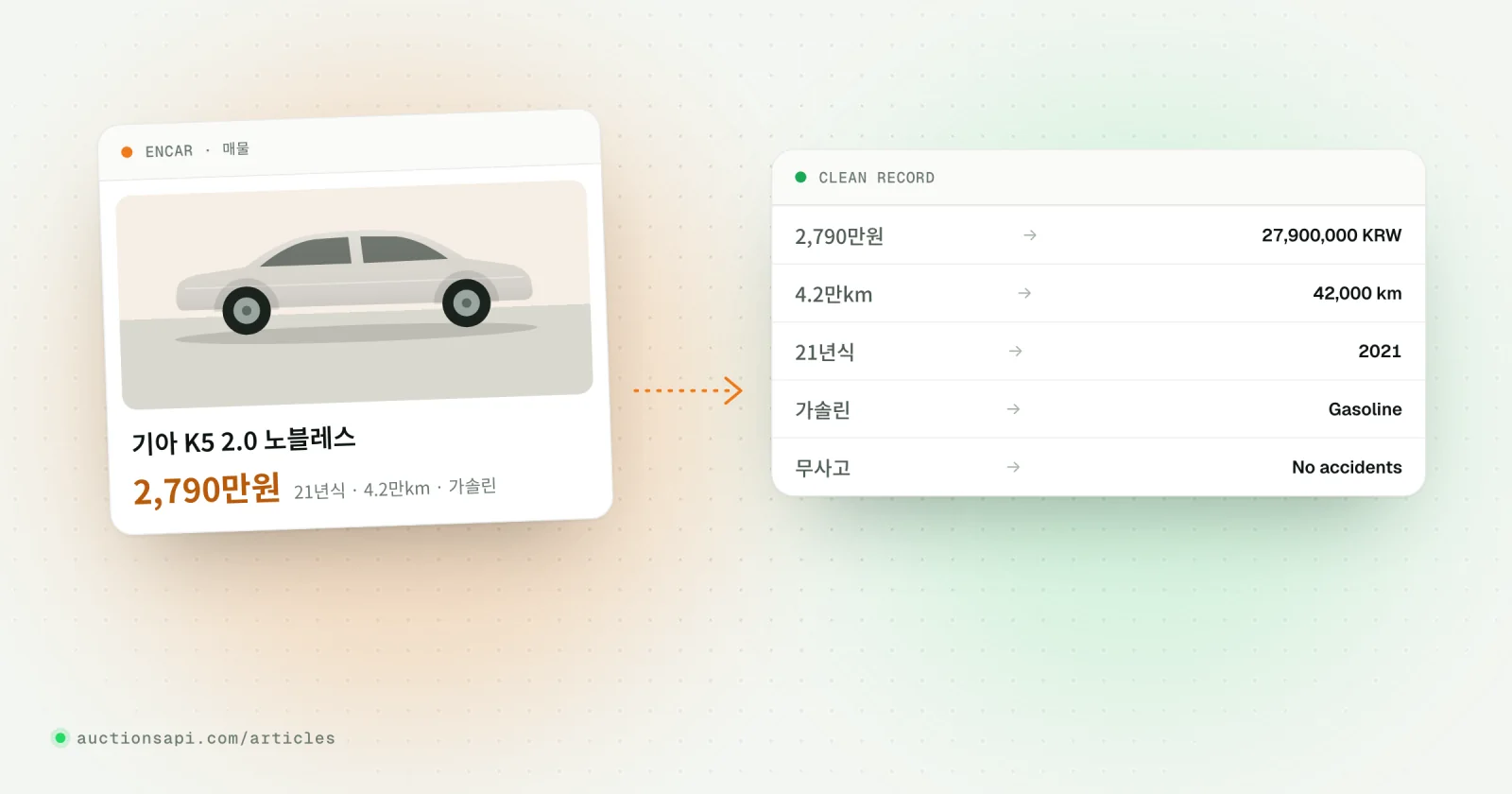
| Price | 2,790만원 | 27900000 with currency krw, plus a dollar figure you calculate |
| Age | 21/03식, sometimes with (22년형) | Year 2021, month 3, and the model year when given |
| Mileage | 98,760km | 98760 in kilometres |
| Fuel | 가솔린, 디젤, LPG, 하이브리드, 전기 | Gasoline, diesel, LPG, hybrid, electric |
| Gearbox | 오토, 수동 | Automatic, manual |
| Options | 선루프, 통풍시트, 어라운드뷰… | A list of option ids with names in your language |
| Inspection | 성능점검 record with a car diagram | Each panel with its result: OK, repainted, replaced |
| Insurance history | 보험이력: claims, owner changes, total loss | Counts plus dated events with amounts |
| Seller | 딜러 (dealer) or 개인 (private) | A seller type you can filter on |
| Photos | A gallery on Encar’s image servers | Full-size image URLs |
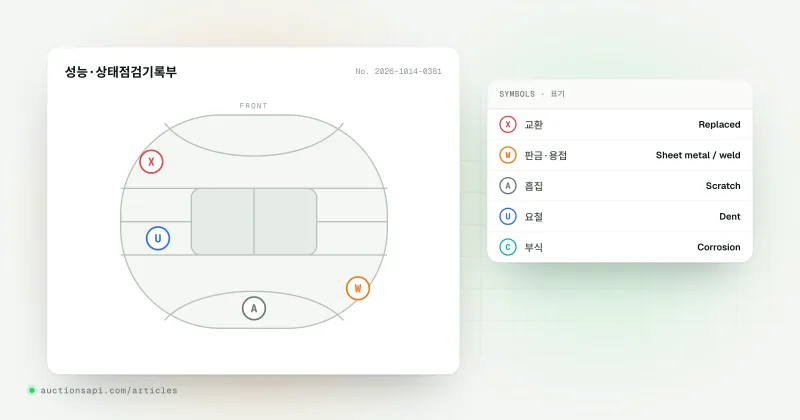
Two of these deserve a word. The performance and condition record (성능·상태점검기록부) is a legal form in Korea: a dealer has to hand it to the buyer, and it shows which panels were repainted or replaced and whether the frame was touched. The insurance history comes from the claims database run by the Korea Insurance Development Institute and shows what insurers paid out for the car. We go through the first one panel by panel in How to read an Encar inspection report.
Why raw Encar data is hard to work with
Getting the HTML or the JSON is the easy part. Turning it into something your filters, your sorting and your client's eyes understand is where the time goes.
Prices in 만원
Korean sites count money in 만 (man), units of 10,000 won. A price of 2,790만원 is 2,790 × 10,000 = 27,900,000 won. Store the text and you cannot sort or filter; strip the non-digits and you get 2,790, a car that costs about two dollars. The raw data behind the page uses the same convention, often as a bare number with no unit at all, so a parser has to know which scale it is reading. Lease and rental listings can also show a monthly figure next to the price.
Korean model names
Model names follow Korean marketing, not the VIN. A fourth-generation Sorento is listed as 쏘렌토 4세대 and its facelift as 더 뉴 쏘렌토 4세대; a Grandeur can be 그랜저 IG, 더 뉴 그랜저 IG or 디 올 뉴 그랜저. As a rule of thumb, 더 뉴 (“the new”) marks a facelift and 올 뉴 or 디 올 뉴 (“all new”) a new generation. Imported brands are transliterated: 벤츠 is Mercedes-Benz, 비엠더블유 is BMW. Trims mix both scripts, as in 2.2 디젤 4WD 시그니처.
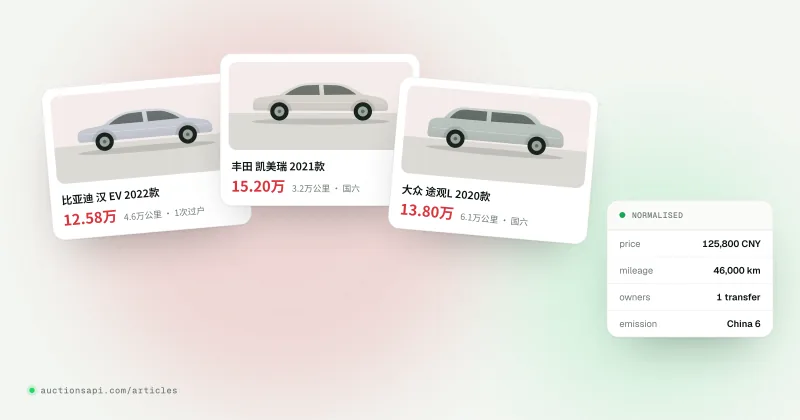
If your catalog also carries cars from K Car or KB Chachacha, each site spells the same model slightly differently. Without one dictionary for makes, models and generations, a buyer filtering for “Sorento” misses half the cars.
Dates and model years
Encar dates a car as 21/03식, the year and month it is counted from (March 2021 here). When the model year differs, a label such as (22년형) is often added in brackets. Buyers abroad care about the first registration, some customs offices care about the production date, and the two are not always the same. Keep both fields and never overwrite one with the other.
Three documents for one car
The listing, the performance check record and the insurance history are separate pages in separate formats. The record is a form with a car diagram; the insurance history is a set of counters and dated claims. Joining them to the right car, and noticing when one of them is missing, is part of the job.
How an Encar API request looks
With AuctionsAPI, Encar comes through the marketplace API, the same one that serves K Car, KB Chachacha, Che168 and the other marketplaces. The key goes in the api_key query parameter, and every source enabled for your key is searched together. This request asks for cars from 2020 onward that have an inspection report, priced up to 30,000,000 won (3,000만원), cheapest first:
/search returns flags such as has_inspections and has_history_reports but not the full reports, which keeps result pages light. When a client opens one car, fetch it by VIN and the reports come attached:
If the same Sorento is also for sale on KB Chachacha or K Car, it arrives as one car with several listings and several prices, which is handy when a client asks whether the Encar price is fair. The lang parameter switches option names and report labels to another supported language, Russian and Ukrainian among them.
An example normalised Encar record
Here is a shortened response for a made-up 2021 Kia Sorento. The field names are the real ones; the values are an example.
- Price
- ₩27,900,000 · about $19,930
- Price change
- ₩29,500,000 → ₩27,900,000
- Dated
- March 2021
- Mileage
- 98,760 km
- Inspection
- Front fender (right) replaced
- Frame
- No accident recorded
- Insurance claims
- 2
- Owner changes
- 2
Two things are worth seeing here. The replaced front fender does not make this an accident car under the Korean record: a bolted-on outer panel counts as a simple repair, while any work on the frame does not. And two insurance claims say little on their own; the amounts matter, which is why the full history arrives as dated events with sums rather than a yes or no.
Converting won to dollars without surprises
Exporters quote in dollars, Encar prices in won. Keep the won price as the source of truth and calculate the dollar figure when you show it:
- Read the price as a whole number of won: 27,900,000.
- Divide by the current rate. At an example 1,400 won per dollar: 27,900,000 / 1,400 = 19,928.57, shown as about $19,930.
- Store the rate and the time you used it, so a quote can still be explained a week later.
- Never save the converted number as if it were the listing price. When the rate moves, recalculate.
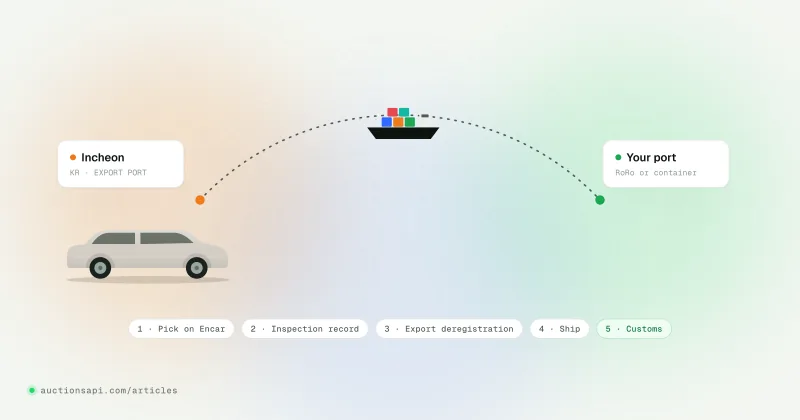
Remember that the Encar price is the price of the car standing in Korea. Deregistration, inland transport, port charges and freight come on top, and so do the duties at home, as the guide to importing a car from Korea shows step by step.
Keeping Encar data fresh
Encar listings change all the time: dealers cut prices, cars sell and disappear, new stock arrives through the day. A catalog that was right on Monday shows sold cars by Friday. Three habits keep it honest:
- Refresh prices as well as adding cars. Store every price with its date. A drop from 2,950만원 to 2,790만원 over seven weeks tells a buyer the dealer may be ready to talk; the API keeps that history in
price.history. - Mark removed cars instead of deleting them. When a listing stops appearing, flag it as gone. A client who saved the car sees that it sold, and you keep its last price for your own statistics.
- Re-check reports before money moves. A dealer can have a car inspected again after a repair, and the insurance history can gain a claim. Fetch the car by VIN once more on the day your client commits.
For day-to-day browsing, /search pages through up to 10,000 results per set of filters. For a full export of everything enabled for your key, the marketplace API also has a cursor-based /cars endpoint that walks every active car with its reports, batch by batch.
Scraping Encar yourself or using an Encar data API
Plenty of exporters start with a scraper, and for a few hundred cars a week it can work. The trouble starts when it has to run every day for a year, through Encar redesigns and blocked IP addresses.
- Written in days, then fixed every time a page changes
- Blocks and rate limits to manage
- Your own rules for 만원, model names and options
- Inspection and history pages parsed separately
- A format only your team knows
- Starts with no past prices
- One documented format
- Prices as whole numbers with a currency
- English values, option names in several languages
- Reports as structured data
- The same schema for K Car, KB Chachacha, Che168
- Price changes kept with their dates
If you need a handful of cars for one client, browsing Encar with a browser translator is fine. If the cars feed a website, a Telegram bot or a CRM, the scraper becomes a second product you have to keep alive.
Where to start
Open the Encar API page to see the request builder and a full example record, or look through the other Korean and Chinese sites on the sources page. A free demo key is enough to check the format on real data before you change anything in your catalog. If your buyers ask about panels and frame damage, and they will, read the inspection report guide next.
Questions people ask
Does Encar have a public API?
Not as far as we know. Encar's website and apps use internal endpoints, but there is no public developer programme, documentation or API key for outside companies. Services that offer an Encar API collect publicly visible listings themselves and deliver them in their own format. They are independent of Encar, so check how each one handles reports, prices and updates.
Can I get Encar listings in English?
Yes, through a data API that translates the values. Makes, models, fuel, gearbox, options and inspection results arrive as English values, prices as whole numbers in won and dates as a year and month. Keeping the original Korean next to them helps when you check a car by hand, but your filters should run on the normalised fields.
How do I convert 만원 to won?
Multiply by 10,000. 만 (man) is a unit of ten thousand, so 2,790만원 is 27,900,000 won and 950만원 is 9,500,000 won. To get dollars, divide the amount in won by the current exchange rate, and keep the won figure as the original price, because the rate changes every day.
Is Encar an auction?
No. Encar is a marketplace where dealers and private sellers list cars at fixed asking prices. A record from Encar has a price and a price history, never bids. Korean car auctions, such as the dealer auctions run by Autobell or K Car, are separate services with their own sites.
Does an Encar API include the inspection report?
Ours does, where Encar has one. The performance and condition record arrives as structured data: each checked panel with its result, such as repainted or replaced, plus conclusions on accidents, flood and fire. Search results only flag that a report exists; fetching the car by VIN returns the full report and the insurance history.