 English
How to import a used car from South Korea: a step-by-step guide
How to import a car from Korea: picking it on Encar or K Car, checking its records, export deregistration, RoRo or container, documents and typical timelines.
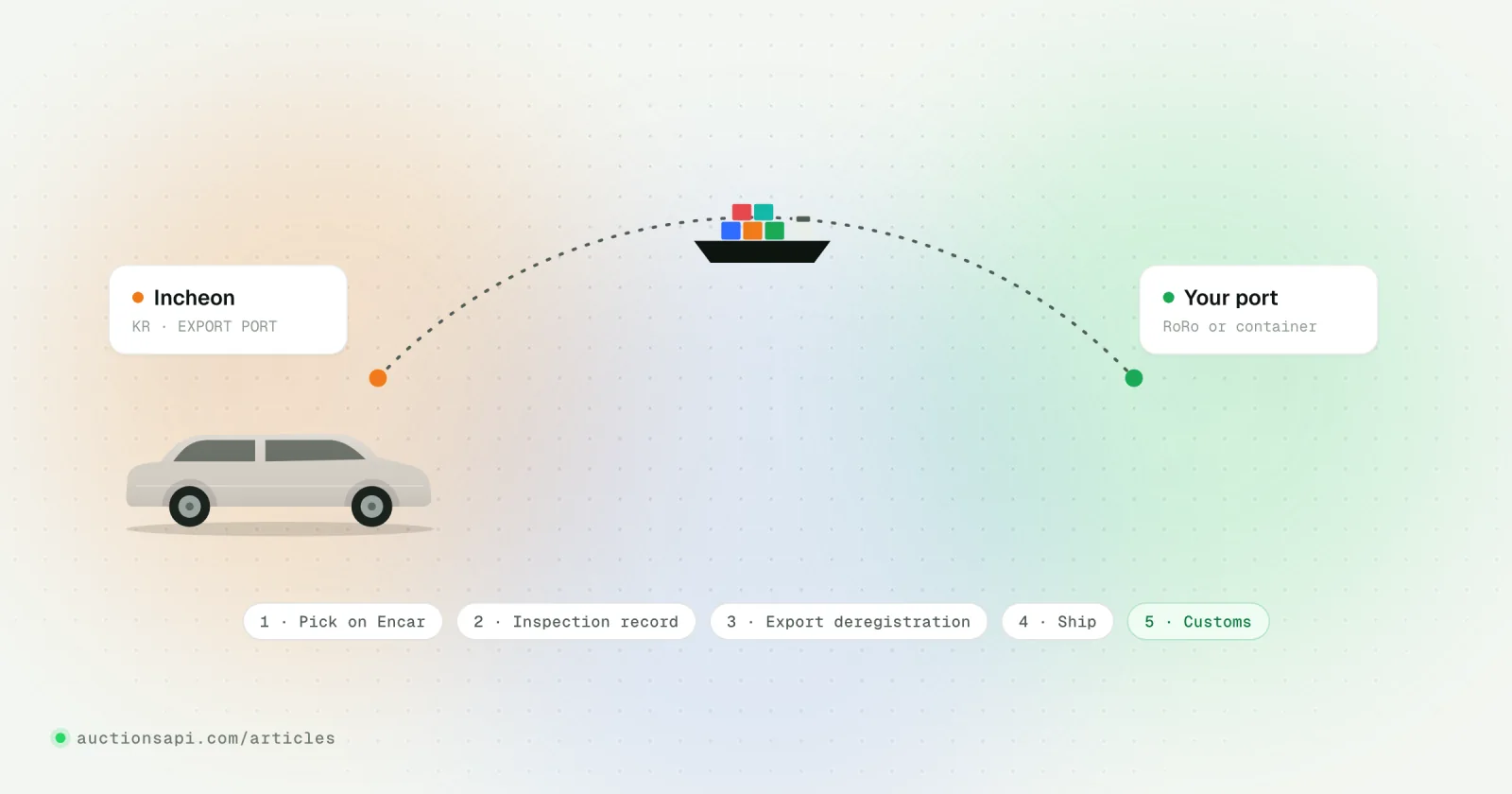
To import a car from Korea, you choose it on a Korean marketplace such as Encar or K Car, check its performance record and insurance history, buy it through a Korean exporter, have its registration cancelled for export, ship it by RoRo or in a container, and clear it through customs at home. From payment to arrival it usually takes somewhere between four and ten weeks, and most of the spread comes from the sea route and the wait for a vessel.
This guide follows that order and points out where buyers lose money: a frame repair hidden behind a “simple repair” tick, a car that cannot be deregistered because of an unpaid loan, a container that waits two weeks to fill. Duties, age limits and emission rules at home differ by country and change often, so treat that part as a checklist to take to your customs broker, not as advice.
Key takeaways
- Korea's domestic marketplaces (Encar, K Car, KB Chachacha) list the cars; a Korean exporter buys, deregisters and ships them for you.
- Read the performance record and the insurance history before you pay: frame repairs and large claims are what change a car's value abroad.
- A car can only leave once its Korean registration is cancelled for export (수출말소), which needs a title free of liens and seizures.
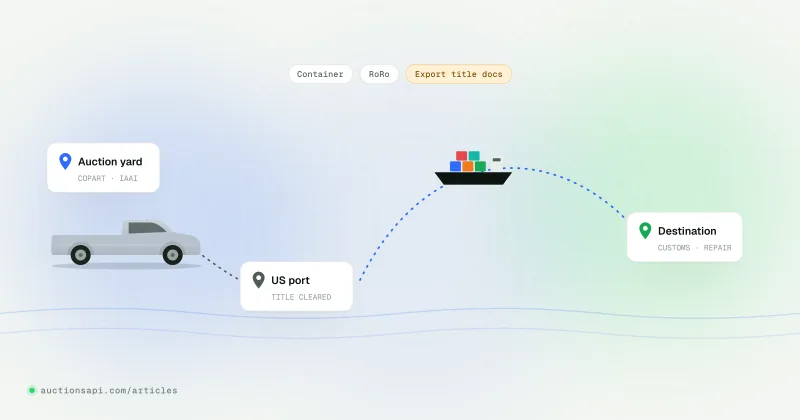
- RoRo usually suits a single drivable car; containers suit several cars, non-runners and routes without regular RoRo service.
- Customs at home decide the final cost, so get the current rules in writing before you send money for the car.
Step 1: choose the car on a Korean marketplace
Most Korean used cars destined for export are found on the same sites Koreans use to buy them. Domestic sites price in won and write in Korean; export sites price in dollars and already include the exporter's margin. Both are useful: the domestic price tells you what the car is worth in Korea, the export price tells you what a finished deal costs.
| Site | What it is | Prices | Good for |
|---|---|---|---|
| Encar | Korea's largest used-car marketplace, dealers and private sellers | KRW, written in 만원 | The widest choice, with inspection records and insurance history on many listings |
| K Car | A dealer that sells its own stock from branches across Korea | KRW | Cars checked by one company, with its own diagnosis report |
| KB Chachacha | Marketplace run by KB Capital | KRW | Price changes and detailed options |
| Autowini | Export marketplace for Korean cars | USD, FOB | Prices already set for export |
| Autobell | Hyundai Glovis's used-car brand, with a global site | USD and KRW | Dealer stock and auction cars with inspection reports |
Before you fall for a car, check what your country will register. Korea drives on the right, so cars are left-hand drive, which suits Central Asia, the Middle East, Eastern Europe and the left-hand-drive markets of Africa. LPG cars (often former taxis or rentals) are cheap in Korea, but not every country can register or refuel them. A diesel that meets Korea's emission rules may still fail the class your country asks for. Ten minutes with a broker at this stage saves a car stuck in a port.
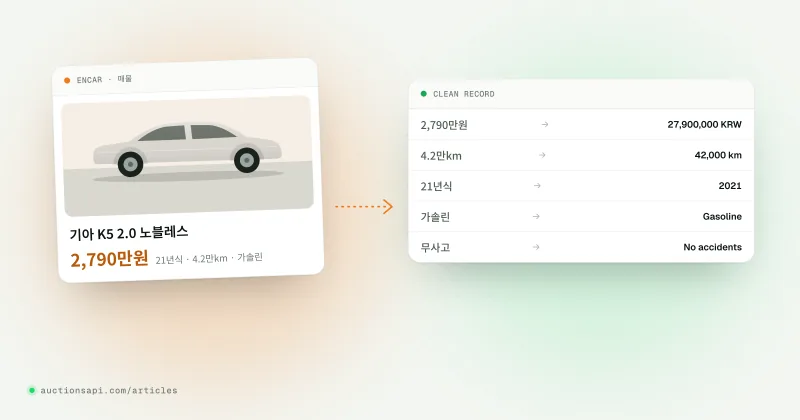
Then compare prices properly. A 2021 Kia Sorento listed at 2,790만원 is 27,900,000 won; the same car can appear on two or three sites at slightly different prices. Our Encar API article explains how 만원 prices, model names and dates are written. Look at how long it has been listed and whether the price has dropped, because a car that has been cut twice has a dealer ready to talk.
Step 2: check the performance record and the insurance history
Two documents tell you most of what you need, and you should read both before paying anything.
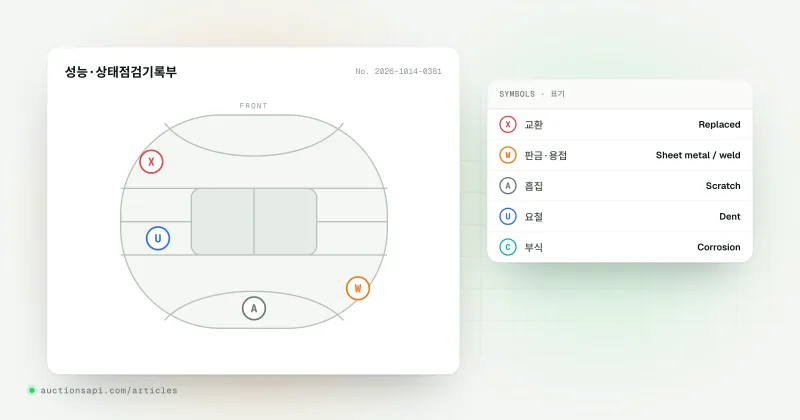
The performance and condition record (성능·상태점검기록부) is a standard government form that Korean dealers must give the buyer. A registered inspection shop fills it in: odometer, flood and fire, tuning, a car diagram where X marks a replaced part and W a part with sheet-metal work or welding, the frame, and the engine and gearbox. We explain it line by line in How to read an Encar inspection report.
The insurance history comes from CarHistory (carhistory.or.kr), run by the Korea Insurance Development Institute (보험개발원). It lists claims paid for damage to this car (내차 피해) and for damage it caused to others (타차 가해), total losses (전손), flood (침수) and theft, owner and plate changes, and whether the car was used as a rental or for business. Encar shows a summary on many listings.
Read them together. A replaced door with a ₩300,000 claim is cosmetic. A ₩9,000,000 claim for damage to this car next to a record that shows only “simple repair” deserves a hard look at the photos, because the two documents should tell the same story. Ask the exporter for pictures of the trunk floor, the inner wings and the door hinges, where repairs show.
Step 3: buy through a Korean exporter
In practice, foreign buyers rarely buy straight from a Korean dealer. Someone in Korea has to take ownership of the car, deregister it and file the export declaration, and that is what exporters (수출업체) do. A good exporter also checks the car in person before you pay: extra photos, a video of a cold start, a look underneath.
Ask for a quote that separates every cost, so you can compare exporters line by line:
- The price of the car, in won, as listed or as negotiated with the dealer.
- The exporter's fee.
- Transport from the dealer to the exporter’s yard and the port.
- Deregistration and export paperwork.
- Port, loading and, for containers, packing charges.
- Freight and marine insurance to your port, if you buy CIF rather than FOB.
FOB (free on board) means the price covers the car up to loading in Korea and you arrange the sea freight; CIF (cost, insurance and freight) includes freight and insurance to your port. Payment is usually a bank transfer to the exporter's company account. Where you can, pay in stages (a deposit to secure the car, the balance before loading) and check the company's business registration before the first transfer. Compare the VIN in the photos with the one on the inspection record; a mismatch ends the deal.
Step 4: export deregistration (수출말소)
A car cannot leave Korea while it is registered there. The exporter files a deregistration for export (수출말소 등록) with the vehicle registration office, returns the plates and receives the certificate of deregistration (말소사실증명서). That certificate is the car's main export document, and many destination offices ask for it when you register the car at home.
Deregistration only goes through on a clean title. A seizure (압류, often for unpaid fines or taxes) or a lien from a car loan (저당) has to be cleared first. Dealers usually settle these before a sale, but this is where unexpected delays come from, so ask the exporter to confirm the title is clean before you pay the balance.
With the deregistration done, a customs broker files the export declaration with the Korea Customs Service, and the exporter receives the export declaration certificate (수출신고필증). Only then can the car be loaded.
Step 5: ship by RoRo or container
Incheon is the centre of Korea's used-car export trade, with many exporters based near the port, and a large share of its used cars leave in containers. Pyeongtaek is a common port for RoRo vessels, and Busan handles some used-car volume as well. Your exporter will pick the port by route and schedule; what you choose is the way the car travels.
| RoRo | Container | |
|---|---|---|
| How the car travels | Driven onto a car-carrier deck | Loaded and lashed inside a 20- or 40-foot container |
| Must the car run? | Usually yes | No, non-runners can be loaded |
| Several cars | Each car booked separately | Several cars share a 40-foot container, depending on size |
| Items inside the car | Usually not allowed | Possible, if your customs rules allow it |
| Cost | Often lower for one car | Often lower per car when the container is full |
| Routes | Ports with regular RoRo calls | Almost any container port, plus rail or truck inland |
For landlocked Central Asia, cars usually travel by sea to a transit port and continue by rail or truck. Ask for a quote for the whole route to your city, and ask who is responsible at each hand-over, because a car that waits at a transit port without a clear owner of the problem can sit there for weeks.
Step 6: documents and customs at home
When the car reaches your port, you or your broker need a set of papers. The usual list:
- Bill of lading (B/L): issued by the shipping line or forwarder; the original or a telex release lets you collect the car.
- Commercial invoice: the price you paid; customs use it, so it must match the money you sent.
- Export declaration certificate (수출신고필증): proof the car left Korea legally.
- Certificate of deregistration (말소사실증명서): proof the Korean registration was cancelled, often translated for registration at home.
- Packing list: for containers with several cars.
- Inspection record and insurance history: not customs papers, but keep them for resale.
Customs is where the real price is decided. Depending on the country, you may pay import duty, excise, VAT, a recycling fee and registration charges; some countries base duty on engine size, others on value or age; some refuse cars above a certain age or below an emission class, and many ban right-hand drive. These rules differ widely and change, sometimes with little notice. Get the current rules in writing from a broker at home before you pay for the car, and build them into your landed cost.
How long does it take to import a car from Korea?
- Days 1–7Choose and checkShortlist cars, read both records, get extra photos and a video from the exporter.
- Days 2–10Payment and purchaseDeposit, the exporter buys the car and moves it to its yard.
- Days 3–14Deregistration and export declarationPlates returned, deregistration certificate issued, customs declaration filed.
- 1–3 weeksWaiting for a vesselDepends on the route and sailings; a shared container waits until it is full.
- Days to 6+ weeksAt seaA few days to the Russian Far East, several weeks to the Gulf or Africa, plus any transit by land.
- 1–4 weeksCustoms and registrationDuties paid, the car is released and registered at home.
The parts you control are the first three: a fast decision, a clean title and an exporter who files the paperwork the same week. The vessel and customs set the rest.
What makes up the landed cost
Write the landed cost down before you commit, line by line, in one currency:
- The car price in won, converted at the rate on the day you pay.
- The exporter's fee, inland transport, deregistration and documents.
- Port and loading charges in Korea.
- Freight and marine insurance (already in the price if you buy CIF).
- Transit costs for land legs, if your city has no port.
- Duties, taxes and fees at home, from your broker’s written estimate.
- Broker, port storage and registration at home.
If the total is close to what the same car costs at home, the deal depends on the details: a clean frame, a well-known engine and a colour that sells. If the margin only works because the record says “no accident”, read that record twice.
Doing this for many cars
Exporters who ship dozens of cars a month stop browsing by hand. They pull listings from Encar, K Car and the other sites into one catalog, filter by what each destination will register, and send clients a link instead of screenshots. That is the job an Encar API and a K Car API do: the same car with its price in won as a number, the inspection report as fields and the insurance history as dated events, in one format for every Korean site. The full list of Korean, Chinese and other sites is on the sources page.
Before you send money
- Confirm with a broker that your country will register this car: age, engine, fuel, emission class, steering side.
- Read the performance record and the insurance history, and make sure they tell the same story.
- Match the VIN in the photos with the VIN on the record; the VIN decoding guide shows what each part means.
- Get an itemised FOB or CIF quote and check the exporter’s business registration.
- Have the exporter confirm the title has no seizure or lien.
- Agree on paying in stages and on which documents you receive, and when.
Questions people ask
How long does it take to import a car from South Korea?
Usually between four and ten weeks from payment to having the car at home. Choosing, buying and deregistering take one to two weeks; waiting for a vessel can add one to three; the sea leg ranges from a few days to the Russian Far East to several weeks to the Gulf or Africa; customs and registration take one to four weeks more.
Can a foreigner buy a car directly from a Korean dealer?
Rarely in practice. Someone in Korea has to own the car, deregister it for export and file the export declaration, so most foreign buyers work through a registered Korean exporter who buys the car for them, handles the paperwork and books shipping. Some dealers export directly; check their business registration before paying.
What is 수출말소?
수출말소 is deregistration for export: the Korean registration is cancelled because the car is leaving the country. The plates are returned and a certificate of deregistration (말소사실증명서) is issued. It needs a title free of seizures and liens, and it must be done before the export declaration can be filed with customs.
Is RoRo or container shipping cheaper from Korea?
For one drivable car, RoRo is often cheaper and simpler. For several cars, a shared 40-foot container often costs less per car and also takes non-runners and routes without RoRo service. Rates change with the route, the season and fuel prices, so ask your exporter to quote both for your port.
Which Korean ports ship used cars?
Incheon is the centre of Korea's used-car export trade and ships many cars in containers. Pyeongtaek is a common RoRo port, and Busan handles some used cars as well. Your exporter usually chooses the port based on your destination, the type of shipping and the next sailing.
How do I check the accident history of a Korean car?
Use two sources. The performance and condition record shows replaced or repaired panels and any frame work, with a yes or no on accident history. The insurance history from CarHistory, run by the Korea Insurance Development Institute, shows claims, total losses, flood and owner changes. Repairs paid in cash appear in neither, so check the photos too.