 English
Copart vs IAAI: the differences that matter to buyers and to your data
Copart vs IAAI compared: sellers, auction formats, fee structure, condition and damage labels, identifiers, and how to merge both auctions into one dataset.
Copart vs IAAI comes down to this: both are online salvage auctions selling mostly insurance write-offs across the US and Canada, to much the same buyers, but they run their sales differently, charge fees from different tables and describe the same car in different words. For a buyer the differences are auction format, fees and access rules. For anyone building software on top of them, the differences are labels and identifiers.
Neither auction is cheaper as a rule. Final prices depend on the car, its damage, its title, its yard and the week, and the honest way to compare is lot against lot with real sold prices, not by reputation.
Below we go through both views: what a buyer or an importer should know, and what a developer has to normalise to put Copart and IAAI lots in one catalog.
Key takeaways
- Copart and IAAI sell the same kind of inventory, mostly from insurers, through online auctions with Buy Now on some lots.
- Both use a sliding buyer fee plus fixed charges; the tables differ and change, so compare the total for the actual price you expect.
- The same condition, damage or title can be written differently on each site, so filters only work after normalisation.
- IAAI has a stock number and an item ID per listing, Copart a lot number; lot numbers can collide across the two.
- The same VIN can appear on both auctions over its life, which is why history belongs on the VIN, not the lot.
Copart vs IAAI at a glance
| Copart | IAAI | |
|---|---|---|
| Company | Copart, Inc., a US-listed company | Insurance Auto Auctions (IAA), part of RB Global since 2023 |
| Where it sells | US and Canada, plus the UK and several other countries | US and Canada, plus the UK |
| Main sellers | Insurance companies; also rental fleets, lenders, dealers | Insurance companies; also rental fleets, lenders, dealers |
| Auction format | Preliminary bidding, then a live online auction; Buy It Now on some lots | Pre-bidding, then a live online auction; timed auctions; Buy Now on some lots |
| Sale conditions | Pure Sale, Minimum Bid, On Approval | Sales outright or subject to seller approval |
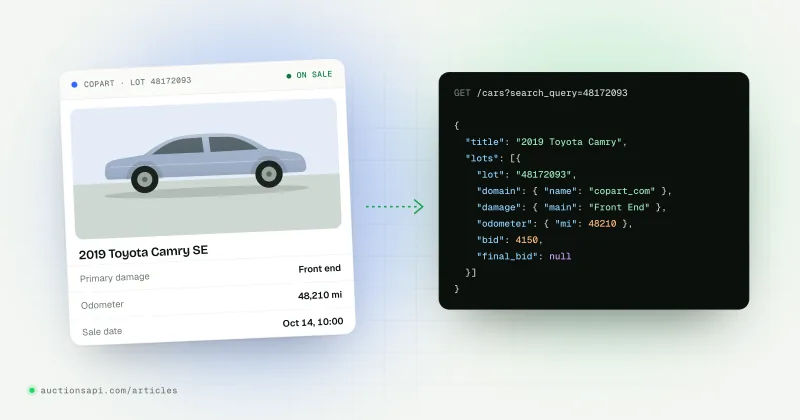
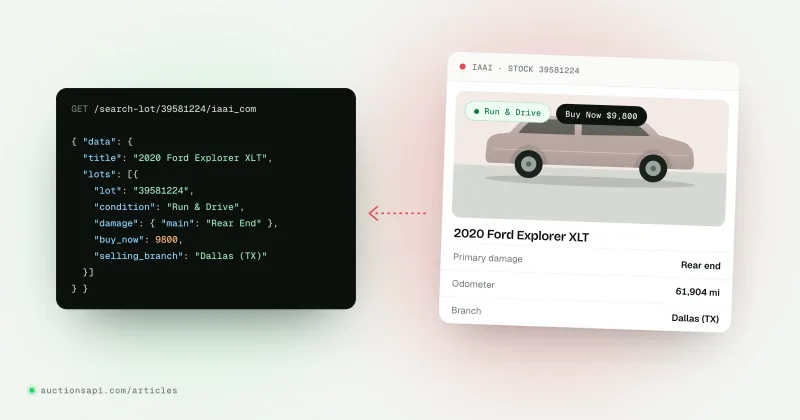
| Listing number | Lot # | Stock #, plus an item ID in the page URL |
| Where the car is | Yard (location) | Branch, or offsite |
| Run / start labels | Run and Drive, Engine Start Program, Enhanced Vehicles | Run & Drive, Starts, Stationary |
| Fees | Sliding buyer fee by price plus fixed fees | Same structure, different tables |
| In our API | domain_id 3, copart_com | domain_id 1, iaai_com |
Who sells at Copart and IAAI
Most cars on both auctions come from insurance companies: total losses after collisions, floods, hail, fire or theft recoveries. The rest come from rental companies retiring fleet cars, banks and finance companies with repossessions, dealers clearing trade-ins, and fleets. In the data, a lot's seller is seller (with is_insurance, is_rental and is_credit_company flags where known) and seller_type is insurance or non-insurance.
Why buyers care: a non-insurance car on a clean title, say an ex-rental Nissan Altima with normal wear, is a different purchase from an insurance total with a salvage certificate, even if the two sit next to each other in search results. Filter by seller type and title before you compare prices.
How Copart and IAAI auctions run
Copart
Copart sells online. Before the sale day, registered buyers place preliminary bids; on the day, the lot goes through a live online auction (Copart calls its platform VB3) and the high bid either wins or goes to the seller for a decision. The lot's sale status tells you which: a Pure Sale goes to the highest bidder, a Minimum Bid lot has a seller minimum that has to be reached, and an On Approval lot waits for the seller to accept the high bid. Some lots also carry a Buy It Now price that takes the car off the auction.
IAAI
IAAI also sells online, with pre-bidding followed by a live online auction, and it runs timed auctions where bidding stays open for a window and closes at a set time. Buy Now is offered on some vehicles. As at Copart, some sales are outright and some depend on the seller approving the high bid.
In normalised data the format is one field: auction_type is pure_sale, minimum_bid, on_approval, live or timed, and is_timed_auction marks the timed ones. When a lot did not sell and comes back a week later, it is a new sale date, often with a new status; with prices_history=1 you can see each attempt with its bid.
Fees: how they are structured
We will not quote fee amounts here: both auctions revise their tables, and the numbers depend on your account type, your state and how you pay. What is stable is the structure, and it is similar on both sides:
- A buyer fee that grows with the sale price, read from a table of price bands. It differs between licensed and unlicensed buyers and, at Copart, between secured and unsecured payment methods.
- Fixed charges per vehicle: a gate or loading fee, an online or virtual bid fee, sometimes an environmental or title-handling fee.
- Storage charges after a short free period. Slow pickup costs real money on cheap cars.
- Late payment fees if the deadline passes.
- If you buy through a broker, the broker's own fee on top.
The practical way to compare: take the hammer price you expect for the car, add both auctions' fees from their current fee pages on copart.com and iaai.com for your account type, then add towing from that specific yard or branch. On cheap lots, fixed fees and storage are a large share of the total, and the cheaper auction for a $1,500 parts car may not be the cheaper one for a $15,000 repairable SUV.
Condition, damage and title labels: same car, different words
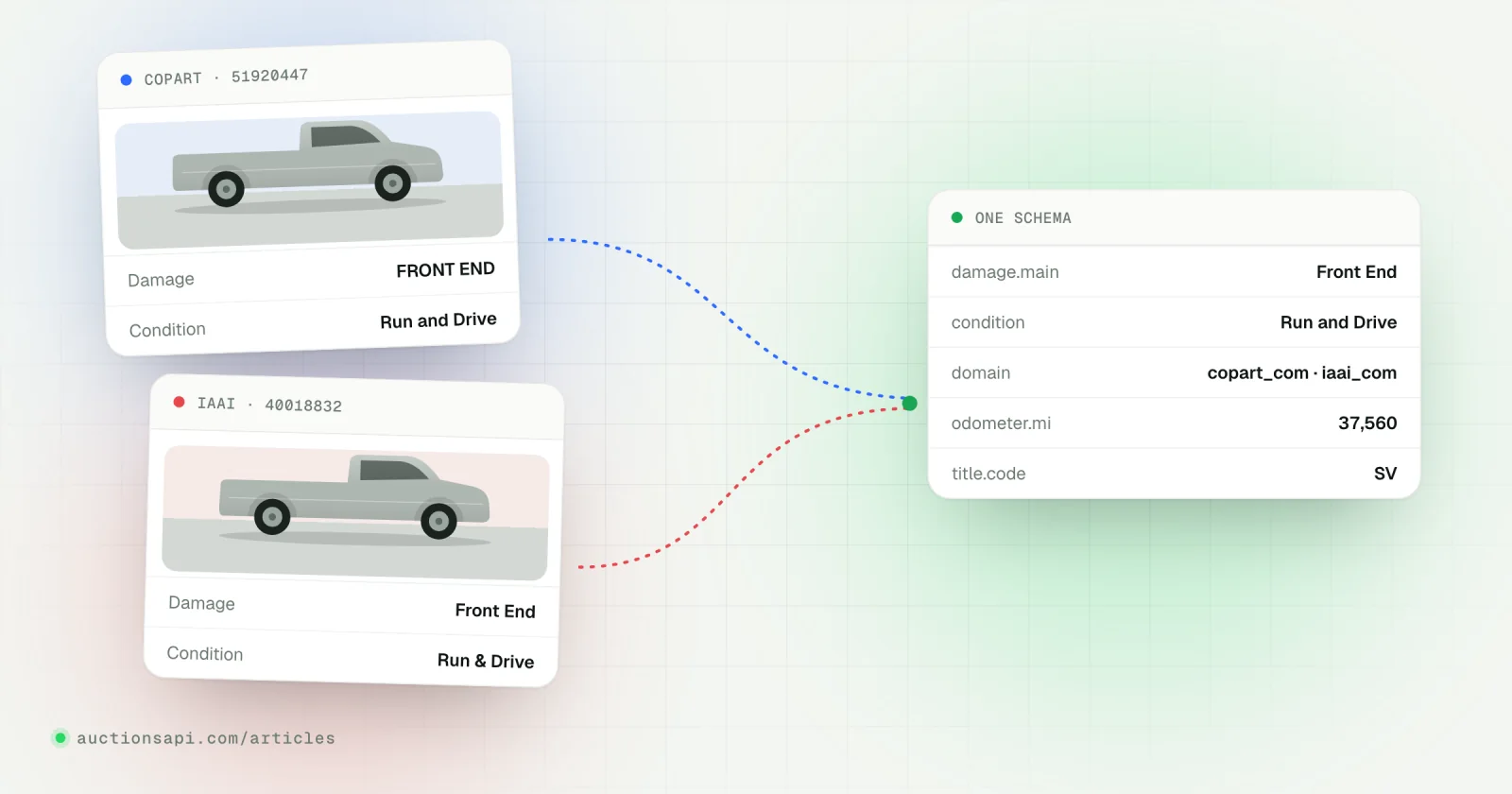
This is the part that matters most if you build anything on both auctions. Copart prints "Run and Drive" where IAAI prints "Run & Drive". Copart's Engine Start Program and IAAI's Starts describe the same observation. Copart writes some damage names in capitals, IAAI in title case, and a few damage names exist on one site only. Title documents carry the state and the document name, with a slightly different order and wording on each site.
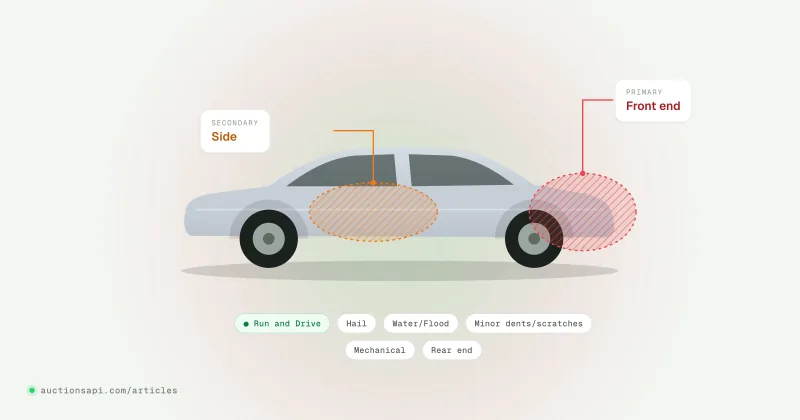
Two cautions. First, a run-and-drive label on either site is what the yard saw at check-in, not an inspection: a car can lose its battery or develop a leak before you collect it. Second, the damage label is the primary damage the auction recorded, not a full list. A Toyota RAV4 marked FRONT END can also have frame damage or deployed airbags; read the secondary damage, the airbags field and the photos. Our guide to Copart damage types goes deeper, title brands included.
Valuations, locations and transport
Both auctions publish valuation figures on some lots, and buyers often misread them. Copart shows an estimated retail value; IAAI shows an actual cash value (ACV) and sometimes a repair estimate. They are the auction's or the seller's reference numbers, not appraisals of the car you will receive and not a forecast of the final bid. In the data they are separate fields (actual_cash_value, estimate_repair_price, pre_accident_price, clean_wholesale_price), present only where the source publishes them, and they belong under their own label.
Location matters more than it seems because inland transport is part of the price. Copart talks about yards, IAAI about branches, and IAAI also sells offsite vehicles that sit at a body shop or another lot. For an importer shipping to Klaipeda, Poti or Jebel Ali, a cheaper car in a yard far from the export port can end up costing more than a slightly dearer one near it. Normalised data gives you the state, city, yard or branch and coordinates for both auctions, so you can estimate towing distance before you compare prices.
Is Copart or IAAI cheaper?
There is no general answer, and we would not trust anyone who gives one without data. Final prices depend on the same factors on both auctions: make, model and year, damage, title type, whether it runs, mileage, the yard's region, the number of bidders that week and the seller's minimum. Two near-identical cars can sell hundreds of dollars apart on the same auction on the same day.
A fair comparison looks like this: pick one model and year range, one damage type, one title type, then compare the final bids of sold lots on each auction over the same weeks. Count only lots with a recorded final bid; a high bid that the seller refused is not a price. With the API that means final_bid from archived lots or the stored aggregates from /statistics, which returns average, minimum and maximum final bids per model and year with a domain on each row so you can split Copart from IAAI.
The same car on both auctions
A VIN often has more than one auction appearance, sometimes on different auctions. A typical path: an insurer sells a 2018 Ford Escape with rear damage on IAAI, a rebuilder repairs it, and a year later it comes back on Copart with a rebuilt title and different photos. Or a lot fails to sell, is relisted, and sells on the second attempt.
- MarchIAAI · stock 39811470Rear damage, salvage certificate, Starts. High bid not approved by the seller.
- AprilIAAI · stock 39811470, relistedSold. Final bid recorded on the lot.
- Next yearCopart · lot 71250413Rebuilt title, repaired rear, Run and Drive. New photos, new seller, new lot.
For a buyer, this history is the most useful thing you can show: earlier damage photos explain a suspiciously clean rebuilt car. For a developer, it means auction history belongs to the VIN. A VIN lookup that returns every lot, on both auctions, is the way to read it.
Normalising Copart and IAAI data into one catalog
If you collect both auctions yourself, this is the mapping layer you will write and maintain. If you take them from a provider, check that it has been done for you. The minimum:
- Split vehicle and lot. The VIN identifies the car; each auction appearance is a lot with its own source, number, photos, damage, odometer and prices.
- Key lots on source plus number. A Copart lot number and an IAAI stock number can be the same digits. Keep IAAI's item ID too, because pasted links carry it.
- Map condition, damage, title, sale format and seller type to one set of ids, and keep the raw text for display and debugging.
- Store times in UTC. Both auctions show sale times in local zones on their pages.
- Keep prices apart: current bid, Buy Now, seller reserve and final bid each in its own column with its own update time.
- Use one location model: country, state, city, plus the yard or branch, and an offsite flag for IAAI cars that are not at the branch.
In AuctionsAPI both auctions already arrive in one vehicle object with one set of enum ids, and each lot carries its source in domain. A filter like condition=0&damage=Front End works on both; the enums page lists every value, and the Copart and IAAI API page shows what the feed includes. One caution even with normalised data: a vehicle returned for domain_id=3 can also hold an active IAAI lot, so read lots[].domain.id before you label a lot.
Which one to watch
Both. For buyers, the same car type can be cheaper on either auction in a given week, and limiting yourself to one halves the choice. For importers and brokers quoting clients, a catalog with both lets you offer the better lot instead of the only one you saw. For developers, the real decision is not Copart or IAAI but whether you normalise them yourself; the Copart API and IAAI API guides cover the requests for each.
Questions people ask
What is the difference between Copart and IAAI?
Both are online salvage auctions in the US and Canada that sell mostly insurance total losses, plus rental, lender and dealer cars. They differ in auction formats (IAAI also runs timed auctions), fee tables, access rules for non-licensed buyers, and wording: condition, damage and title labels, and listing numbers (Copart lot vs IAAI stock number).
Is IAAI cheaper than Copart?
Not as a rule. Final prices depend on the car, damage, title, whether it runs, the yard and the week. Compare sold lots of the same model, year, damage and title over the same period, counting only lots with a recorded final bid, and add each auction's current fees for your account type plus towing from that yard.
Can a regular person buy from Copart or IAAI?
Often, for some vehicles. Both let non-dealers buy certain cars directly, depending on the state and the title type, while others require a dealer or dismantler licence. Buyers without a licence commonly use a registered broker. The rules change and differ by state, so check each auction's current buyer requirements before you bid.
Does Run and Drive mean the same thing on Copart and IAAI?
Yes, in substance. On both, it means the yard saw the vehicle start, engage a gear and move at check-in. It is not an inspection or a guarantee. Copart's Engine Start Program and IAAI's Starts both mean only that the engine started. Normalised data stores both auctions' labels as the same condition values.
Can the same car be on Copart and IAAI?
Yes, over its life. A car can sell on one auction, be repaired, and come back on the other with a rebuilt title, or be relisted after it fails to sell. That is why auction history is looked up by VIN, which returns every lot of the car on both auctions with its photos, damage and recorded prices.