 English
Copart and IAAI damage types: primary, secondary and what labels hide
Copart damage types explained: front end, hail, flood, mechanical, burn and more, primary vs secondary damage, Run and Drive labels and how to read photos.
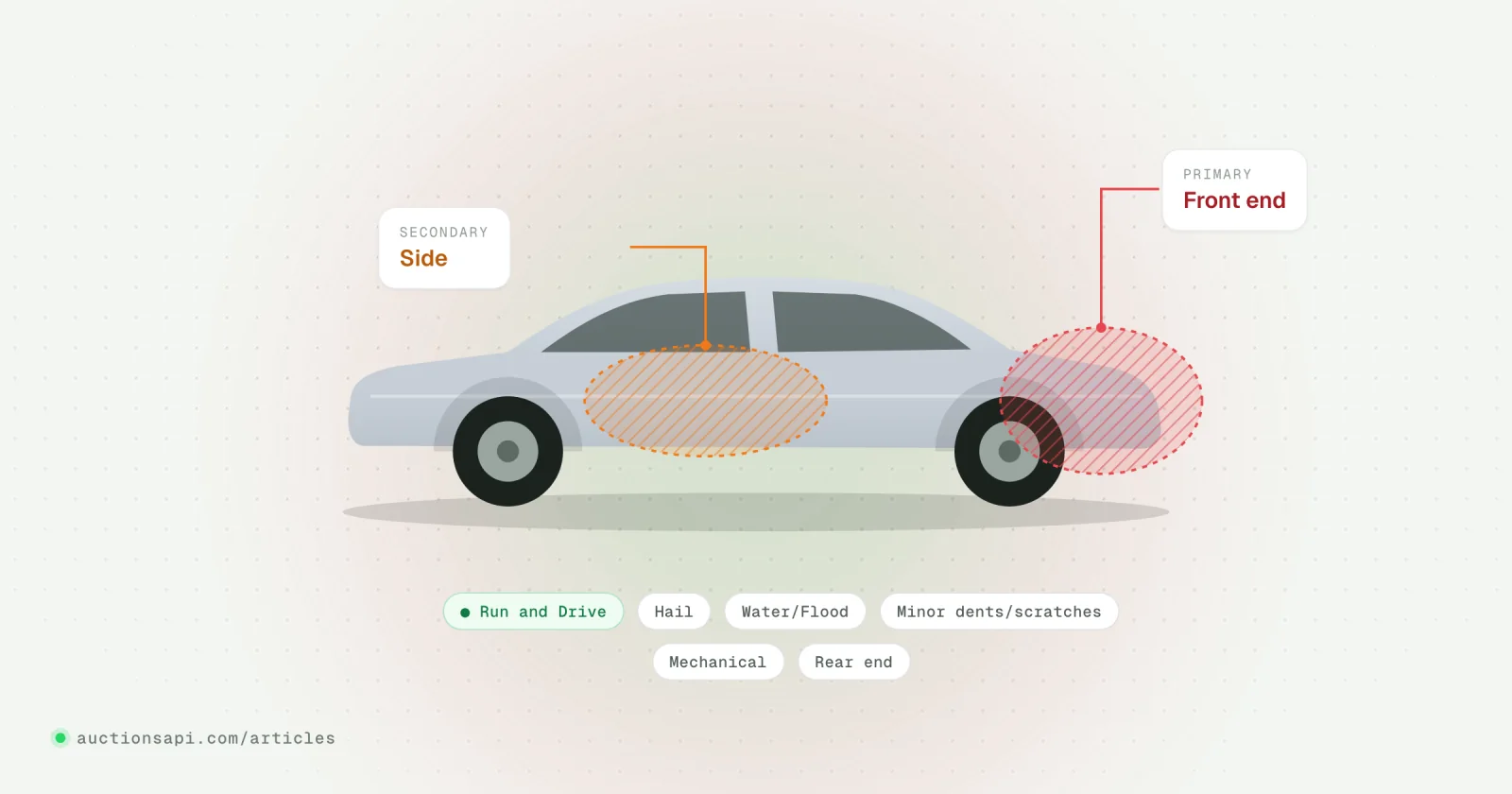
Copart damage types are short labels that say where, or how, a lot was damaged: “Front End”, “Rear End”, “Side”, “All Over”, “Hail”, “Water/Flood”, “Mechanical” and a couple of dozen more. Each lot has a primary damage (the main one) and often a secondary damage (the next most visible). IAAI uses almost the same idea with slightly different wording.
The labels come from a walk-around when the car is checked in at the yard, not from a repair estimate. They tell you where to look in the photos. They do not tell you how much the repair costs, whether the frame is straight or whether the engine runs, and two cars with the same “Front End” label can be a cracked bumper and a written-off front structure.
This guide lists the labels you will meet on Copart and IAAI, what each one usually hides, how the run-and-drive style condition labels differ between the two auctions, and how to read photos against the label.
Key takeaways
- Primary damage is the main damaged area or cause; secondary damage is the next one, and an empty secondary label proves nothing.
- Damage labels describe location or cause, never severity or repair cost.
- Copart and IAAI use similar but not identical wording, so normalise labels before you compare the two auctions or build a filter.
- Condition labels such as Run and Drive or Starts were checked on arrival at the yard and are not guaranteed at pickup.
- Water, burn, biohazard and stripped lots carry risks that photos show poorly; budget for the worst case.
Primary and secondary damage: what the two lines mean
Every Copart lot shows a primary damage, and many show a secondary damage. The primary label is the area or cause that drove the loss: for a car rear-ended at a light it is “Rear End”, for a car that sat in a flooded parking lot it is “Water/Flood”. The secondary label is whatever the inspector considered the next most important issue, which can be a second area (“Front End” on a car pushed into the vehicle ahead) or a cosmetic note (“Minor Dent/Scratches”).
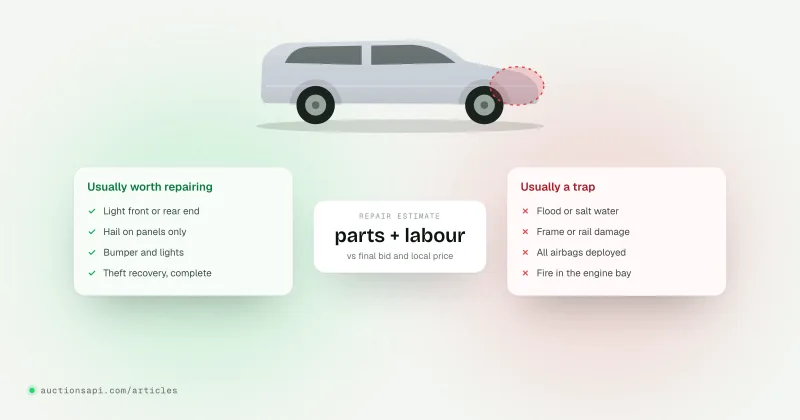
Three things catch new buyers out. The labels are picked from a fixed list, so anything that does not fit is squeezed into the nearest label. Secondary damage is often left empty even when there is more damage. And the labels never grade severity: “Front End” is used for a scuffed bumper cover and for a car with the engine pushed into the firewall.
In practice, treat the primary label as a pointer to the right photos, and the secondary label as a hint that there is more than one story. The photos, the airbag status, the keys and the condition label tell you more than both lines together.
Every common Copart damage type, explained
The table covers the labels we see most often on Copart and IAAI lots. Wording drifts a little over time and between the two auctions, so match on the meaning rather than the exact spelling.
| Label | What it usually means | What to check |
|---|---|---|
| Front End | Impact to the front: bumper, hood, lights, radiator, sometimes the engine bay. | Radiator support, headlight mounts, airbags, fluid leaks under the car, hood alignment. |
| Rear End | Impact from behind: bumper, trunk or tailgate, rear panels. | Trunk floor buckling, spare wheel well, rear frame rails, tailgate gaps. |
| Side | Doors, fenders or quarter panels on one side (IAAI usually says which side). | B-pillar, sill, side curtain airbags, door gaps; a pushed-in pillar is expensive. |
| All Over | Damage on several sides, often a crash with several impacts or a car that left the road. | Roof line, every pillar, glass; assume structural work. |
| Top/Roof | Damage to the roof from an object or a partial rollover. | Roof rails, windshield frame, headliner, A-pillars. |
| Rollover | The car rolled over. | Every pillar and the roof structure; many importers skip these entirely. |
| Hail | Many small dents across the top surfaces; glass may be broken. | Dent count on roof and hood in angled light, glass, sunroof; interior water if glass broke. |
| Water/Flood | Water entered the car: rain through an open window up to full submersion. | Water line, silt, seat rail rust, electrical connectors, fogged lamps, salt or fresh water. |
| Burn, Burn – Engine, Burn – Interior | Fire damage, from a small engine-bay fire to a burnt-out shell. | Wiring loom, firewall, smell; interior burns usually mean replacing most of the cabin. |
| Mechanical | No visible body damage; the problem is mechanical (engine, transmission, other). | Condition label, oil and coolant photos; assume an engine or gearbox until proven otherwise. |
| Undercarriage | Damage under the car: hitting a curb, debris or a high obstacle. | Subframe, oil pan, suspension arms, fuel lines, battery pack on electric cars. |
| Suspension | Bent suspension parts, often after a wheel strike. | Wheel angle in photos, tires, steering rack; wheel strikes can bend the subframe. |
| Frame Damage | Damage to the structural frame or unibody rails. | Rail kinks, panel gaps; budget for frame-straightening work. |
| Vandalism | Deliberate damage: scratched paint, broken glass, slashed interior. | Interior photos, missing parts, ignition and steering column. |
| Theft / Stripped | Recovered after theft, often with parts removed (wheels, seats, airbags, electronics). | List of missing parts, ignition damage; stripped cars cost more than they look. |
| Minor Dent/Scratches | Cosmetic damage only, at least on the surface. | Why an insurer or seller sent it to auction: look for a hidden issue. |
| Normal Wear | No specific damage; the seller is a dealer, fleet, rental or bank. | Mileage, service needs, tires and brakes; often the cleanest lots. |
| Biohazard/Chemical | Contamination of the interior (bodily fluids, chemicals, mold). | Interior photos; cleaning may need specialists and some buyers refuse these. |
| Electrical | An electrical fault, not visible damage. | Warning lights in dash photos, condition label; can be cheap or endless. |
| Replaced VIN / Missing or Altered VIN | The VIN plate was replaced or is missing or changed. | Title and registration at your destination; many importers avoid these. |
| Rejected Repair / Partial Repair | The car was repaired before, poorly or not completely. | Repair quality, paint depth, history of earlier sales. |
| Unknown | The yard did not record a damage type. | Photos only; treat it as unknown, not as undamaged. |
IAAI damage labels and how they map to Copart
IAAI uses the same broad categories, with two habits that matter when you compare lots. It names the side and corner more often (“Left Front”, “Right Rear”, “Left Side”), where Copart tends to say “Front End” or “Side”. And it uses slightly different spellings for the same thing. If you build a filter or a price comparison across both auctions, map both spellings to one value first; otherwise “Rear End” and “Rear” look like two different damage types.
Keep the original label as well. A buyer looking at one car wants to see “Right Rear” exactly as IAAI wrote it; the grouped value is only for filters, counts and price statistics. For a wider comparison of the two auctions, see Copart vs IAAI.
Condition labels: Run and Drive, Starts, Enhanced, Stationary
Next to damage, each lot carries a condition or start label. These are the labels people misread most, because they sound like promises.
- Copart marks verified lots “Run and Drive”: on check-in the car started, went into gear and moved under its own power. It is the label buyers pay the most for.
- Copart's “Engine Start Program” label means the engine started and idled, but the car was not confirmed to drive or move.
- Copart's “Enhanced Vehicles” means the seller paid for an extra service such as cleaning or covering. It says nothing about whether the car runs.
- IAAI uses start codes: “Run & Drive” (started, forward and reverse gears engaged, steering turned), “Starts” (started and idled) and “Stationary” (did not start, has engine damage, or was not tested). IAAI explains them on its start codes page.
Both auctions are clear that the check happened when the car arrived at the yard. Batteries die, coolant leaks out and cars get moved with a forklift, so a run-and-drive car can fail to start at pickup. Neither label says the car is roadworthy.
In AuctionsAPI records this arrives as the lot's condition, an object such as { "name": "run_and_drives", "id": 0 }. Other values include engine_starts, enhanced, not_run and unconfirmed; the full list is on the enums page. Note that 0 is a real value (run and drives), so never treat it as empty.
What the damage labels hide
The label is one word chosen from a short list, and a car can have five problems. These are the gaps we see again and again.
- Airbags. A “Front End” car with deployed airbags is a different repair from one with intact airbags. Copart and IAAI usually record airbag status separately; read it.
- Structure. Frame or unibody damage is labelled only when someone notices it; most structural damage hides under “Front End”, “Side” or “All Over”.
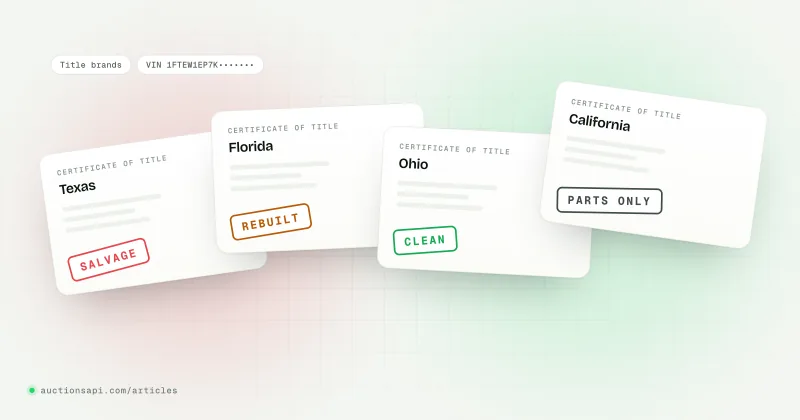
- Water. A flooded car can be listed under “Normal Wear” or “Mechanical” when the water came in without visible damage. Check the title brand and the interior photos.
- Engine. “Mechanical” can mean anything from a dead battery to a seized engine. Without a start label assume the expensive version.
- Missing parts. Theft recoveries often lose wheels, seats or electronics that the label does not list; count them in the photos.
- Secondary damage. An empty secondary line means none was recorded, not that there is none.
How to read the photos against the label
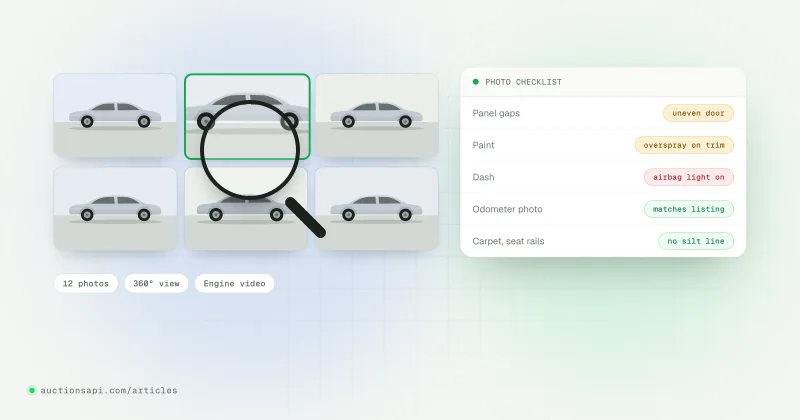
Copart and IAAI listings usually have a dozen or more photos, sometimes a 360 view or a short engine video. Go through them with the label in mind, in this order:
- Panel gaps around the damage. Uneven gaps at the hood, doors or trunk mean the structure moved, not only the skin.
- Under the hood (front damage). Look at the radiator support, headlight mounts and the strut towers; a bent strut tower is a major repair.
- The dashboard. Lit airbag or engine warnings, the odometer reading and whether the cluster powers on at all.
- The interior. Deployed airbags, seat belt pretensioners, water lines on door cards, silt under the seats, mold on belts.
- The wheels and tires. A wheel leaning in or out after a side or undercarriage hit suggests suspension or subframe damage.
- The trunk and spare wheel well. Rear damage shows here first, and so does flood silt.
- Hail lots. Angled photos of the roof and hood; count dents per panel and check the glass and sunroof.
- The VIN plate and door sticker. They should match the listing and each other.
One habit that saves money: compare the photos with earlier sales of the same VIN. A car that sold as “Front End” two years ago and comes back as “Rear End” with a fresh repaint in front has a history the current label will not show. Our guide to auction history by VIN explains how to pull it.
Filtering by damage type in auction data
If you list lots on your own site, the damage arrives as two objects on each lot: damage.main and damage.second, each with an id and a name, or null when nothing is recorded. The names come from one dictionary for both auctions, which you can load from the damages endpoint.
The /cars endpoint filters with damage, a case-insensitive substring that is checked against both the primary and the secondary damage. So damage=hail finds hail as either line, and damage=front finds every name containing “front”. If the text matches no dictionary name at all, the filter is silently not applied, so check it against the dictionary first.
Because the filter is a substring, “flood” will not catch a label written as “Fresh Water”. If you need all water damage, run one query per spelling or store the lots and filter by your own grouped value, as in the figure above.
What to do with a damage label
Use the label to choose which photos to study, then check the condition label, airbags, keys and the title before you form an opinion on the price. For any car you are serious about, look up the earlier sales of the VIN and compare the damage and photos each time.
If you are building a catalog or a price tool, the Copart and IAAI API gives you primary and secondary damage, condition, airbags and title on every lot, active and sold, so you can normalise labels once and filter across both auctions.
Questions people ask
What does primary damage mean on Copart?
Primary damage is the main damaged area or cause the yard recorded at check-in, such as Front End, Rear End, Hail or Water/Flood. It points to where the biggest problem is. It does not grade how bad the damage is or what the repair costs, so always confirm it in the photos and with the condition and airbag information.
What does secondary damage mean on Copart?
Secondary damage is the next most significant issue the inspector noted, such as a second impact area or cosmetic dents. Many lots have no secondary damage recorded, which only means nothing else was written down. It does not mean the rest of the car is undamaged, so check every side in the photos.
What does normal wear mean on Copart?
Normal Wear means no specific damage was recorded. These lots usually come from dealers, fleets, rental companies or banks rather than insurers. They are often the cleanest cars at the auction, but expect the usual wear on a used car (tires, brakes, service items) and still check for warning lights and the mileage brand.
Does Run and Drive at Copart guarantee the car drives?
No. Run and Drive means the car started, engaged a gear and moved under its own power when it arrived at the yard. Copart does not guarantee it will do the same at pickup, and it says nothing about roadworthiness. Batteries, leaks and storage can change things, so plan for towing.
Is a mechanical damage car at Copart a good buy?
It can be, because there is no body damage to fix, but Mechanical covers everything from a flat battery to a seized engine or a failed transmission. Look for a start label, engine video and dashboard photos. Without them, price the car as if it needs an engine or gearbox and treat anything less as a bonus.