 English
How to read an Encar inspection report (성능·상태점검기록부)
How to read an Encar inspection report: the X, W, C, A, U and T panel codes, rank 1 and 2 panels vs A, B and C frame parts, red flags and Encar diagnosis.
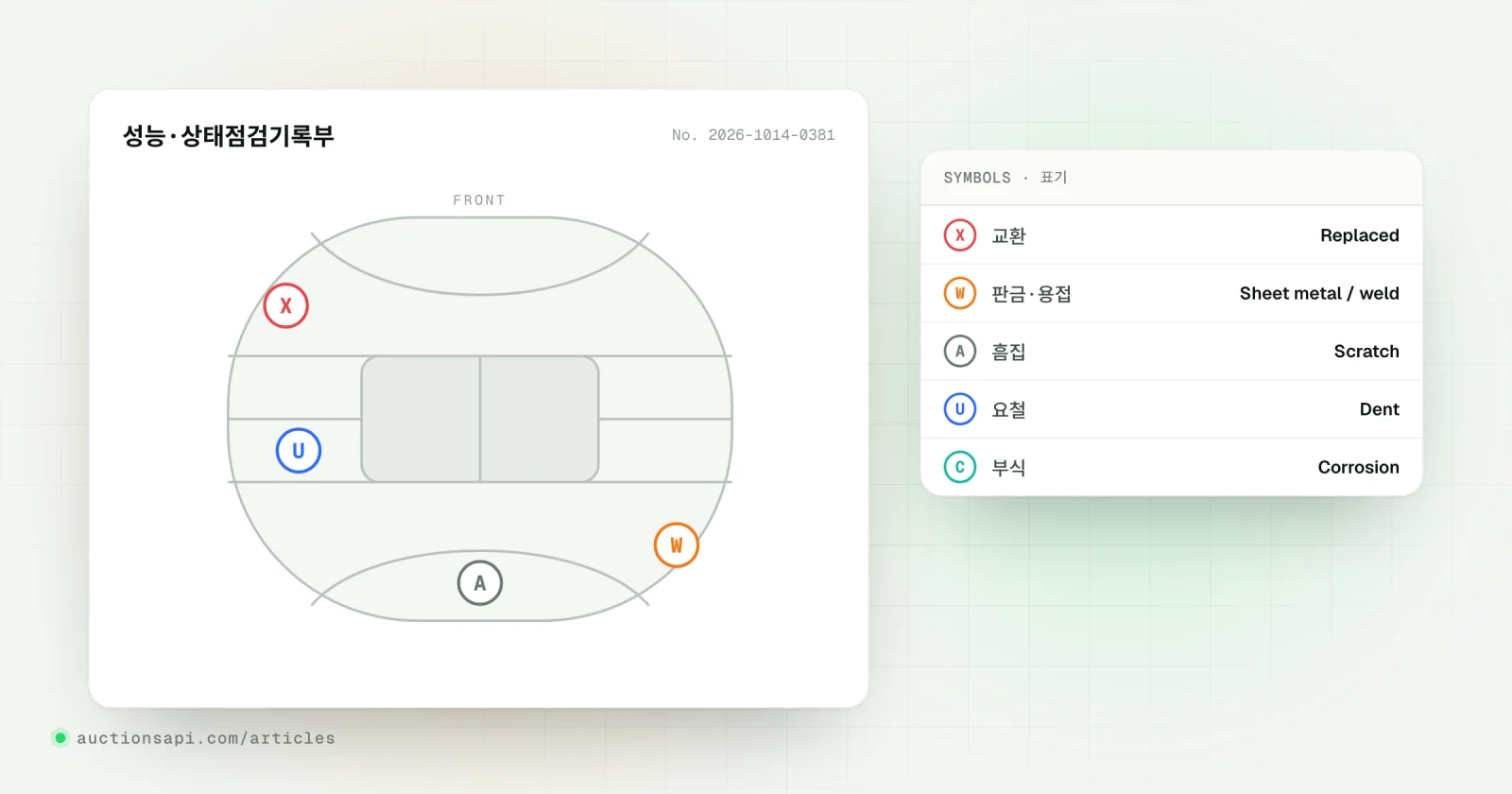
An Encar inspection report is, in most cases, the Korean performance and condition record (중고자동차 성능·상태점검기록부), a standard government form that a dealer must hand to the buyer. Read it in three passes: the summary ticks (accident history, simple repair, flood, fire, tuning, odometer), then the car diagram, where X means a part was replaced and W means sheet-metal work or welding, and finally whether those marks sit on bolt-on outer panels or on the frame.
The form is dense: several pages, most of it checkboxes in Korean. This guide goes through it in the order an exporter should read it, with the Korean terms you will meet, what they mean in English and which marks should change your price or your mind.
Key takeaways
- The record is a legal form (Form 82 of the enforcement rules of Korea's Motor Vehicle Management Act) filled in by a registered inspection shop, not by Encar.
- On the car diagram, X (교환) means replaced, W (판금/용접) sheet metal or welding, C corrosion, A scratch, U dent and T damage.
- Outer panels are ranked 1 and 2, frame parts A, B and C; work on bolt-on outer panels is a “simple repair”, while work on the frame makes it an accident car.
- Encar diagnosis (엔카진단) is Encar's own check on some listings and is separate from the legal record.
- The record shows the car on one day; the insurance history and the photos fill the gaps.
What the Encar inspection report is
On an Encar listing, the 성능점검 (performance check) button opens a scan or a rendered copy of the 성능·상태점검기록부. The form is defined in the enforcement rules of Korea's Motor Vehicle Management Act, so it looks the same whichever site shows it: encar.com, K Car, KB Chachacha or a dealer's own page. Encar displays it; Encar does not write it.
The check is done by a registered performance inspection operator. The operator guarantees the result for at least 30 days or 2,000 km after delivery, whichever comes first, backed by liability insurance. That guarantee is written for buyers in Korea; for a car that is already on a ship it rarely helps, so an export buyer should treat the record as information, not as cover.
Dealers are the ones obliged to provide the record. Private sellers on Encar are not bound by the same rule, so private listings often have none, which is one reason exporters tend to buy from dealers.
The sections, in reading order
1. Vehicle information (자동차 정보)
Model name (차명), VIN (차대번호), year (연식), first registration (최초등록일), gearbox (변속기), fuel (사용연료), engine type (원동기형식), inspection validity (검사유효기간) and the warranty type (보증유형). The first thing to do: compare the VIN with the listing and with the photo of the VIN plate. If they differ, stop there.
2. Overall condition (자동차 종합상태)
A block of short lines, each with a box to tick:
- 주행거리 및 계기 상태: odometer and gauges, 양호 (good) or 불량 (faulty), with the reading and whether mileage is high, average or low for the age.
- 차대번호 표기: the VIN marking itself, 양호 (good), 부식 (corroded), 훼손 (damaged), 상이 (does not match) or 변조 (altered).
- 배출가스: emission readings.
- 튜닝: tuning, 없음 (none) or 있음 (yes), marked 적법 (legal) or 불법 (illegal), and whether it changed the structure (구조) or a device (장치).
- 특별이력: special history, 침수 (flood) and 화재 (fire).
- 용도변경: change of use, such as 렌트 (rental), 리스 (lease) or 영업용 (commercial).
- 색상: colour, including 전체도색 (full repaint) and 색상변경 (colour change).
- 주요옵션: main options, and 리콜대상: whether a recall applies and was done.
3. Accident, replacement and repair history (사고·교환·수리 등 이력)
Two lines decide most prices: 사고이력 (accident history) 있음/없음 (yes/no) and 단순수리 (simple repair) 있음/없음. Under them sits the car diagram, top and side views with numbered parts, where the inspector writes a status code next to every part that was touched.
4. Detailed condition (세부상태)
Mechanical checks, each marked 양호 (good) or 불량 (faulty), sometimes with a degree: 자기진단 (self-diagnosis of engine and gearbox), 원동기 (engine: idle, oil and coolant leaks), 변속기 (gearbox), 동력전달 (drivetrain), 조향 (steering), 제동 (brakes), 전기 (electrics) and 연료 (fuel system, including gas leaks on LPG cars). Leaks are graded 없음 (none), 미세누유 (slight seepage) and 누유 (leak). Newer versions of the form also cover the high-voltage parts of hybrids and electric cars.
5. Repairs needed, notes and signatures
A short list of things that need work (exterior, interior, polish, wheels, tyres, glass), the basic items supplied with the car, the inspector's special notes (특기사항), the date of the check and the signatures. Read the notes; inspectors put the context there that the checkboxes cannot hold. Check the date too: a record from many months ago describes a car that has been driven since.
The panel codes on the car diagram: X, W, C, A, U, T
| Code | Korean | English | What it usually tells you |
|---|---|---|---|
| X | 교환 | Replaced | The part was swapped. On a bolt-on panel, often a cosmetic fix; on the frame, a sign of a real impact. |
| W | 판금 또는 용접 | Sheet metal or welding | The panel was beaten out, filled or welded. On a quarter panel or the roof, look at the photos closely. |
| C | 부식 | Corrosion | Rust. Where it is matters: a spot on a sill is not a rotten floor. |
| A | 흠집 | Scratch | Cosmetic. |
| U | 요철 | Dent | Cosmetic, unless it sits on a structural part. |
| T | 손상 | Damage | Damaged and not repaired; the notes should say what. |
The X is sometimes printed as ✕ or ×, and some sites show the codes as coloured dots instead of letters, but the legend on the form is always the same six.
Outer panels (rank 1 and 2) vs frame parts (rank A, B and C)
The numbered parts on the diagram fall into two groups, and each group is ranked by how deep into the body it sits. This is the part of an Encar inspection report that matters most for price.
| Group | Rank | Parts (number · Korean · English) |
|---|---|---|
| Outer panels (외판) | Rank 1 (1랭크) | 1 후드 hood · 2 프론트 펜더 front fender · 3 도어 door · 4 트렁크 리드 trunk lid · 5 라디에이터 서포트 radiator support (bolted) |
| Outer panels (외판) | Rank 2 (2랭크) | 6 쿼터 패널 quarter panel (rear fender) · 7 루프 패널 roof panel · 8 사이드실 패널 side sill panel |
| Main frame (주요골격) | Rank A | 9 프론트 패널 front panel · 10 크로스 멤버 cross member · 11 인사이드 패널 inside panel · 17 트렁크 플로어 trunk floor · 18 리어 패널 rear panel |
| Main frame (주요골격) | Rank B | 12 사이드 멤버 side member · 13 휠 하우스 wheel house · 14 필러 패널 pillar panel (A, B, C) · 19 패키지 트레이 package tray |
| Main frame (주요골격) | Rank C | 15 대쉬 패널 dash panel · 16 플로어 패널 floor panel |
The rule behind the two summary ticks follows from this table:
- Rank 1 outer panels and bumpers: replacement, sheet-metal work or welding counts as a simple repair (단순수리), not an accident.
- Rank 2 outer panels: the quarter panel, roof and side sill count as an accident only when they were cut or welded, because they are welded to the body rather than bolted on.
- Frame parts (A, B, C): sheet-metal work, welding or replacement means 사고이력 있음, an accident car.
Mechanics read the ranks as a map of the impact. Work on rank A parts usually comes from a front or rear hit, rank B from a side hit or a heavier one, and rank C (the dash and the floor) means the damage reached deep into the cabin structure. A car with an X on a front fender and a W on the front panel (9) had a front-end hit that went past the bolt-on parts.
What is normal and what is a red flag
Few used cars come back from an inspection perfectly clean, and that is fine. What you want to know is whether the marks are the kind a buyer abroad will accept at the price.
- A replaced or repainted bumper
- X on one or two rank 1 panels (door, fender, hood)
- A and U marks on outer panels
- Slight oil seepage on an older diesel
- Former rental use, if the price reflects it
- Any W or X on frame parts (사고이력 있음)
- W on a quarter panel or the roof
- Flood (침수) or fire (화재) ticked
- VIN marking not 양호 (good)
- Odometer or gauges marked faulty
- Illegal tuning, or a colour change
A replaced front fender on a five-year-old car with 90,000 km is common and usually cosmetic: someone touched a pillar in a car park. A W on the front panel and a cross member on the same car is a different conversation, even if the photos look perfect, because the structure has been repaired and that is what a buyer at home will pay less for.
Encar diagnosis (엔카진단) vs the mandatory record
Some Encar listings carry an Encar diagnosis badge (엔카진단). That is a separate check by Encar's own staff, offered to sellers as a service, with its own frame and panel results and photos. It does not replace the legal record and is not a copy of it. K Car runs its own diagnosis in the same spirit for the cars it sells.
When both exist, read both and compare. They are done by different people, sometimes on different days, so a small difference (a scratch one inspector noted and the other did not) is normal. A difference on the frame is not. What Encar promises around its diagnosis can change, so read the terms on the listing itself rather than relying on what was true last year.
Read it with the insurance history and the photos
The record captures one day, by a shop the seller chose. Two other sources check it:
- The insurance history (보험이력) shows claims paid for this car and their amounts. A large claim for damage to this car next to a record that only says “simple repair” means one of them is incomplete.
- The photos. Ask for the trunk floor, the inner wings under the hood, the door hinges and the sealer along the seams. Turned bolt heads on a fender confirm an X on a rank 1 panel; rippled sealer or fresh paint inside the trunk does not fit “no accident”.
Getting Encar inspection reports as data
For one car, a translator and this guide are enough. For a catalog, you want the record as fields, so you can filter for “no frame work”, draw the diagram in your own language and show buyers the same layout for every Korean site listed on the sources page. The Encar API returns each checked part with its result:
The keys are the same whichever Korean site the record came from, and labels can be returned in English, Russian or another supported language.
Next steps
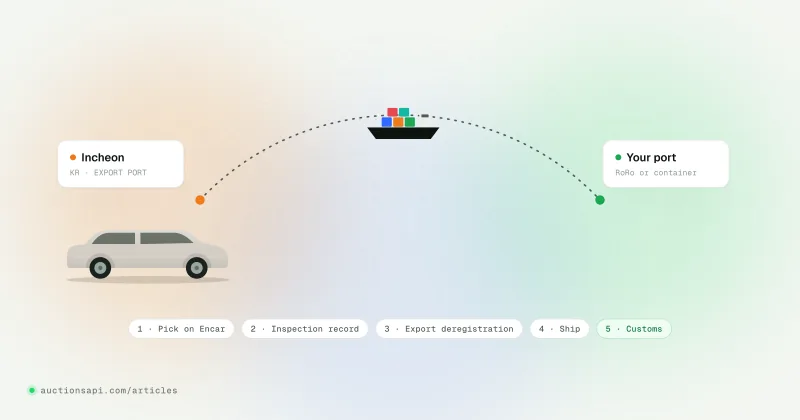
Open a few Encar listings in the car class you buy and read their records with the tables above; after ten of them the pattern becomes quick. If you are about to buy, the step-by-step guide to importing a car from Korea covers what comes after the inspection: the exporter, deregistration, shipping and customs. If you want to see how records, prices and Korean names look once they are cleaned up, read the Encar API article.
Questions people ask
What does X mean on a Korean car inspection report?
X (교환) means the part was replaced. On a bolt-on outer panel such as a door, fender, hood or trunk lid it counts as a simple repair, not an accident. On a frame part, such as the front panel, a cross member or a side member, a replacement means the car is recorded as having accident history.
What is the difference between 사고 and 단순수리?
사고 (accident) on the record means the main frame was repaired, welded or replaced. 단순수리 (simple repair) means only outer panels or bumpers were repaired or replaced: hood, front fenders, doors, trunk lid and, unless they were cut or welded, the quarter panels, roof and side sills. Simple repairs lower the price less than accident history.
Is the Encar inspection report reliable?
It is a legal document from a registered inspection shop, backed by a short guarantee and liability insurance, so it is more than a seller’s description. It still records one day, by a shop the seller chose, and it can miss things. Check it against the insurance history and the photos before you buy, especially for frame parts.
Does every Encar car have an inspection report?
No. Dealers must give buyers the performance and condition record, so most dealer listings show one. Private sellers are not bound in the same way, and their listings often have none. Some cars also carry Encar’s own diagnosis, which is a separate check by Encar staff and does not replace the legal record.
What is 엔카진단 (Encar diagnosis)?
It is a check of the car by Encar’s own staff, offered to sellers as a service and shown with a badge on the listing. It reports frame and panel condition with photos. It is separate from the legal performance and condition record, so when a car has both, read both and compare them, especially on frame parts.