 English
Odometer at auction: actual, not actual, exceeds limits, exempt
Copart odometer not actual, exempt and exceeds mechanical limits explained: federal disclosure rules, the 20-year change and how to spot a rollback by VIN.
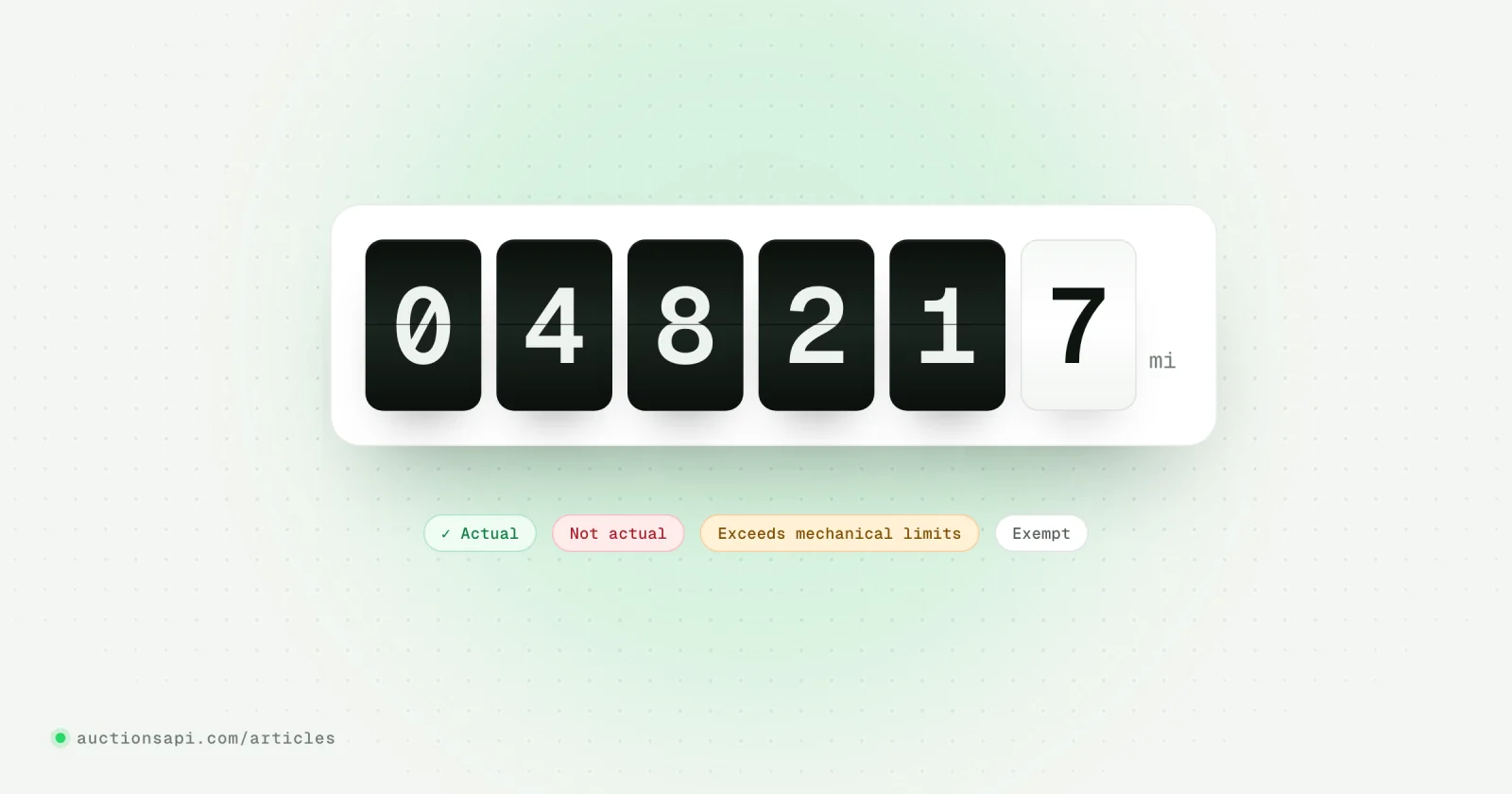
“Odometer not actual” on a Copart lot means the mileage shown is known or declared not to be the car's true mileage: the title, the seller's disclosure or the auction's own check says the number is wrong, so it tells you nothing reliable about wear. “Actual” means the reading is believed to be true, “exceeds mechanical limits” means the counter has rolled past its maximum, and “exempt” means the car is old enough (or heavy enough) that federal law no longer requires anyone to vouch for the reading.
These four statuses come from the US federal odometer disclosure rules, which every seller follows when ownership changes. They matter more at salvage auctions than anywhere else, because damaged cars often have dead dashboards, replaced instrument clusters and long, messy histories.
Below: what each status means, what the federal rules actually require (including the 2021 change from 10 to 20 years), why exempt is so common on older lots, and how to spot a rolled-back odometer by comparing readings across several sales of the same VIN.
Key takeaways
- Actual is the only odometer status that vouches for the number; not actual means the reading is known to be wrong.
- Exempt does not mean wrong: since 2021, model year 2011 and newer vehicles need a disclosure for 20 years, while model year 2010 and older are exempt.
- Exceeds mechanical limits means the counter rolled over, so the real mileage is higher than shown by at least one full turn.
- Readings that drop between two dated sales of the same VIN are the clearest rollback signal; a km/mile mix-up or a typo explains some of them.
- Treat the mileage as unknown on any lot without an actual status, and check the history before you trust a low number.
Actual, not actual, exceeds mechanical limits, exempt: what each means
Copart and IAAI print the reading with a status next to it, for example “98,765 mi (Actual)” or “12,480 mi (Exceeds Mechanical Limits)”. The status is the part to read first. The table sums up what each one means and how we would treat the number.
| Status | What it means | Where it comes from | How to treat the number |
|---|---|---|---|
| Actual | To the best of the seller's knowledge, the reading is the true mileage. | The standard disclosure statement on transfer. | Usable, but still compare with earlier records. |
| Not actual | The reading is known not to be the true mileage. Some state titles say “not actual mileage” or “TMU” (true mileage unknown). | A title brand, or a seller who knows of a cluster swap, rollback or fault. | Ignore it for valuation; assume high mileage. |
| Exceeds mechanical limits | The odometer has passed its maximum and started again from zero. | Disclosure on older cars with five-digit counters, and on some trucks. | Real mileage = reading + at least one full turn (often 100,000 miles). |
| Exempt | No federal disclosure was required, so nobody certified the reading. | The vehicle's age or weight puts it outside the rules. | Unverified, not necessarily wrong; check history. |
| Hours | The meter counts engine hours, not distance. | Equipment, boats and some machinery. | Not comparable with miles at all. |
What “odometer not actual” means on a Copart lot
A not actual status says one thing clearly: do not trust the number. The reasons behind it vary, and the lot rarely says which one applies.
- The title already carries a not actual or TMU brand from an earlier owner, so every later sale repeats it.
- The instrument cluster was replaced at some point (common after airbag deployments and dash damage), and the new cluster started from a different reading.
- A rollback was found earlier, by a state, an insurer or a history check.
- The seller simply cannot vouch for the reading and chose the not actual statement on the disclosure.
There is a related case that confuses people. When a damaged car's dash cannot be powered at the yard, the reading may be missing, zero or taken from paperwork. That is a gap in the data, not a not actual brand, but you should treat the number the same way: unknown.
For an importer the cost is real. A 2017 Mercedes C-Class with 41,000 miles on the dash and a not actual status has to be priced as a car with unknown mileage, which in practice means valuing it as a high-mileage example. Buyers at the destination will discount it the same way once they see the US history. Presenting a not actual reading as genuine mileage is also the kind of misrepresentation odometer laws exist to stop, so carry the status forward in your own listing.
The federal odometer disclosure rules, in short
Federal law requires the seller to give a written odometer disclosure whenever ownership of a motor vehicle changes, and makes tampering with an odometer a federal offence. The details are in 49 CFR Part 580. The seller states the reading and one of three things: the reading is the actual mileage, it exceeds the odometer's mechanical limits, or it is not the actual mileage.
Some vehicles are exempt from the disclosure. The ones you meet at auction are mostly:
- Old vehicles. Until 2020 the cut-off was 10 model years. A rule that took effect on January 1, 2021 extended it to 20 years for model year 2011 and newer vehicles. Model year 2010 and older vehicles kept the old 10-year exemption, so they are all exempt now.
- Heavy vehicles, with a gross vehicle weight rating above 16,000 pounds.
- Vehicles that are not self-propelled, such as trailers.
A worked example in 2026: a 2010 Honda Accord is exempt. A 2011 Accord needs a disclosure until its exemption starts on January 1, 2031, and a 2015 Accord until 2035. States can add their own requirements on top, and title wording differs between states, so check the state DMV for a specific title. The NHTSA odometer fraud page explains the rules for consumers and how to report suspected tampering; NHTSA estimates that more than 450,000 vehicles are sold each year with false odometer readings.
Why exempt is so common on older auction cars
Salvage auctions sell a lot of older cars: an insurer totals a 2009 Corolla over damage that would be a routine repair on a 2023 model, because the car is worth so little. Every model year 2010 and older car is now outside the disclosure rules, so on budget lots exempt is the normal status, not a warning.
Exempt only means nobody had to certify the number. The reading on a 2008 Camry listed as “178,000 mi (Exempt)” may be perfectly true. It just has no legal statement behind it, so the earlier sales of the VIN and any service records carry more weight. On a cheap, old car the honest approach is to price the wear you can see in the photos (seats, pedals, steering wheel, tires) rather than the number on the dash. For model years 2011 to 2015 you will see fewer exempt lots in the coming years, because the 20-year rule keeps them inside the disclosure system until 2031 to 2035.
Exceeds mechanical limits: the rolled-over counter
Many older odometers had five digits for whole miles, so after 99,999 they showed 00,000 again. A 1998 pickup showing 23,410 miles with this status has done 123,410 miles at the very least, and could have done 223,410. Modern digital odometers count far higher, so on recent cars you see this status rarely, mostly on trucks and on clusters with faults.
Treat the reading as a remainder, not a total. For valuation, assume the higher end of what the car's age and use suggest. A work truck that spent its life on a farm or a delivery route can easily have rolled over twice; a weekend convertible of the same age probably has not. The body, the interior wear and any earlier records of the VIN are the only way to narrow it down.
Digital odometers can be rolled back too
A common belief is that rollback died with mechanical odometers. It did not. On a digital cluster the mileage is a number stored in memory, and tools that rewrite it are sold openly for “cluster repair”. What changed is where the traces are left: many modern cars store the mileage in more than one control unit, and service tools, dealers and some history providers record readings at every visit.
For an auction buyer that means two practical checks. First, the cluster reading should agree with the other evidence you can see: wear on the steering wheel, pedals and driver's seat bolster, the age of the tires, the service sticker on the windshield or door jamb. A three-year-old car with a polished steering wheel and 19,000 miles on the dash deserves a second look. Second, a replaced cluster is legal when it is disclosed, but it breaks the reading's link to the car's history, so it should come with a not actual status or a door-jamb sticker recording the old mileage, as federal rules require for a repaired or replaced odometer that cannot be set to the true reading.
Damaged cars add a third twist. After a front-end impact or a flood, a cluster may not power on at all, so the yard records nothing, or takes a figure from the paperwork. The reading on the listing can then be older than the car's last trip. Read it as approximate until another record confirms it.
How to spot an odometer rollback across several sales
A car that goes through Copart or IAAI more than once leaves a reading, a date and a status in each sale. Mileage should only go up over time. When it drops, something happened. Here is an example history for one VIN:
- Mar 2021IAAI: 48,210 mi, ActualRear-end damage, sold by an insurer. The reading looks normal for a 2018 truck.
- Nov 2022Copart: 71,950 mi, ActualSold again after a repair and two years of use. About 23,700 miles in 20 months.
- Jun 2024Copart: 52,300 mi, Actual19,650 miles fewer than 19 months earlier, still declared actual. A rollback or a swapped cluster.
- Feb 2025Copart: 55,100 mi, Not actualThe title now carries a not actual brand, but the dash still shows the lower number.
Before you call a drop fraud, rule out the boring explanations:
- Kilometres and miles mixed up. Canadian lots are recorded in kilometres; 80,000 km is about 49,700 miles. Compare like with like.
- A typo at check-in: an extra or missing digit (7,195 vs 71,950) is usually obvious from the age of the car.
- A placeholder reading on a car whose dash could not be powered.
- A documented cluster replacement, which should come with a not actual status from then on.
If none of these fits, treat the higher earlier reading as the floor for the real mileage. Auction records are only part of the picture; title records, inspections and service visits in a vehicle history report fill the gaps between sales, and our guide to auction history by VIN shows how to collect every earlier lot.
If you check many VINs, automate it. The lookup by VIN returns every lot of the vehicle, active and archived, each with its odometer and dates; the function below flags readings lower than an earlier one.
How odometer data appears in an auction record
In AuctionsAPI records the odometer belongs to the lot, not the vehicle, because every sale has its own reading. Each lot has odometer with both units and a status object; the status can be null when the source gave none.
The status ids are 1 actual, 2 not_actual, 3 exempt, 4 exceeds_mechanical_limits and 5 hours. The /cars endpoint filters the reading with odometer_from_mi / odometer_to_mi (or the _km pair), inclusive; there is no filter on the status, so if you only want actual readings, filter on your side after the request. Every lot of a VIN, with its reading, comes from the search by VIN endpoint.
On your own site, show the status next to every reading, exactly as the auction did. A bare “55,100 mi” on a not actual lot misleads your visitors, and on a vehicle page a small table of readings by sale date lets people check the trend themselves.
What to do before you trust the miles
- Read the status before the number. Only actual vouches for the reading.
- Check the model year against the exemption rule: 2010 and older are exempt; 2011 and newer need a disclosure for 20 years.
- Pull every earlier sale of the VIN and line up the readings by date, in one unit.
- Look at the dashboard photo: does the cluster power on, and does the reading match the listing?
- For a car you are serious about, add a full history report with title and service records.
If you only need the auction side for one car at a time, Pay per VIN returns the stored record of a VIN, with each lot's reading and status, and you pay only when we have a record.
Questions people ask
What does odometer not actual mean on Copart?
It means the mileage shown is known or declared not to be the true mileage. The cause can be a title brand from an earlier owner, a replaced instrument cluster, a discovered rollback or a seller who cannot vouch for the number. Treat the reading as unknown and value the car as if it has high mileage.
What does exempt mean on a Copart odometer?
Exempt means federal law did not require an odometer disclosure for that vehicle, usually because of its age (model year 2010 and older) or a gross weight above 16,000 pounds. Nobody certified the reading, but that does not make it wrong. Compare it with earlier sales of the VIN and any service records.
What does exceeds mechanical limits mean?
It means the odometer passed its highest possible number and started again from zero. On older cars with five-digit counters, a reading of 23,410 with this status means at least 123,410 miles, possibly more. The real mileage is the reading plus one or more full turns of the counter.
How many years does a car need an odometer disclosure?
Since January 1, 2021, model year 2011 and newer vehicles need a disclosure on transfer for 20 years, so a 2011 model becomes exempt on January 1, 2031. Model year 2010 and older vehicles kept the old 10-year rule and are now exempt. States can add their own rules, so check the state DMV.
How can I check if an auction car has a rolled-back odometer?
Compare the readings from every earlier sale and record of the VIN in date order, in one unit. A reading lower than an earlier one is the main warning sign, once typos, kilometres versus miles and replaced clusters are ruled out. A history report adds title, inspection and service readings between auction sales.