 English
How to check a car's auction history by VIN
Check auction history by VIN: what a Copart or IAAI record shows, step-by-step checks, why one VIN has several lots, and how a free VIN check works.
To check a car's auction history by VIN, take the 17-character VIN from the car itself, enter it in a service that keeps finished Copart and IAAI lots (an auction archive, a history report or a VIN lookup API), and read every lot it returns: the sale date, damage, odometer reading, title, photos from the yard and the final bid. If the car went through a salvage auction, that is where it shows, often with photos of the damage before anyone repaired it.
A clean history report and a tidy ad do not rule that out. Thousands of damaged cars are bought at US auctions every month, repaired and resold, in the US and abroad, and the auction record is the one document the seller cannot polish.
Here is what an auction record contains, how to check it step by step, why one VIN often has several lots, and what to do when nothing comes up.
Key takeaways
- The VIN must come from the car (windscreen, door pillar, registration), not from the ad.
- Auction photos show the damage before repair, which no later report can.
- One VIN with several lots usually means a failed sale and a relist, or a repaired car that came back to auction.
- An odometer reading at auction that is higher than the one on the dashboard today is a red flag on its own.
- No auction record is not proof of a clean past: it means no lot was found in that source.
Why auction history matters when you buy a used car
Insurers in the US send cars they have written off to Copart and IAAI. Dealers, rebuilders and exporters buy them, fix them (well or badly) and sell them again. Many go to Europe, the Middle East and Central Asia, where a US salvage title does not follow the car: once it is registered in Poland or Lithuania, the paperwork says "imported from the USA" and nothing more.
That is why the auction record is so useful. It was made before the repair, by someone who had no reason to hide the damage. A 2019 RAV4 sold as "one owner, no accidents" in Germany and a Copart lot of the same VIN with a crushed front end and deployed airbags cannot both be right.
In the US the stakes are a little different: a salvage or rebuilt brand normally stays on the title, but brands can be lost when a car is retitled in a state with looser rules. Either way, the auction lot is the first thing we would check, before paying for an inspection.
What an auction record shows
A Copart or IAAI lot is a snapshot of the car on the day it went to auction. A good archive keeps all of it:
- Lot
- 71552034
- Sale date
- 11 Apr 2024
- Status
- Sold
- Final bid
- $6,850
- Primary damage
- Front end
- Secondary damage
- Undercarriage
- Odometer
- 48,350 mi, actual
- Title
- Salvage certificate (NY)
- Condition
- Run and drive
- Airbags
- Deployed
- Keys
- Yes
- Photos
- 28
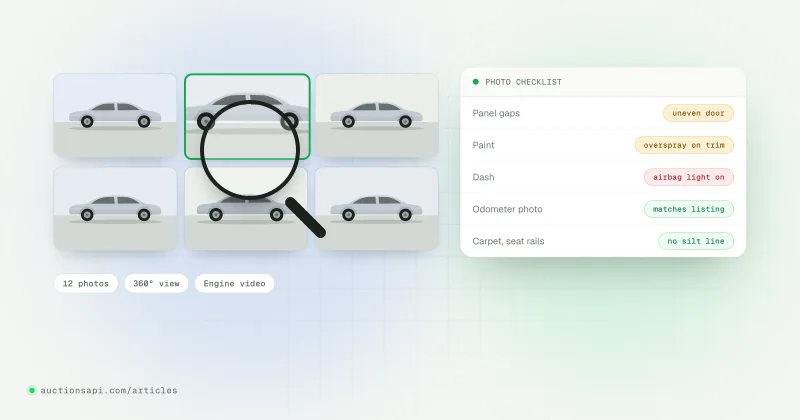
- Photos. Usually 10 to 30 from the yard, sometimes a 360 view or engine video. They are the most valuable part: you see the damage, the interior, the dashboard with the odometer and any warning lights.
- Damage. A primary and often a secondary damage (front end, side, rear end, hail, water/flood, burn, mechanical). Labels are the auction's, chosen quickly; the photos are the truth.
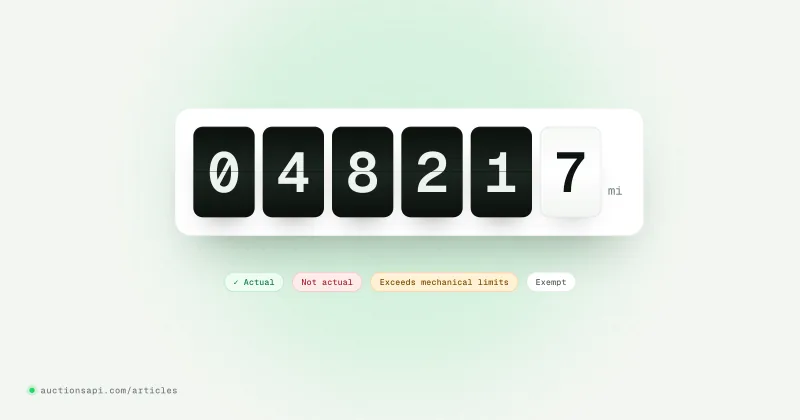
- Odometer and its status. The reading in miles or kilometres and whether it is actual, not actual, exempt or beyond the mechanical limit.
- Title. The document the car was sold with: salvage certificate, certificate of destruction, clean title, and the state that issued it.
- Condition. Run and drive, engine starts, or neither. Airbags, keys.
- Sale date, status and final bid. Whether the lot sold, when, and for how much at the hammer.
- Seller and location. Often the insurer's name and the yard where the car stood.
The final bid deserves one warning: it is the hammer price, and only when the status says sold. A lot that ended without a sale shows its last bid. Our article on Copart sold prices goes through the price fields one by one.
How to check auction history by VIN, step by step
- Read the VIN from the car. Look at the plate at the base of the windscreen and the sticker or stamp on the driver's door pillar, and compare both with the registration document. A VIN copied from the ad can be mistyped or belong to another car.
- Check that it is a valid VIN. 17 characters, no I, O or Q. For cars built for North America, the 9th character is a check digit you can verify yourself; how to decode a VIN shows the calculation. A VIN that fails the check is either mistyped or not what it claims to be.
- Search it in an auction archive. Enter the full VIN, not a partial one. Note how many lots come back, from which auction and on which dates.
- Open every lot, oldest first. Look at the photos, the damage, the odometer, the title and the status. Write down the odometer reading of each lot.
- Compare with the seller's story. Damage that the ad does not mention, a title the seller calls clean, a mileage lower today than at auction: each needs an answer before you go further.
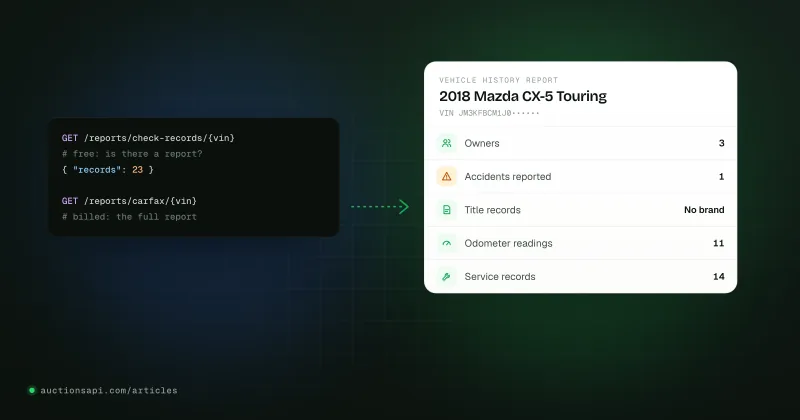
- Add a history report. Auction records show auctions; title brands, registrations, accidents reported to insurers and service visits come from reports such as Carfax or AutoCheck, and in the US from the official NMVTIS title data. Our piece on the vehicle history report API explains what each covers.
- Inspect the car. With the auction photos in hand, ask the inspector to look at exactly the areas that were damaged: welds, panel gaps, airbag modules, flood marks under the carpet.
Why one VIN can have several auction lots
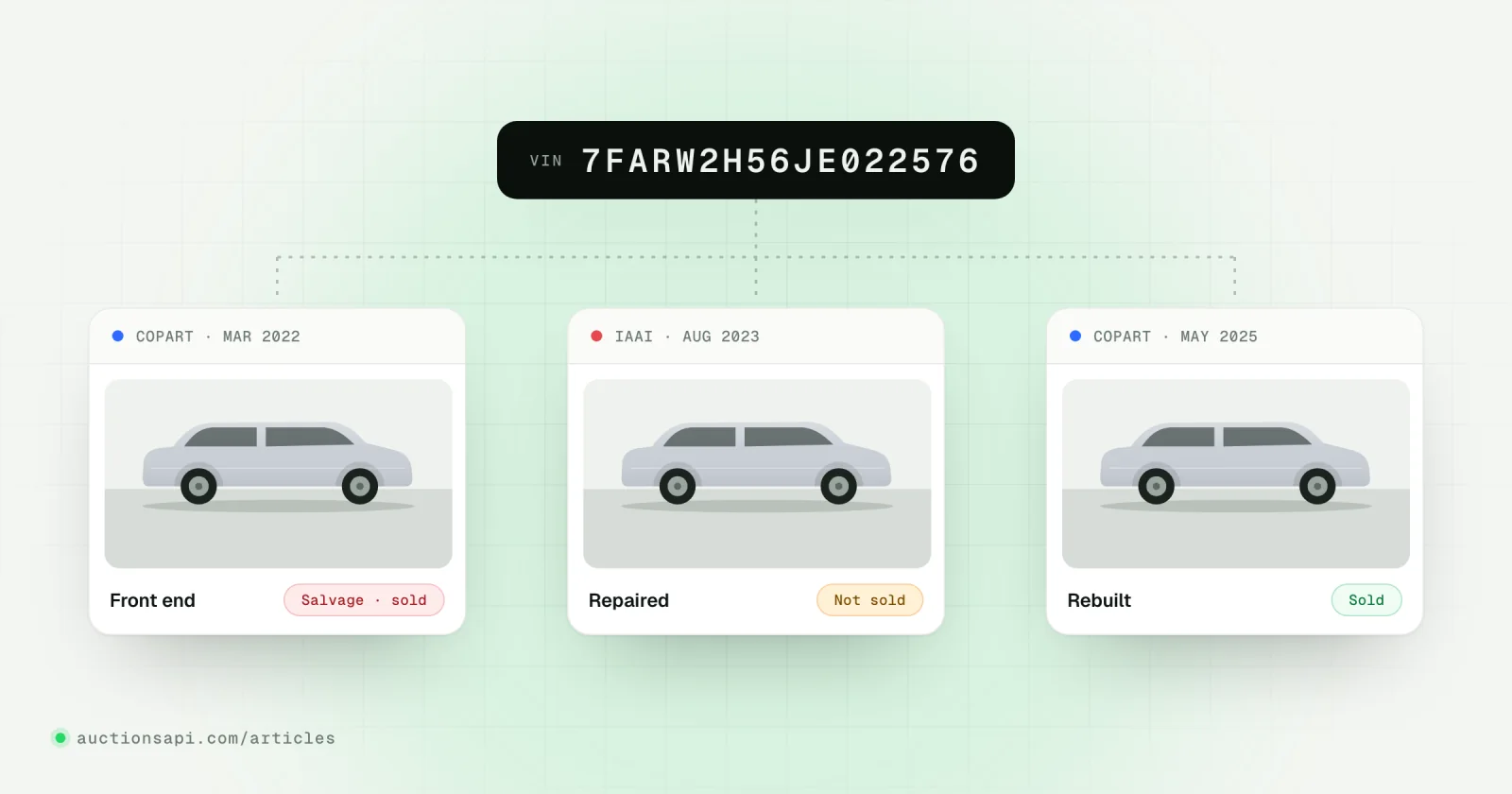
A VIN identifies a car; a lot number identifies one attempt to sell it. One car often has several lots, and the pattern tells a story.
- Mar 2024IAAI · lot 37720915Front-end damage, salvage title, 48,210 mi, run and drive. High bid $6,100 rejected by the seller: not sold.
- Apr 2024Copart · lot 71552034Same damage, relisted at the other auction, 48,350 mi. Sold, final bid $6,850.
- Feb 2025Copart · lot 88310452Back after repair: rebuilt title, minor dents and scratches, 51,960 mi. Sold, final bid $13,400.
- Jun 2025Retail ad in Europe"Imported from the USA, no accidents", 52,400 km on the dashboard. The miles became kilometres, and the damage is not mentioned.
The common patterns:
- Relist after a failed sale. The seller rejected the high bid, or the buyer did not pay. The car comes back a week or a few weeks later with a new lot number, sometimes at the other auction. Same damage, almost the same mileage.
- Resale after repair. Months later the car returns with a rebuilt title and a lighter damage label, or with a clean-looking body and "minor dents". The earlier lot shows what was under the paint.
- Repeated sales of a problem car. A car that goes through auction three or four times in a year, each time with a mechanical or electrical note, has a fault nobody managed to fix cheaply.
- Dealer trade-ins. A car that was never damaged can still pass through a dealer or rental-fleet auction. A clean title and no damage label are the clue.
Note also the units. US lots record miles; if a European ad shows a number close to the auction miles but in kilometres, the car has covered more distance than the ad suggests, or the cluster was swapped.
How to read the auction photos
Damage labels are typed by yard staff in seconds; the photos are where the real information is. Go through them in this order and compare each one with the car you are about to buy:
| Look at | What it tells you | What to check on the car today |
|---|---|---|
| Dashboard photo | Odometer reading, warning lights, airbag light | The same reading or higher; no airbag warning |
| Front three-quarter views | Bumper, headlights, bonnet, wing alignment | Panel gaps, overspray, new headlights on an old car |
| Engine bay | Radiator support, strut towers, fluid leaks | Welds or fresh paint around the slam panel |
| Interior and seats | Deployed airbags, water lines, mud on carpets | New airbag covers, musty smell, rust on seat rails |
| Underside and wheels | Bent suspension, scraped sills | Tyre wear pattern, alignment, new arms on one side |
Water damage needs special attention. A flood car can look clean in a European showroom, and the label at auction may say "water/flood" or only "mechanical". Tide marks on the door cards, silt in the spare-wheel well and fogged instrument clusters in the yard photos are hard to argue with. Hail damage is the opposite case: it looks dramatic in the photos, but the structure is usually untouched, and a paintless repair can be fine.
What it means when nothing comes up
A VIN with no auction lots in a source means that source has no lot for it. It does not mean the car was never damaged. Many accidents never reach an insurance auction: the owner repaired the car privately, the insurer paid out without taking the car, or the car was sold at an auction the archive does not cover. Older lots may also be missing if the archive started collecting later.
So treat an empty result as "no evidence found here", run a history report for title brands and insurance events, and rely on the inspection. A car with a full service history and a matching odometer is still the best sign.
Checking a VIN with Pay per VIN
If you check cars one at a time (a dealer, an importer, an inspection service, a VIN check page), paying for a subscription to the whole auction feed makes little sense. Pay per VIN is built for that case. It looks the VIN up in one database that holds Copart and IAAI lots from the USA and Encar listings from South Korea, in two calls:
- Check, free.
/local-exists/{vin}answers whether we have the car. When we do, it also returns the title, a photo, the sites it was on and the ids of its lots. You can call it as often as you like. - Record, one report.
/local-report/{vin}returns the whole vehicle with every lot: dates, damage, odometer, title, prices and full-size photos. One report is taken from your balance only when a vehicle comes back.
A VIN we do not have answers 404 local data not found and costs nothing; a balance that is too low answers 402 and a key without Pay per VIN answers 403, also free. Every record comes back with your remaining balance. Calling /local-report twice for the same VIN takes two reports, so keep the record on your side. A set of test VINs is free, so you can build the flow before spending anything; they are listed in the Pay per VIN documentation.
Auction history by VIN in your own app
With a Copart and IAAI plan, /search-vin/{vin} returns one vehicle with all its lots, active and archived, on the sources your key includes. Add prices_history=1 to get the recorded bid and Buy Now changes of each lot.
Two answers need care. A 404 with the hint empty lots for your key means the vehicle exists but only on a source your key does not include. A 423 means the VIN was removed at the owner's request; treat it like not found. And read status before you print final_bid as "sold for". The /search-vin reference lists every field.
Before you pay for the car
Get the VIN from the car, check every auction lot it ever had, compare the photos and the odometer with what you see today, then add a history report and an inspection aimed at the damaged areas. If the seller's story and the auction record disagree, believe the record.
Questions people ask
Can I check Copart history by VIN for free?
Often, yes. Several sites show the latest Copart or IAAI lot of a VIN with a few photos at no cost, and Pay per VIN's existence check is free. The full record, with every lot, all photos and the final bids, is usually a paid lookup. Whatever you use, open each lot rather than relying on a summary line.
Does a Carfax report show auction history?
It can show that a car was sold at auction or branded salvage, depending on what was reported to it, but it does not carry the auction photos, damage labels and final bids of each lot. Use a history report for title brands, registrations and service records, and an auction archive for what the car looked like at the yard.
Why does the same VIN appear at Copart and IAAI?
Usually because the first sale failed: the seller rejected the high bid or the buyer did not pay, and the car was relisted at the other auction. It can also mean the car was repaired, resold and came back to auction later. Compare dates, damage and odometer of each lot to tell which.
What does it mean if a VIN has no auction history?
Only that the source you searched has no lot for that VIN. The car may have been repaired privately, paid out without an auction, or sold somewhere the archive does not cover. Treat it as no evidence found, then rely on a history report and an inspection.
Is a salvage auction car always a bad buy?
No. Hail damage, light rear-end hits and theft recoveries are often repaired properly and priced fairly. The problem is a car sold as accident-free when it was not. Knowing the auction history lets you judge the repair and pay a price that reflects it.