 English
Buying a car from a US auction and shipping it overseas: the full process
How to buy a car from Copart or IAAI and ship it overseas: brokers, choosing a lot, fees, the title and 72-hour export rule, container or RoRo, customs.
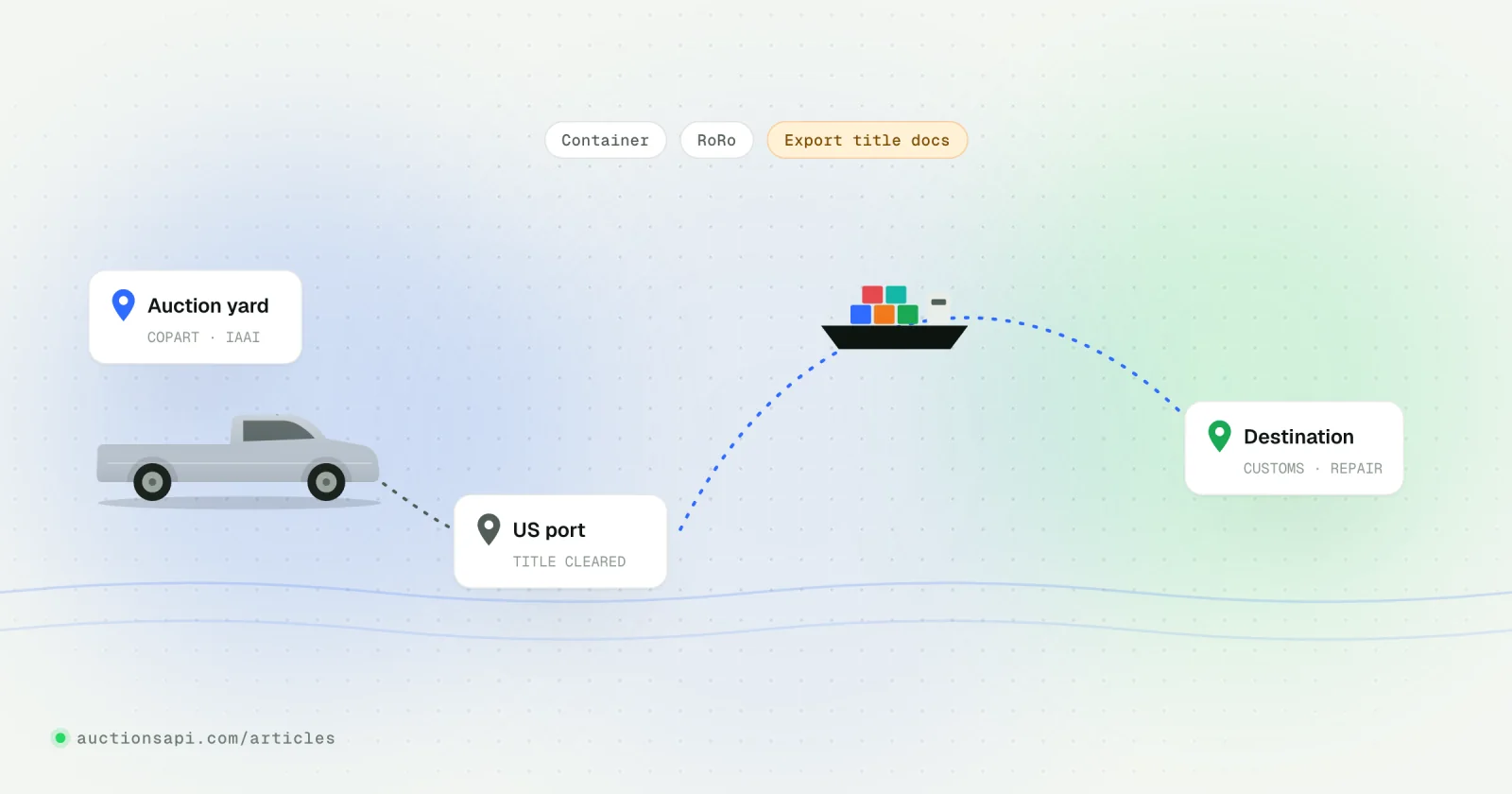
To buy a car from Copart and ship it overseas, most foreign buyers work through a broker who is registered with the auction: you choose the lot, the broker buys it in their name for you, you pay the auction price plus fees, a truck takes the car to an export port such as New Jersey, Savannah, Houston or Los Angeles, a freight forwarder clears it for export with the original title, and it sails in a container or on a RoRo ship to your country, where you pay import taxes, repair it and register it. From sale day to a car on your driveway, six to twelve weeks is typical, and longer is common.
The same steps apply to IAAI. What changes between buyers is the destination: Europe, the Caucasus, Central Asia and the Middle East each have their own port, tax and registration rules.
This is the whole process in order, with the places where it usually goes wrong. Fees, freight rates and import taxes change and differ by country, so we describe their structure and leave the numbers to your broker and your local customs office.
Key takeaways
- Most salvage lots on Copart and IAAI can only be bought by licensed dealers, so foreign buyers usually go through a registered broker.
- Judge a lot by its damage, title type, condition label and odometer status, and compare it with final bids of similar cars that already sold.
- Nothing leaves the US until the original title is in hand: US Customs wants the title documents at least 72 hours before export.
- Damaged cars that do not run usually ship in containers; RoRo suits cars that can be driven on and off.
- Import duty, VAT and registration rules depend on your country and change often; get a written estimate before you buy.
Who can buy a car from Copart and ship it overseas
Both auctions accept members from outside the US, but membership alone does not open every lot. In many states, cars with salvage and other branded titles can only be sold to licensed dealers, dismantlers or rebuilders. Some lots are open to the public, many are not, and the lot page says which licence it needs.
That is why most buyers from Europe, the CIS and the Middle East use a broker: a company that holds the required licence and is registered with the auction to buy for other people. The broker buys under its own account, you pay the broker, and the broker pays the auction. In practice the broker also handles the paperwork, arranges inland transport and often the export as well.
Choose the broker before you choose the car. Ask in writing for their fee, their deposit rules, what happens if you change your mind after a win, how fast they pay the auction (late payment brings fees) and which export ports and forwarders they work with. A broker who cannot answer those clearly will not get easier after the sale.
Choosing a lot: damage, title, condition and history
An auction listing compresses a lot of information into a few labels. Read each of them before you look at the photos, because the photos are where optimism starts.
| Field on the lot | What it tells you | What to watch for |
|---|---|---|
| Primary and secondary damage | The auction's own description of the main damage | A label, not an inspection. "Front end" can mean a bumper or a radiator support and both airbags |
| Title type | Clean, salvage, rebuilt, certificate of destruction and other brands | Some brands cannot be registered for the road again in the US, and some countries refuse them too |
| Condition | Run and drive, engine starts, enhanced, not checked | A snapshot from the yard on one day, not a guarantee the car will run on delivery |
| Odometer status | Actual, not actual, exempt, exceeds mechanical limits | "Not actual" means the reading is known to be wrong |
| Airbags and keys | Deployed or intact; keys present or not | Deployed airbags add parts and labour; no key means a programmed replacement |
| Sale type | Pure sale, minimum price or seller approval | On approval, the seller can still decline the final price |
Title brands deserve the most attention, because they decide whether the car can be registered at the other end. Our guide to salvage title brands lists what each one means and which are a problem for export.
Check the VIN history first
Run the VIN before you commit. Many cars at Copart and IAAI have been through an auction before: the same VIN may have failed to sell last month with different photos, or sold a year ago with less damage and been rebuilt badly. A VIN's earlier lots, photos and prices are often the most honest description of the car you can get. Auction history by VIN explains where to look and what to make of it.
Set your price from sold comparables, not from the current bid
The current bid a week before the sale says very little. What matters is what similar cars actually sold for: same model, year range, damage type and title, ideally from the last few months. Look at final bids of several of them and set your ceiling from that, then subtract fees, transport, taxes and repair to see what is left. Copart sold prices covers where final bids come from and how to read them.
A seller reserve, where it is shown, is the seller's minimum, not a sale price. A car with a reserve far above comparable final bids will often not sell, and will come back to the auction later.
Payment and fees: what you pay after the win
After a win the clock starts. The auction expects payment within a few business days, and storage fees start once the free storage days at the yard run out. Copart and IAAI publish their current fee schedules on copart.com and iaai.com; they change from time to time, so check them for the date of your purchase.
The total you pay is a stack of separate items. Ask your broker for an estimate of each one before the sale:
- The sale price of the car.
- Auction buyer fee, usually tiered by the sale price, plus an online sale fee for buying over the internet.
- Smaller auction fees such as a gate fee for moving the car out of the yard and title or document handling.
- Broker fee, fixed or a percentage, and sometimes a separate fee for the money transfer.
- Storage, if pickup is late or the title is delayed.
- Inland transport from the yard to the export port.
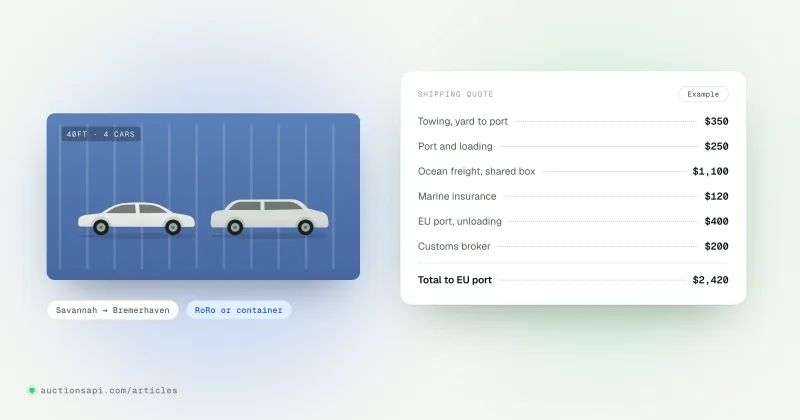
- Export handling, ocean freight and insurance, quoted by the forwarder (how a quote is built: shipping a car from the USA to Europe).
- Destination costs: unloading, port and terminal fees, customs broker, import duty, VAT and any excise or registration tax.
- Repairs, certification and registration in your country.
Pay for the car by bank transfer to the broker or the auction as agreed. Wire transfers take a day or two to arrive; if your bank holds an international payment for checks, a late payment fee can follow, so send it early.
Inland transport to the export port
Copart and IAAI have yards across the US and Canada, and the car has to get from its yard to a port that serves your destination. Forwarders that ship to Europe, the Caucasus and the Middle East commonly load in New Jersey (Newark and Elizabeth), Savannah, Houston and Los Angeles or Long Beach, and some also use other ports such as Baltimore or Miami. Which one is cheapest depends on where the yard is and which routes your forwarder runs.
Inland transport is usually by car carrier truck. A damaged car that does not roll or steer needs a carrier that can winch or lift it, which costs more and takes longer to book. From a yard near the port this step can take a few days; from a yard far inland, one to three weeks is normal. A car that sits in the yard waiting for a truck also collects storage fees.
The title and US export clearance
The title is the document that most often holds up an export. The auction mails or hands the title to the buyer (your broker) after payment, and some sellers, insurance companies especially, take weeks to deliver it to the auction. Until the original title is in hand the car cannot be cleared for export, however long it sits at the port.
US Customs and Border Protection requires the exporter to present the original Certificate of Title, or a certified copy, plus two complete copies, and for shipments by sea the documents and the vehicle must be presented at least 72 hours before export. If there is a lien, the lienholder must give written permission. The rules are on the CBP motor vehicle export page; ports can add their own procedures.
Used vehicles also need Electronic Export Information filed in the US government's Automated Export System, which your forwarder normally does and which produces an ITN number for the documents. Ask the forwarder to confirm it was filed before the car is loaded.
One more check before you buy: US export controls restrict shipments of many goods, including many vehicles, to some destinations, and the list changes. If your final destination or the route goes through a country under US or EU sanctions, ask your forwarder before the sale, not after.
Container or RoRo shipping
There are two ways to get the car across the ocean, and the condition of the car usually decides for you.
- Several cars share one 40-foot container, loaded and strapped by the forwarder
- Cars that do not run can be loaded with a forklift
- Better protection against weather and theft on the way
- Waits until the container is full, which can add days
- The usual choice for damaged auction cars
- The car is driven onto the ship and parked on a deck
- Usually the car must start, steer and brake
- Often simpler for one running car on a route with RoRo service
- No personal items allowed inside the car
- Fewer destination ports than container shipping
Common destinations for this traffic include Klaipėda, Gdynia, Bremerhaven and Rotterdam in Europe, Constanța on the Black Sea, Poti in Georgia, and Jebel Ali and Aqaba in the Middle East. From there, many cars continue by truck to a neighbouring country. Ask for the ocean transit time and the date of the next sailing; a car that misses a vessel can wait a week or more for the next one.
How long it takes: a typical timeline
- Day 0SaleThe broker wins the lot for you at the agreed price or below.
- Days 1–3PaymentYou pay the broker, the broker pays the auction before the deadline.
- Days 2–20Pickup and inland transportA truck collects the car from the yard and takes it to the export warehouse.
- Days 5–30+Title arrivesThe original title reaches the broker or forwarder. Insurance sellers can be slow.
- 72 hours before sailingExport clearanceTitle documents go to CBP, EEI is filed, the car is loaded.
- 3–7 weeksOcean transitDepends on the route, transhipment and the next sailing.
- 3–10 daysArrival and customsUnloading, customs declaration, taxes paid, car released.
- WeeksRepair and registrationRepair, technical inspection and registration in your country.
The two places where time disappears are the title and the vessel. A car can be at the port in ten days and wait another month for its title. Build that into your plan, and into what you tell a customer if you are importing for someone else.
Customs, repair and registration at home
Import taxes are where estimates differ most from reality, so take the structure from this section and the numbers from a customs broker in your country. In most countries you pay some combination of:
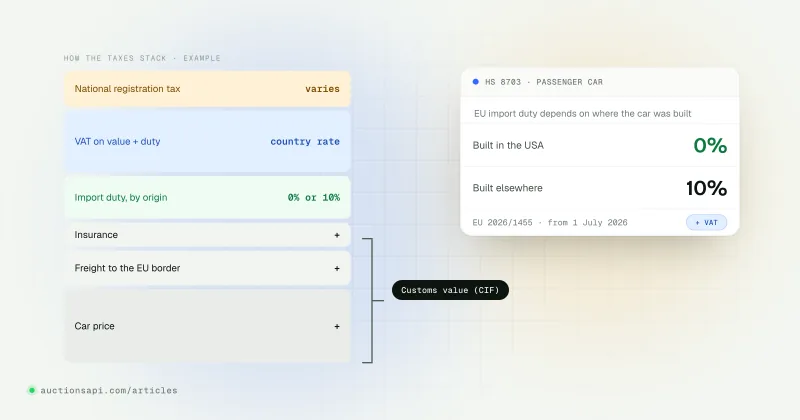
- Import duty, a percentage of the customs value. In the EU and many other places that value includes the price paid plus freight and insurance to the border; since July 2026 the EU rate also depends on where the car was built (see customs duty and VAT on cars from the USA).
- VAT or sales tax, charged on the customs value plus the duty.
- Excise or registration taxes based on engine size, CO2 emissions, fuel or the age of the car, in countries that have them.
- Fixed fees for the customs declaration, terminal handling and certificates.
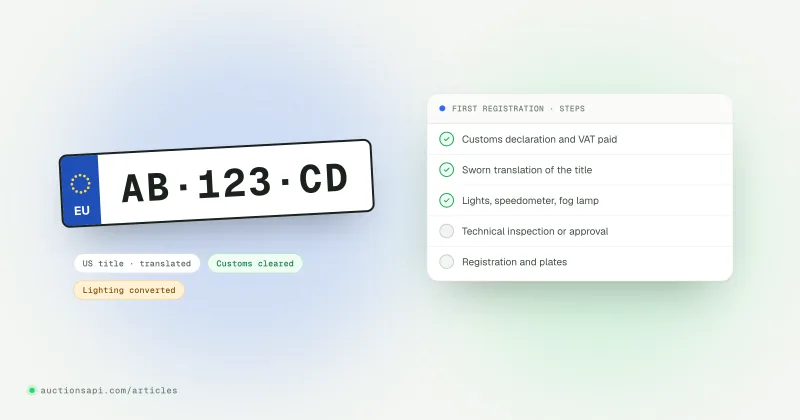
Several countries changed their rules for imported cars in recent years, and some have special rates for older cars or electric vehicles. Ask for a written calculation for your exact car (VIN, engine, year, price) before the sale, and keep the auction invoice and freight invoice: customs will ask for both. The EU paperwork after customs is in our guide to registering a US car in Europe.
After customs, the car still has to be repaired and registered. Many EU countries require a technical inspection, and a car with a salvage history may need a more detailed one or an individual approval. Some title brands, or damage such as a flood, can make registration impossible. Check with your registration authority what they will require for a car with this title and this damage, before you buy it.
Mistakes that cost buyers the most
- Setting the price from the current bid instead of from final bids of similar sold cars.
- Ignoring the title brand until the car is at the port.
- Forgetting that storage keeps running while the title is late.
- Choosing RoRo for a car that will not start.
- Using an import tax calculator from a forum instead of a written estimate from a customs broker.
- Skipping the VIN history and buying a car that was already rebuilt once.
Where to start
Pick a broker and a forwarder first and get their fees and routes in writing. Then shortlist three or four lots, check each VIN's history and the final bids of similar cars, and run the full cost stack for each one before sale day. If you are an import business doing this every week, the same data can be pulled into your own tools: our Copart and IAAI API provides current lots, final bids and VIN history for that, while the buying itself still goes through the auction and your broker.
Questions people ask
Can a foreigner buy directly from Copart?
A foreign buyer can register with Copart, but many lots, especially salvage titles, can only be bought by licensed dealers in that state. Public buyers can buy only the lots marked as open to them. That is why most buyers outside the US use a registered broker who buys on their behalf under the broker's licence and handles the paperwork.
How long does it take to ship a car from a US auction to Europe?
Six to twelve weeks from the sale is typical. Payment and inland transport take one to three weeks, the title can take from a few days to over a month, and ocean transit to a European port usually takes three to six weeks. Customs and registration add more. Title delays and missed sailings are the most common reasons for longer waits.
Do I need the title to export a car from the US?
Yes. US Customs requires the original title or a certified copy, with two copies, presented at least 72 hours before a vehicle is exported by sea, and the car is not loaded until that is done. A lot sold with a bill of sale only or with a delayed title cannot be exported until the title arrives.
Is container or RoRo shipping better for an auction car?
For damaged cars, a container is usually the only option, because RoRo normally requires the car to drive onto the ship. Containers also protect the car better and allow several cars to share the cost. RoRo can be simpler for a single car that runs well, on a route that has RoRo service to your port.
How much are import taxes on a car from the USA?
It depends on the country, the car's value, engine, emissions and age. Most countries charge import duty on the customs value, which often includes freight and insurance, plus VAT, and some add excise or registration taxes. Rules change often, so get a written calculation for the specific car from a customs broker before the sale.