 English
Importing a classic car from the USA: what changes when a car is 25+ years old
How to import a classic car from the USA to Europe: where to buy, pre-1981 VINs, old titles, HS 9705 duty and VAT relief, historic plates and rust checks.
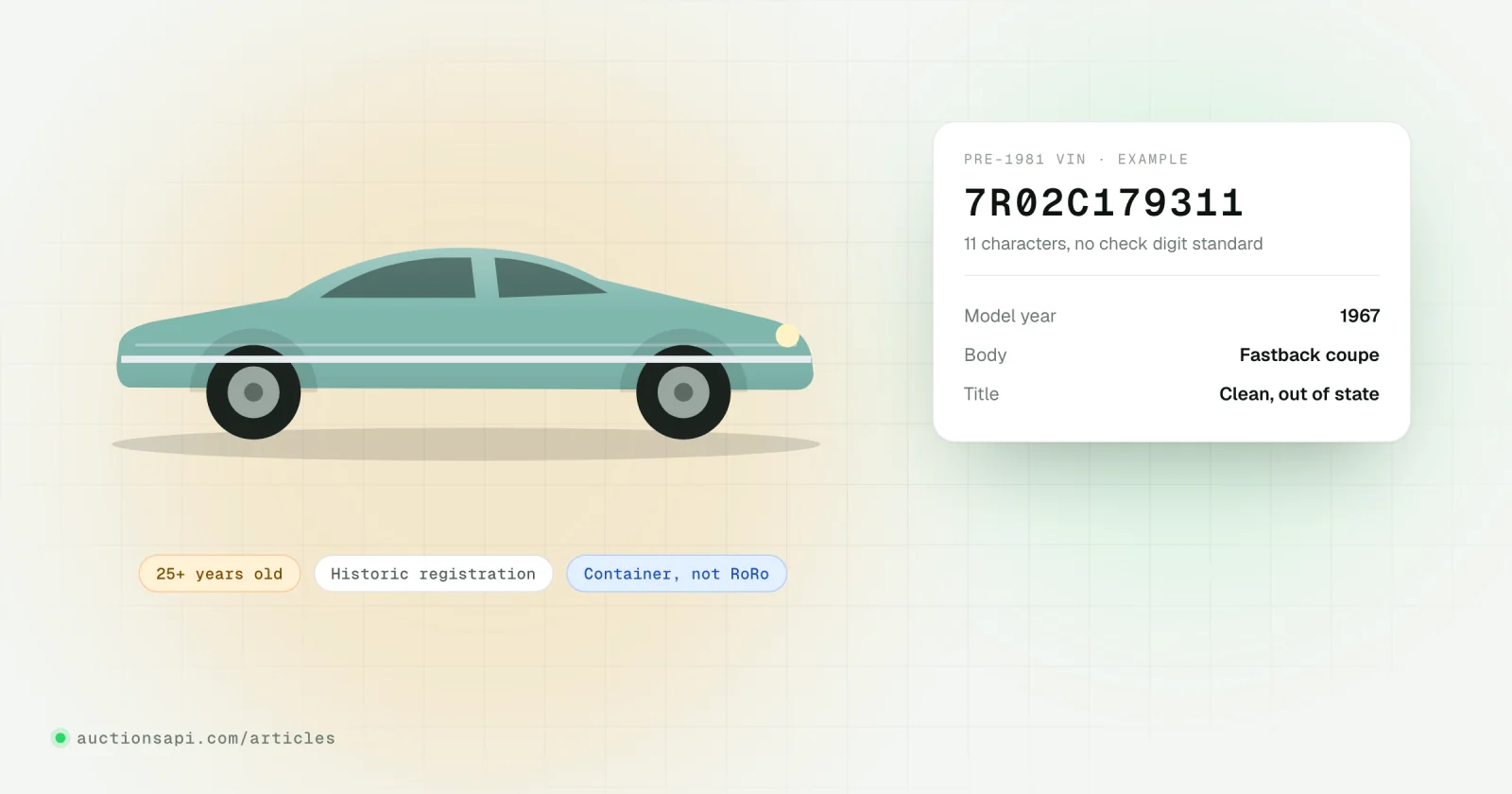
To import a classic car from the USA into Europe, you buy it (usually from a specialist auction, a dealer or a private seller rather than Copart or IAAI), export it with its title or, for some old cars, a bill of sale, ship it in a container, and declare it at an EU port. Age changes three things on the way: a car at least 30 years old, in original condition and of a model no longer made can be declared as a collector's vehicle under tariff heading 9705, which is free of customs duty and in some countries pays reduced import VAT; many EU countries offer historic registration from 25 or 30 years; and the paperwork and the VIN look different from a modern car's.
The "25 years" in many guides comes from the US rule for importing cars into America. For a car going the other way, the lines that matter in Europe are national: 25 years in some countries, 30 in others, and 30 for the customs treatment.
Below is the route with the points where old cars differ from modern imports. Rules for collector vehicles are applied case by case and change, so take the structure from here and the final answer from your customs broker and registration authority.
Key takeaways
- Most classics are bought from specialist auctions, dealers and private sellers; Copart and IAAI sell old cars only now and then.
- Cars built before 1981 have no standard 17-character VIN, so checking identity takes manufacturer records and trim or body tags.
- Some US states do not issue titles for older cars; export then needs a bill of sale and proof that no title exists for that car.
- Heading 9705 (collector vehicles) means no customs duty and, in some EU countries, reduced import VAT, but only for original, unmodified cars at least 30 years old.
- Historic registration in Europe has its own age and originality rules per country, and rust is the inspection item that ends most deals.
Importing a classic car from the USA: what changes with age
Up to about 25 years, an American car imported into Europe is treated like any used US car: full duty and VAT, an individual approval against modern rules, the usual conversion of lights and instruments. Past that age, a few things start working for you and a few against you.
| Topic | Modern US car | Classic (25–30+ years) |
|---|---|---|
| Where to buy | Copart, IAAI, dealers, private sellers | Specialist auctions, classic dealers, private sellers; insurance auctions only occasionally |
| VIN | 17 characters, check digit, decodable | Before 1981: shorter, maker-specific, no check digit |
| US paperwork | Title required for export | Some states issue no title for older cars; bill of sale plus proof |
| Customs | Car duty or the US-origin zero rate, standard VAT | Possible heading 9705: no duty, reduced import VAT in some countries |
| Registration | Individual approval against current rules | Often the rules of its era; historic registration where it qualifies |
| Main risk | Hidden crash or flood damage | Rust, filler and non-original parts |
Where classic cars from the USA are sold
Copart and IAAI mostly sell insurance write-offs of recent cars. Older vehicles do appear, often an insured classic damaged in a storm, a fire or a garage collapse, or an old truck sold by a fleet or a dealer, but they are the exception, and a damaged classic is a restoration project with a title brand attached. Read the title brand before getting attached: a salvage brand on a valuable classic can cost more in value than the repair.
Most classics are bought elsewhere:
- Specialist auctions, both in-person events and online auction sites focused on collector cars. Listings are long, with hundreds of photos, and sellers answer questions in public. Prices are higher than at salvage auctions, because the cars are expected to be on the road.
- Classic car dealers, who often know export and can deliver the car to the port with paperwork in order.
- Private sellers and classified sites. The widest choice and the best prices, and the most homework: you are relying on one person's description of a car you cannot see.
Whichever channel, pay an independent inspector near the car to look at it on a lift before you pay for it. A few hundred dollars for an inspection is small next to a floor that has to be replaced. Ask for photos of the underside, the sills, the boot floor and every number plate and tag on the car, and a short video of a cold start.
Pre-1981 VINs and proving the car is what it claims
The 17-character VIN with its check digit became standard for cars sold in the US from the 1981 model year. Before that, each manufacturer used its own format, often 11 to 13 characters, with its own codes for model, body, engine, plant and sequence. Free decoders built on NHTSA data start at 1981, so an older car has to be decoded from the maker's tables or a marque club's records. Our guide on how to decode a VIN covers the structure, including what changes before 1981.
For a classic, the VIN is only the start. Value often depends on whether the car still has its original engine, gearbox and axle ("matching numbers"), and on its trim and options. Look for:
- the VIN plate or stamping in the place the maker used for that year (dashboard, door pillar, inner wing or frame), with original rivets;
- body or trim tags on the cowl or door pillar that encode paint, interior and build date on many US cars;
- engine and gearbox stamp codes that match the car's year and, where the maker did so, part of the VIN;
- factory or marque-registry documents, such as a build sheet or a certificate from the maker's heritage service, where they exist.
Very old cars can be titled under an engine or body number instead of a VIN. That is legal, but the number on the title has to be found on the car. A title number that matches nothing you can see is a reason to stop.
Titles, bills of sale and US export
Most US states issue titles for cars of any age, but some stop at a certain model year. Georgia, at the time of writing, does not issue titles for 1962 and older models and makes them optional up to the 1985 model year; ownership of an untitled car there passes with a bill of sale and the registration. Other states have their own cut-offs and exemptions, and some have changed them over the years, so check the rules of the state the car comes from.
US Customs accepts untitled vehicles for export, with conditions. According to the CBP vehicle export page, the exporter must provide the original ownership document (such as a bill of sale) with two copies, a written statement that the transaction was legitimate and the car is not stolen, and proof that the state has no ownership document requirement for such vehicles. As with any car, the documents go to CBP at least 72 hours before export by sea.
Check for liens and theft records too. A seller's lender may still hold the title, and a car that was stolen decades ago can still be listed as stolen. Your broker or a title service can check the state records.
Customs duty and VAT on a classic car: heading 9705
An ordinary passenger car falls under tariff heading 8703, with a 10% EU duty for most origins. Collector vehicles of historical interest can instead be declared under heading 9705, which carries no customs duty. The EU's explanatory notes set three conditions for motor vehicles:
- Original state. No substantial changes to the chassis, body, steering, brakes, transmission, suspension or engine. Repair and restoration are allowed if the car is kept in historically correct condition; modernised or modified cars are excluded.
- At least 30 years old.
- A model or type no longer in production.
Cars that were demonstrably part of a historic event, or racing cars with a significant competition record, can qualify regardless of age. A restomod with a modern engine, brakes and suspension does not qualify, however old the body is. Customs may ask for photos, the car's history or an expert's report, and the decision is theirs.
The second benefit is VAT. The EU VAT Directive allows member states to apply a reduced rate to imports of collectors' items, and several do: Germany, for example, charges 7% import VAT instead of the standard 19% on vehicles accepted under heading 9705. Other countries apply their standard rate. Ask your customs broker which rate applies where you will clear the car.
One recent change matters here. Since 1 July 2026 the EU applies a 0% duty to many goods of proven US origin, vehicles included, under Regulation (EU) 2026/1455; the Commission's notice on EU tariff duties for US goods explains what evidence it needs. For a US-built classic, the duty saving of heading 9705 may therefore be small, and the VAT difference becomes the main reason to apply. For a European car coming back from the US, say a 1970s Mercedes roadster or a Porsche bought in California, US origin does not apply, so heading 9705 can save the full 10% duty as well.
Customs value works the same way for both headings: the price paid plus freight and insurance to the EU border. Keep the purchase contract, the payment proof and the freight invoices together.
Historic registration in EU countries
Registration is national, and so are the rules for historic vehicles. At EU level, the roadworthiness testing Directive (2014/45/EU) defines a vehicle of historic interest as one made or first registered at least 30 years ago, of a type no longer produced, historically preserved and without substantial technical changes, and lets countries exempt such vehicles from periodic testing or set their own rules. Each country builds its own scheme on top, typically with an age threshold, an originality requirement and an expert's assessment, and in return offers lower tax, cheaper insurance or a lighter inspection regime, sometimes with limits on use.
Two examples show how different the thresholds are:
- Germany: the historic "H" plate is for a vehicle first put into traffic at least 30 years ago, largely in original condition, well preserved and serving to preserve automotive heritage, as defined in § 2 of the vehicle registration ordinance (FZV). An expert assessment is required.
- Poland: a car can be recognised as a historic vehicle ("pojazd zabytkowy") from 25 years of age if the model has been out of production for at least 15 years and at least 75% of its original parts remain, confirmed by an expert's opinion; the conservation authority's register is another route.
Before historic registration, an imported car usually has to be approved for the road at all. Many countries judge an old car against the requirements of its era rather than today's, which helps: a 1968 car will not be asked for a rear fog lamp in the same way a 2018 car is, though turn signals and headlamps are still checked. Sealed-beam US headlamps and red rear indicators are a common point of discussion, and the answer differs by country. Ask the inspection body before the car arrives, with photos.
Inspecting an old American car: rust, frame and originality
Rust is the reason most classic deals should not happen. Cars from dry states such as California, Arizona or Texas are generally in better shape underneath than cars from the snowy, salted north and east, which is why so many European buyers shop in the Southwest. A dry climate does not stop a previous restorer from hiding rot under filler, though.
- Sills (rocker panels), floor pans and the boot floor. Look underneath, not through the carpet. Fresh underseal on an old car can hide holes.
- Frame rails and body mounts on body-on-frame cars and trucks: rust at the mounts, kinks or welded plates from old accidents.
- Lower wings, door bottoms, the windscreen frame and around the rear window, where water collects.
- Filler. A magnet that does not stick, paint that ripples in side light or uneven panel gaps point to bodywork.
- Mechanical basics. Leaks, smoke on a cold start, brakes (drum brakes on many older cars), the wiring behind the dashboard and signs of overheating.
- Flood history. Silt in odd places, corrosion on seat rails, a musty interior. Old cars get flooded too, and a flood-damaged classic is rarely worth saving.
Parts are the good news. For the most popular American classics (Mustang, Camaro, Chevelle, Corvette, Chevrolet and Ford pickups and many others) reproduction parts are made in large numbers and ship from US suppliers to Europe routinely. Rarer models are another story: trim, glass and body panels can take months to find. Price the car with the parts you can see it needs, not the ones you hope it does not.
Shipping a classic car from the USA
Most classics cross the Atlantic in a container, either alone in a 20-foot box or shared with other cars in a 40-foot one. A container protects against weather and handling and suits a car that does not run well. RoRo is cheaper on some routes but means the car is driven by port staff and parked on an open deck; for a valuable car, the container is the usual choice.
Insure the car for its agreed value, not the minimum cover the forwarder includes by default, and photograph it before it is loaded. Forwarders usually want little fuel in the tank, the battery disconnected and no loose parts or personal items inside the car unless declared. The rest of the export and shipping process is the same as for any car and is covered step by step in buying a car from a US auction and shipping it overseas.
- 1Find and inspectIndependent inspection on a lift, photos of numbers and tags
- 2Check papersTitle or bill of sale, state rules, liens and theft records
- 3ExportDocuments to CBP 72 hours before sailing, container booked, agreed-value insurance
- 4CustomsHeading 9705 or 8703, duty if due, import VAT at the applicable rate
- 5RegisterRoad approval, then historic registration where the car qualifies
Before you commit to a classic
Decide where the car will be registered first, and ask three questions there: what age and originality the historic scheme requires, which import VAT rate customs applies to collector vehicles, and what the road approval will check on an American car of that year. Then choose the car, pay for an inspection, and line up the papers before the money moves.
If you also watch insurance auctions for the occasional older car, the year filters in our Copart and IAAI API can list lots by model year so you see them when they appear, while the judgement on rust and originality stays with an inspector who can touch the car.
Questions people ask
Can I import a classic car from the USA to the EU duty-free?
Often yes. A car at least 30 years old, in original condition and of a model no longer produced can be declared as a collector's vehicle under heading 9705, which has no customs duty. Since July 2026, cars of proven US origin also qualify for a 0% duty rate. Import VAT is still due, at a reduced rate for collector vehicles in some countries.
What is HS code 9705 for cars?
Heading 9705 covers collections and collectors' pieces, including motor vehicles of historical interest. For cars, the EU explanatory notes require original condition without substantial changes, an age of at least 30 years and a model or type no longer in production. Cars with a proven role in a historic event or a significant racing record can qualify regardless of age. Customs decides case by case.
How old does a car have to be to be a classic in Europe?
It depends on the country and on the purpose. For customs under heading 9705 and the EU definition of a vehicle of historic interest, the line is 30 years. National historic registration differs: Germany's H plate requires at least 30 years, while Poland can recognise a car as historic from 25 years if other conditions are met.
Can I export a car from the US without a title?
Yes, if the state does not issue titles for that vehicle. US Customs then accepts the original ownership document, such as a bill of sale, with two copies, a written statement that the car is not stolen and proof that the state has no ownership document requirement for it. The documents go to CBP at least 72 hours before export by sea.
Should I ship a classic car in a container or by RoRo?
For most classics a container is the better choice: the car is protected from weather and handling, it does not need to be driven onto the ship, and it can travel alone or shared with other cars. RoRo can be cheaper on some routes but leaves the car on an open deck driven by port staff. Insure it for its agreed value either way.