 English
US-spec vs EU-spec cars: the differences that matter after import
US spec vs EU spec cars: lighting, miles, emissions, key and TPMS frequencies, radio and maps, glazing and VIN plates, and the usual fix after import.
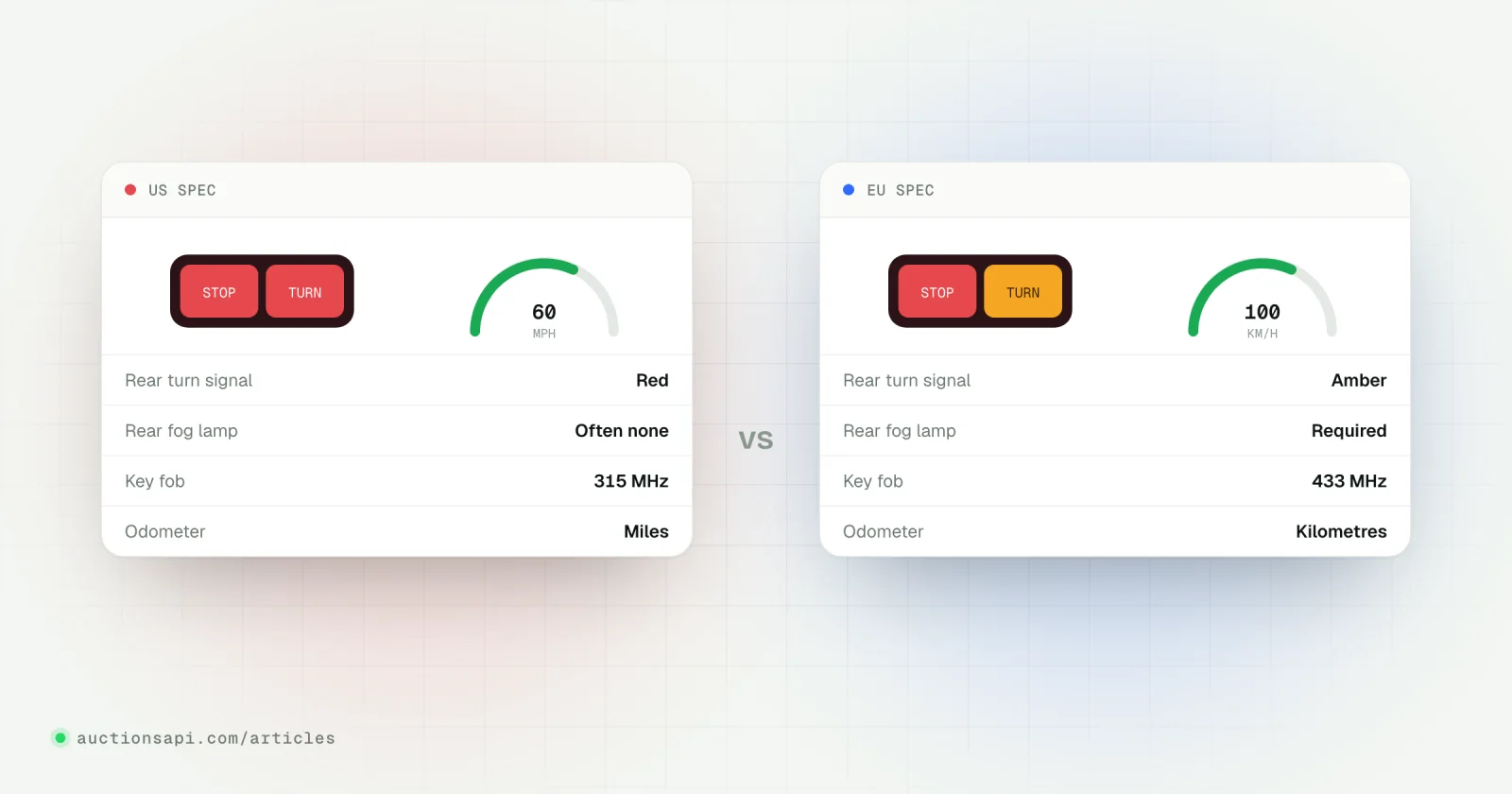
US spec vs EU spec comes down to this: a car built for the American market meets US federal standards (FMVSS and EPA rules), not the EU type approval and UN regulations, so after import it usually needs changes before it can be registered. The usual list is lighting (red rear indicators, side markers, no rear fog lamp, a US headlight beam pattern), a speedometer that must show km/h, emissions paperwork for an engine that was never approved in Europe, and a set of electronics tuned to US frequencies and map regions. Most of it is fixable; a few items decide whether the car is worth importing at all.
The same model name does not mean the same car. A US Passat and a European Passat are different vehicles, while a US Ford Fusion is the European Mondeo under another badge. Knowing which is which tells you how hard parts will be to find.
Below is what differs, why an inspector cares, and the usual fix. Rules are national and change, so treat this as the map and let your local inspection body or homologation specialist confirm the details for your car.
Key takeaways
- A US-market car has no EU certificate of conformity, so most countries register it through an individual approval that checks it against EU rules item by item.
- Lighting is the most common conversion: amber rear indicators, a rear fog lamp, side markers and headlights with a European beam pattern.
- Miles on the dashboard are fine as long as km/h is shown too; the odometer history in miles stays part of the car's record.
- Key fobs, TPMS sensors, FM tuning steps and navigation maps are set for the US and may need new parts or dealer coding.
- Many US models are European cars under another name, which makes parts easy; US-only models and engines are the expensive ones to keep running.
Why a US-spec car is not an EU-spec car
In the US, manufacturers certify their own cars against the Federal Motor Vehicle Safety Standards and US emissions rules, and put a certification label on the door pillar to say so. In the EU a car is type-approved before sale, mostly against UN ECE regulations, and every new car leaves the factory with a certificate of conformity (CoC) that registration offices accept without further checks.
A car built for the US has no EU CoC, and the manufacturer will not issue one for a vehicle that was never type-approved in that form. So in most EU countries an imported US car goes through an individual approval: an inspector or technical service checks it against the requirements one by one and issues the papers that stand in for the CoC. The framework is in Regulation (EU) 2018/858, which allows individual approvals at national and EU level; how strict each country is, and which US documents it accepts as evidence, differs a lot.
That is the practical difference between the two specs. It is rarely about quality. It is about a car that has to prove, part by part, that it meets rules it was never designed for.
US spec vs EU spec: the differences at a glance
| Difference | Why it matters in the EU | Usual fix |
|---|---|---|
| Red rear indicators | EU rules require amber rear direction indicators | Amber bulbs or LEDs in a separate lamp section, EU tail lights, or a converter module |
| Side markers | Red rear markers and markers wired as indicators are often refused | Disable, replace with amber or reflectors, or fit EU parts |
| No rear fog lamp | A rear fog lamp is mandatory on EU cars | Activate an existing unit by coding, or fit an approved lamp and switch |
| Headlight beam pattern | US low beam lights up signs and oncoming drivers differently | EU headlamps; xenon and some LED units also need levelling and washers |
| Speedometer in mph | The speedometer must show km/h | Switch the cluster to metric, dual-scale dial or EU cluster |
| Emissions approval | The engine was certified for US rules, not a Euro standard | Emissions test or documents during individual approval |
| TPMS sensors and key fobs | Often 315 MHz instead of 433 MHz | Keep as is where accepted, or replace sensors and keys |
| FM radio and maps | US tuning steps and US map region | Dealer coding for region, new map data, or a different unit |
| Glazing marks | Inspectors may look for E-marks on glass | Usually accepted as is; E-marked glass when a pane is replaced |
| VIN and type plate | No EU type-approval plate | A plate or record issued with the individual approval |
Lighting: indicators, side markers, fog lamp and headlights
Lighting is where nearly every US car fails its first European inspection, and it is also the part people underestimate, because modern lamps are sealed units with LEDs and the car's computer watches every circuit.
Rear indicators
Many US cars flash the red brake or tail lamp as the turn signal. In the EU rear indicators must be amber. On a car with a separate clear or amber section in the tail lamp, the fix can be an amber bulb and some wiring. On a car with one red lamp doing everything, you either fit the European tail lights (if the model was sold in Europe) or install a separate amber lamp and a module that splits brake and indicator signals. On recent cars the body computer may report a fault when the load changes, so add coding to the budget.
Side markers and reflectors
US cars have amber markers at the front corners and red ones at the rear, and on many models the front markers flash with the indicators. Rules on side markers in Europe are narrower, and inspectors in several countries ask for the rear red markers to be disabled or replaced. A US bumper often has the marker moulded into it; the cleanest fix is a European bumper or a blank, the cheapest is a disabled lamp.
Rear fog lamp
A rear fog lamp is mandatory on European cars and absent from most US ones. Some US cars share the tail lamp housing with the European version and have an empty socket or a lamp that only needs to be activated in software; others need an approved lamp mounted under the bumper, a switch and a tell-tale on the dashboard.
Headlights
US and European low beams have different light patterns. A European headlamp has a sharp cut-off with a step that lights the near-side kerb and keeps light out of oncoming eyes; US units throw more light upwards, for overhead signs. Inspectors check the pattern on a beam setter. Swapping for European headlamps is the usual answer when the model was sold in Europe. Xenon and powerful LED headlamps in the EU also need automatic levelling and, in many cases, headlamp washers, which US versions often lack.
One more detail: on some US cars the front indicators stay lit as running lights. That function is not allowed in Europe and usually has to be switched off.
Speedometer and odometer in miles
European rules require the speedometer to show km/h. A dual-scale dial passes; a mph-only dial does not. Many digital clusters can be switched to metric in the settings menu or by a dealer tool, and that is often enough. Analogue mph-only clusters need a replacement dial face or a European cluster, and a cluster swap must keep the true mileage, which some countries record at the first inspection.
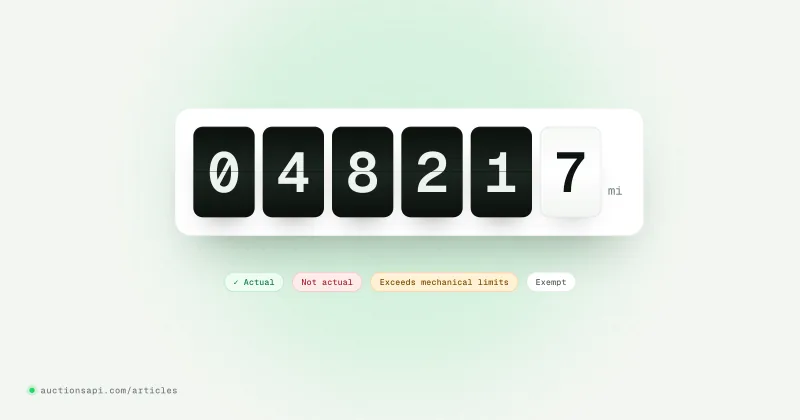
The odometer reading itself stays in miles in the car's history. US title records, auction listings and history reports all use miles, and an auction lot also shows an odometer status such as actual, not actual or exceeds mechanical limits. Read odometer brands before buying: a car with a "not actual" reading carries that doubt into its European papers, and some registration offices note the converted figure only.
Emissions, engines and catalytic converters
A US car is certified against EPA rules (and in some states California's), not a Euro emissions standard. The two systems measure in different ways, so a US certificate does not translate directly into a Euro class. During an individual approval the technical service may test the exhaust, accept manufacturer documents for a related European version, or ask for both. The answer decides the car's emissions class, and in many countries that class drives registration tax, city access zones and insurance.
The engine matters too. Plenty of US models use engines that were never offered in Europe: large V8s in pickups and muscle cars, naturally aspirated V6s in family sedans, specific turbo petrol tunes. They run perfectly well in Europe, but there is no European emissions data for them, and taxes based on displacement or CO2 can be high. A 5.7-litre V8 that costs little to register in Texas can cost a lot every year in a country that taxes engine size.
Hardware differs in smaller ways. Many European petrol cars with direct injection have a gasoline particulate filter that the US version does not. Catalytic converters on US cars are built for US rules and fuels, and a replacement sourced in Europe for the same model may not fit the US exhaust. On damaged auction cars, check whether the converter is still there: they are a common theft target in the US, and a missing one turns into an expensive part with an approval sticker you need.
Electric cars and plug-in hybrids
US electric cars use the CCS1 and J1772 sockets, and recent models increasingly use Tesla's NACS socket. Europe uses Type 2 and CCS2. Adapters exist for slow AC charging; fast DC charging on a US socket in Europe is limited, and converting the inlet is a job for a specialist who knows that model. Check also whether the car's on-board charger handles three-phase AC, which many European chargers provide and US cars usually do not use.
Keys, TPMS, radio and navigation
The electronics are set for the US market at the factory, and the region shows up in four places.
- Key fobs and keyless entry. US cars commonly use 315 MHz remotes, European ones 433 MHz. The car works in Europe, but a lost or missing key has to be a US-frequency key, and whether a 315 MHz transmitter may be used is a question of national radio rules. Many auction cars come with no key at all, so budget for a key that is programmed for that market.
- Tyre pressure sensors. Like the keys, US sensors are often 315 MHz, though some recent models use 433 MHz or dual-band sensors. When you replace tyres or a damaged wheel, order sensors for the US frequency or replace the full set and the receiver where that is possible.
- FM radio and DAB. US FM stations sit on odd decimals (88.1, 88.3…), and many US head units tune in 200 kHz steps. A European station on 98.0 or 101.4 may simply be unreachable until the unit is switched to the European region, which some brands allow through dealer coding. US cars have no DAB digital radio; they use HD Radio, which Europe does not broadcast.
- Navigation and connected services. The map region is US, and many systems refuse European map data until the region is changed. Telematics, emergency call and app services are often tied to a US mobile contract and stop working. Treat navigation as a bonus if it can be recoded, not as a feature you paid for.
EU cars of recent type approval also carry eCall, the automatic emergency call system. Imported used US cars do not have it; most countries do not require retrofitting for an individual approval of a used vehicle, but ask, because rules for recent cars are tightening.
Child seats, glazing and the VIN plate
Some differences sound worrying and usually are not. US cars have LATCH anchors for child seats; the lower anchors are the same bar size and spacing as ISOFIX, so ISOFIX seats normally fit, and the top tether points are similar. Check the owner's manual for the positions, since some US cars have anchors on more seats than the European version.
Glass is marked differently: US panes carry DOT and AS markings, European ones an E-mark. Most inspectors accept original US glass, but if the windscreen was broken in the accident (common on auction cars), fitting an E-marked replacement saves an argument later. Mirrors are similar: the US passenger mirror is convex with the familiar warning text, which is generally accepted.
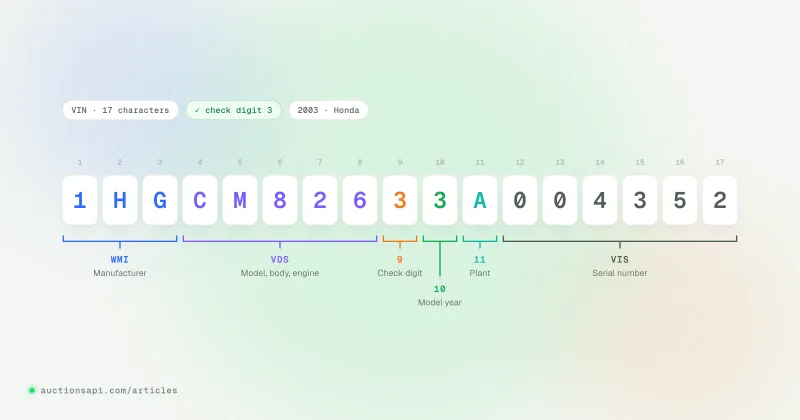
The VIN is the same 17-character format on both sides, but the plates differ. A US car shows its VIN through the windscreen and on the door-pillar certification label. A European car also has a manufacturer's statutory plate with the type-approval number and permitted weights. A US import has no type-approval number to show, so the individual approval provides the missing data and in some countries a plate is fitted. How to read the VIN itself is covered in how to decode a VIN.
The first character of the VIN also says where the car was built: 1, 4 or 5 for the United States, 2 for Canada, 3 for Mexico. That is not only trivia. Since July 2026 the EU applies a zero customs duty to many goods of US origin, including vehicles, provided the origin is proven; a US-sold car built in Japan, Mexico or Germany does not qualify for that. Customs duty on a car imported to the EU goes through it.
The same car under a different name
A large share of US auction cars are European models with an American badge or name. For an importer that is good news: lights, bumpers and many body parts exist in European versions, and a local workshop knows the car. The opposite also exists: models that share a name but are different cars.
| US name | Sold in Europe as | Notes |
|---|---|---|
| Ford Fusion (2013–2020) | Ford Mondeo | Same generation; US lights and bumpers differ |
| Ford Escape (2013 onwards) | Ford Kuga | Same platform and body across two generations |
| Nissan Rogue (2014 onwards) | Nissan X-Trail | Same generations; engines differ by market |
| Honda Fit | Honda Jazz | Same car, different name |
| Mitsubishi Outlander Sport | Mitsubishi ASX | Same car, different name |
| Subaru Crosstrek (before 2023) | Subaru XV | Europe adopted the Crosstrek name with the 2023 generation |
| Buick Encore (2013–2022) | Opel / Vauxhall Mokka | First-generation Mokka |
| Buick Regal (2018–2020) | Opel / Vauxhall Insignia | Second-generation Insignia |
| Chevrolet Sonic | Chevrolet Aveo | Sold in Europe until Chevrolet left the market |
| Chrysler Town & Country | Lancia Voyager | The 2011–2015 Lancia version |
| Toyota Corolla iM / Scion iM | Toyota Auris | Hatchback sold in the US for a few years |
| Hyundai Elantra GT | Hyundai i30 | The hatchback, not the Elantra sedan |
| Volkswagen Tiguan (2018 onwards) | Volkswagen Tiguan Allspace | The long-wheelbase version |
| Volkswagen Passat (2012–2022) | No equivalent | A US-built Passat, a different car from the European one |
| Honda Accord (US) | No equivalent | Larger than the Accord once sold in Europe |
"Same car" means the same platform and body, not identical parts. A Fusion and a Mondeo share doors and glass, but the US headlamps, bumpers, cluster and engine may not be what a European parts catalogue offers. Order parts by VIN through a dealer or a catalogue that knows the US version.
US-only models (big pickups, many SUVs, American sedans) are fine to own but slower and dearer to repair. Body panels come from the US, by post or in the next container. Factor that in when the car is a repair project, which most auction cars are.
Which US cars convert easily and which do not
- Models sold in Europe under the same or another name
- Cars with separate amber rear indicator sections
- Digital clusters that switch to km/h
- Halogen headlights with a European replacement available
- Petrol engines also offered in the European version
- US-only models with sealed red rear lamps
- Xenon or LED headlamps without levelling or washers
- Large engines in countries with displacement or CO2 tax
- Recent cars where lighting changes trigger fault codes
- Cars with a missing key, missing catalytic converter or flood history
In practice, buyers who import regularly shortlist models from the left column and check one thing before anything else: whether European tail lights and headlamps for that exact generation exist and fit. If they do, most of the conversion is bolt-on work. If they do not, get a written quote for the lighting before you commit to the car.
What to check before buying a US-spec car
- Decode the VIN to confirm the model, engine and plant. NHTSA's free decoder covers US-market cars well; see the vPIC API guide.
- Find out whether the model was sold in Europe, and under what name.
- Look at the tail lamps and headlamps in the photos: separate amber sections and halogen lamps make life easier.
- Check the engine against your country's registration tax rules before setting your price.
- Ask a local inspection station or homologation specialist what they will require for this exact model, and what it usually costs.
- Add keys, sensors and radio or map coding to the repair budget for an auction car.
If you shortlist cars from auction data rather than one listing at a time, the decoded fields make the first filter easy: our Copart and IAAI API returns make, model, engine, fuel and drive type for each vehicle, with VIN-based specifications from the US government's vPIC filled in where the source leaves them blank. The spec questions above still need someone to look at the photos and a written answer from your inspection body. For the rest of the route from a US lot to your driveway, see buying a car from a US auction and shipping it overseas.
Questions people ask
What is the difference between US spec and EU spec cars?
US-spec cars are built to US federal safety and emissions standards; EU-spec cars are type-approved under EU and UN regulations. In practice the US version differs in lighting (red rear indicators, side markers, no rear fog lamp, a different headlight pattern), mph instruments, emissions certification, radio and key frequencies and map region. In Europe a US car usually needs an individual approval and some conversion work before registration.
Can I register a US-spec car in Europe?
Usually yes, through an individual vehicle approval, since a US car has no EU certificate of conformity. The inspector checks lighting, instruments, emissions, noise and other items against EU rules, and the car often needs changes first. Requirements and costs differ by country, so ask your local inspection body what they need for the exact model before you buy.
Do I have to change red rear turn signals on a US car?
In the EU, rear direction indicators must be amber, so red flashing tail lamps are not accepted. Depending on the car, the fix is an amber bulb in a separate lamp section, European tail lights for that model, or an extra amber lamp with a converter module. On recent cars the body computer may need coding so the change does not trigger fault messages.
Do US car keys work in Europe?
The keys work, because the car and the key talk to each other wherever they are. The issue is replacement: US cars commonly use 315 MHz remotes and TPMS sensors, while European cars use 433 MHz, so new keys and sensors must match the US version. Whether a 315 MHz transmitter may be used is set by national radio rules.
Is a Ford Fusion the same as a Ford Mondeo?
The 2013–2020 Ford Fusion and the Mondeo of the same period are the same generation on the same platform, sold under different names. Body panels, glass and many mechanical parts are shared, but US headlights, tail lights, bumpers, instruments and some engines differ, so parts should be ordered by VIN rather than by model name.