 English
Customs duty and VAT on a car imported into the EU from the USA
Customs duty on cars from the USA into the EU: 10%, or 0% for US-built cars since July 2026, how customs value and VAT work, national taxes, a worked example.
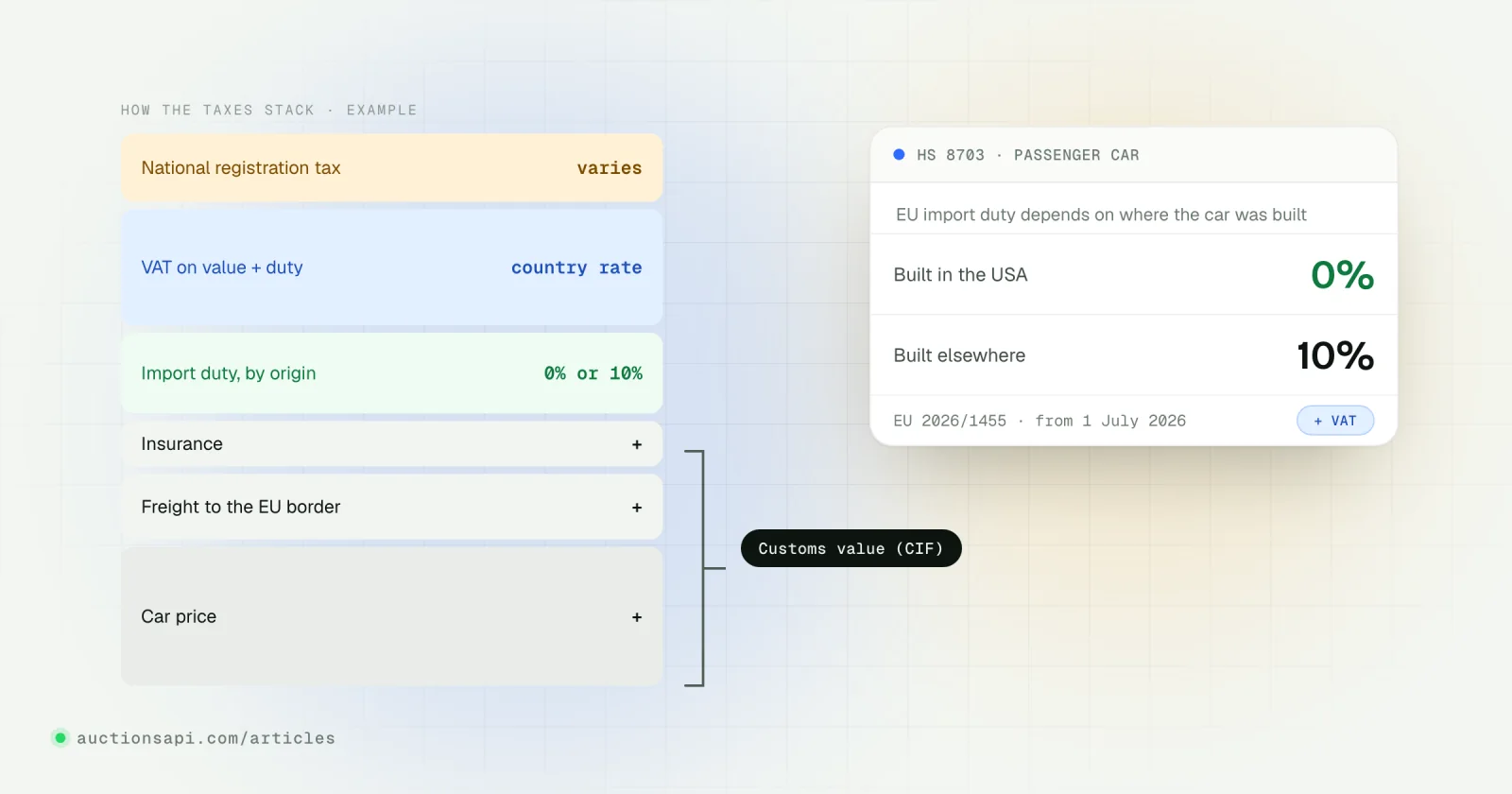
Customs duty on cars from the USA into the EU is 10% of the customs value under the standard third-country rate for passenger cars, but since 1 July 2026 a car that was built in the United States can enter at 0% if the importer proves its US origin and its direct shipment to the EU. On top of any duty you pay import VAT at the rate of the country where the car is cleared, calculated on the customs value plus the duty, and then whatever registration or excise tax that country adds. The customs value is the price paid for the car plus transport and insurance up to the EU border.
So the same auction car can carry very different taxes depending on where it was assembled, which country you clear it in and how big its engine is. Below are the rates we checked in the EU's tariff database, how the value is built, the national layer on top, and a worked calculation with every assumption stated.
Rates and rules change, and your broker's customs office has the final word on classification, origin and value. Use this to understand the structure and to ask the right questions, not as a quote.
Key takeaways
- The EU's third-country duty is 10% for passenger cars, 22% for most used goods vehicles up to 5 tonnes and 6% to 8% for the motorcycles we checked.
- Since 1 July 2026, goods of US origin, cars included, can enter at 0% duty, but only with evidence of US origin and of direct transport to the EU.
- Origin means where the car was built, not where it was bought: a US-assembled Toyota can qualify, a Japan-built Lexus bought in Texas cannot.
- Import VAT is charged on the customs value plus duty (and plus any import excise), at the rate of the country where the car is cleared.
- National taxes such as Poland's excise come on top, so ask a customs broker for a written calculation for the exact car before you buy it.
Customs duty on cars from the USA: the EU rates
The EU has one customs tariff for all member states, so the duty rate is the same whether you clear the car in Rotterdam, Klaipėda or Constanța. What decides the rate is the car's tariff classification (its CN code) and its origin. We looked up the codes below in TARIC, the EU's tariff database, for imports from the United States on 1 October 2026:
| Vehicle | Tariff heading | Third-country duty | US-origin rate since 1 July 2026 |
|---|---|---|---|
| Passenger cars: petrol, diesel, hybrid, electric (the used-car codes we checked) | 8703 | 10% | 0% with proof of US origin |
| Goods vehicles up to 5 t, used, petrol or diesel (many pickups and vans) | 8704 | 22% | 0% with proof of US origin |
| Motorcycles 500–800 cc and over 800 cc | 8711 | 6% | 0% with proof of US origin |
| Scooters 50–250 cc | 8711 | 8% | 0% with proof of US origin |
| Collectors' pieces of historical interest (some classic cars) | 9705 | 0% | 0% |
Two details catch buyers out. First, a pickup is not automatically a passenger car. Whether a double-cab pickup is a goods vehicle (8704) or a passenger car (8703) depends on its design, and the difference outside the US-origin rate is 22% versus 10%. Get the broker's classification in writing before you buy. Second, the duty is only the first layer: VAT and national taxes are calculated on top of it, so a 10% duty raises everything that follows.
The 0% rate for US-built cars since July 2026
Since 1 July 2026, Regulation (EU) 2026/1455 has cut the EU duty on a wide range of goods originating in the United States, vehicles included, to 0%. The Commission's trade portal announced it, and TARIC shows the 0% line next to the standard rate. For a car buyer, three words in that rule matter: originating, proof and directly.
Originating: where the car was built, not where it was sold
Origin here follows the EU's non-preferential rules: broadly, the country where the goods underwent their last substantial processing. For a car that is the country of final assembly. The brand does not matter and neither does the auction: a Toyota Camry assembled in Kentucky is a US-origin car, a BMW X5 from Spartanburg or a Mercedes GLE from Alabama too, while a Lexus built in Japan, a Volkswagen built in Mexico or a Honda built in Canada is not, even though all of them were sold new in the US and bought at Copart.
The first character of the VIN is the quickest check: 1, 4 and 5 mean a vehicle made in the United States (some recent US-built models use codes starting with 7), 2 Canada, 3 Mexico, J Japan, K South Korea, W Germany. It is a first filter, not proof; our VIN decoding guide explains the rest of the structure.
Proof: what the importer has to show
There is no standard certificate for this rate. According to the Commission's questions and answers on the rule, the importer must hold evidence that the goods originate in the US, and a bare "made in USA" statement, an origin line on an invoice or a certificate of origin is not enough on its own. For a used car, the evidence will usually be a combination of the VIN and the manufacturer's build data, the US title, the auction invoice and the transport documents. Exactly what a customs office accepts for a ten-year-old car bought at a salvage auction is new territory, so ask your broker what their office has accepted so far.
Directly: the shipping route counts
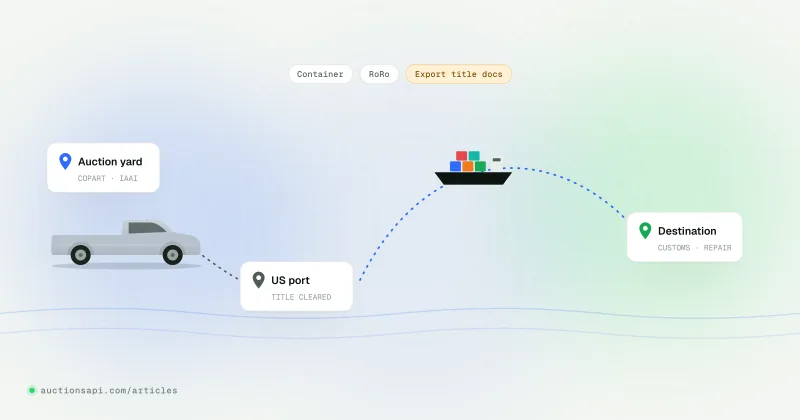
The same rule requires evidence that the goods travelled directly from the United States to the EU, or, if they passed through a third country, that they stayed under customs supervision and were not altered there. A bill of lading from a US port to an EU port covers the usual case, including transhipment in an EU hub such as Bremerhaven or Rotterdam. A route through a non-EU port needs documents that prove the car stayed under customs control; plan the route with your forwarder before the car is loaded, not after it arrives.
Cars built outside the US
A car built in Japan, South Korea, Mexico or Canada comes from a country that has its own trade agreement with the EU, but claiming that preference needs proof of preferential origin for the specific car, which a used car that spent years on US roads rarely has. In practice, plan on the standard 10% for these. Cars built in the EU and exported to the US are no exception either: when they come back they normally pay duty like any other import (see returned goods below).
How the customs value of an auction car is calculated
Duty and VAT are percentages, so the base they apply to matters as much as the rate. For almost every auction car, the base is the transaction value: the price actually paid for the car, adjusted by a set of rules. In the Commission's summary of those rules, the main points for a car buyer are:
| Item | In the customs value? | Notes |
|---|---|---|
| Sale price of the car | Yes | The amount on the auction invoice |
| Auction fees charged to the buyer | Usually yes | They are part of what you pay to acquire the car; confirm with your broker |
| Your own broker's fee | It depends | A buying commission is excluded, other commissions are included; how it is invoiced matters |
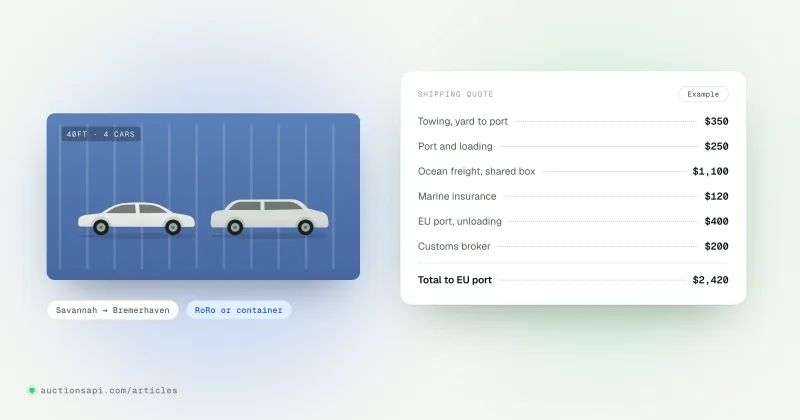
| Towing, loading, ocean freight, insurance up to the EU border | Yes | Apportioned by distance if one price covers a longer route |
| Transport after the car enters the EU | No | The truck from the port to your town |
| Duty and import taxes themselves | No | They are calculated on the value, not added to it |
Prices in dollars are converted at the exchange rate customs uses for that month, not your bank's rate. A damaged car with a low invoice may also be questioned: customs can ask why the price is low and, if not satisfied, value the car another way. The auction invoice, the lot's damage photos and its condition label are your answer. If customs asks, a record of the lot with its photos and final bid, which our Pay per VIN service returns for Copart and IAAI cars, helps show what the car was when it was sold.
Import VAT: the rate of the country where you clear
Import VAT is charged when the car is released for free circulation, at the standard rate of that member state. The base is the customs value plus the duty, plus other taxes and charges due by reason of the import (an import excise, for example) and incidental costs such as transport up to the first place of destination in the EU, where they are not already in the customs value.
Standard rates differ by country. On the Your Europe VAT rates page (last updated in July 2026) Germany shows 19%, Bulgaria 20%, Lithuania, Latvia, Romania, the Netherlands and Belgium 21%, and Poland 23%. A private buyer pays it as a final cost. A VAT-registered business that imports cars for resale can normally deduct import VAT, which is why dealers' calculations look so different from private buyers'.
Clear the car in the country where it will be registered unless your broker has a good reason not to. Clearing in the port country and then driving the car to another member state can create a second round of paperwork, and registration offices check that VAT was paid.
Registration taxes and excise: the national layer
Duty is set by the EU and VAT follows EU rules, but taxes on cars themselves are national, and they differ more than anything else in this article. The common patterns are:
- A one-off excise or registration tax at import or first registration, based on engine capacity, CO2 emissions, fuel type, value or age.
- No one-off tax, but an annual road or ownership tax based on CO2, engine size or weight.
- Fixed fees for registration, plates and the technical inspection, which every country has in some form.
Poland is a clear example of the first kind. According to the Polish tax administration's excise rates page, passenger cars with an engine over 2,000 cm³ pay 18.6% excise and other passenger cars 3.1%, with lower rates for hybrids (1.55% up to 2,000 cm³ and 9.3% between 2,000 and 3,500 cm³). The excise is declared and paid before registration, and the registration office asks for proof. A 2.5-litre petrol sedan therefore pays about 15 percentage points more excise in Poland than the same car with a 2.0-litre engine.
Other countries use CO2 or age instead, and several have changed their rules for imported cars in recent years. A US car often has no EU-standard CO2 figure, which can make a CO2-based tax harder to calculate; ask how your country handles that before buying.
A worked example: the same sedan with and without US origin
Here is the arithmetic for one hypothetical car cleared in Poland: a 2.5-litre petrol sedan (non-hybrid). All amounts are assumptions to show the structure, not prices or official calculations. We assume €12,000 paid for the car including auction fees, and €1,500 for towing, ocean freight and insurance to the EU border. We assume the Polish excise is calculated on the customs value plus duty and that it enters the VAT base, and we leave out port charges and fees to keep the sums readable. Confirm each assumption with your broker.
| Step | US-built, origin proven | Built elsewhere, or origin not proven |
|---|---|---|
| Price incl. auction fees (assumption) | €12,000 | €12,000 |
| Freight and insurance to the EU border (assumption) | €1,500 | €1,500 |
| Customs value | €13,500 | €13,500 |
| Duty | 0%: €0 | 10%: €1,350 |
| Excise, 18.6% of value plus duty | €2,511.00 | €2,762.10 |
| VAT, 23% of value plus duty plus excise | €3,682.53 | €4,050.78 |
| Import taxes in total | €6,193.53 | €8,162.88 |
The duty difference is €1,350, but the total difference is almost €2,000, because duty also raises the excise and VAT that are calculated on top of it. The same car in a country with 21% VAT and no import excise would pay €2,835 with proven US origin and €4,468.50 without (€1,350 duty plus 21% of €14,850). That is the chain to keep in mind: every layer is a percentage of everything before it.
Classic cars, moving house and returning EU cars
Classic cars. Collectors' pieces of historical interest fall under tariff heading 9705, which shows 0% duty in TARIC. A car qualifies only if it meets the criteria customs applies to collectors' vehicles, which typically look at its age (commonly 30 years or more), whether it is in original condition without substantial changes, and whether the model is still produced. Several member states also apply a reduced VAT rate to imports of collectors' items. Both are decided case by case; our classic car import article covers it in more detail.
Moving house. People who move their residence to the EU can usually bring a car they have owned and used abroad for a minimum period without duty or VAT. That relief is for personal belongings, not for a car bought at auction to import.
Returning EU goods. Returned goods relief can exempt goods that were exported from the EU and come back unchanged, within three years and normally for the person who exported them. A German-built car that was sold new in the US and later bought at Copart does not fit that description, so it pays duty like any other import.
What to ask your customs broker before you buy
A short written answer to these questions, for the exact car, is worth more than any online calculator:
- Which 10-digit code will you declare, and for a pickup, will it be a goods vehicle or a passenger car?
- Will you claim the US-origin rate, and what evidence does your customs office want for a used car?
- Is the planned shipping route direct to the EU, and if not, how is customs supervision proven?
- Which costs go into the customs value, and how is a through-freight price split at the EU border?
- Which VAT rate and which national taxes apply in the country where we clear, and on what base?
- What are your fees, and how long does clearance usually take at that office?
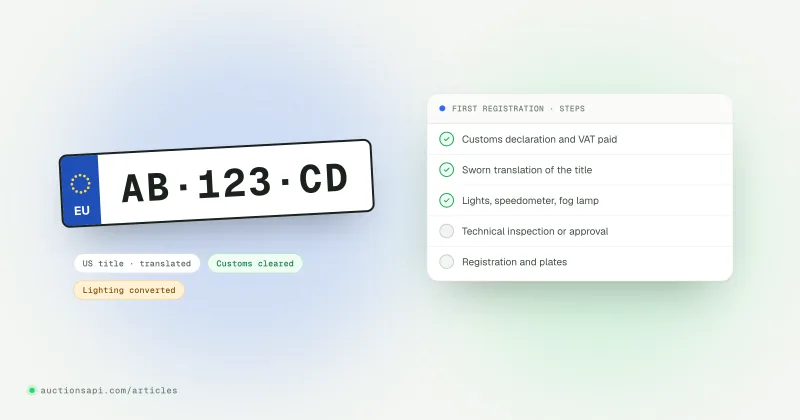
Then put the answers next to your price limit, the shipping quote and the repair estimate. If the numbers still work, the last step is the technical inspection and registration, covered in registering a US car in Europe.
Questions people ask
What is the customs duty on cars from the USA to the EU?
The EU's standard third-country duty for passenger cars is 10% of the customs value. Since 1 July 2026, cars of US origin, meaning built in the United States, can enter at 0% if the importer proves that origin and direct transport to the EU. Cars built elsewhere and bought in the US pay the 10%. VAT and national taxes come on top.
Do I pay VAT on a car imported from the USA?
Yes. Import VAT is charged in the member state where the car is cleared, at that country's standard rate, for example 19% in Germany, 21% in Lithuania or Romania and 23% in Poland. The base is the customs value plus duty and other import taxes. Private buyers cannot reclaim it; VAT-registered businesses usually can deduct it.
Is shipping included in the customs value of a car?
Transport, loading and insurance up to the point where the car enters the EU are part of the customs value, so duty and VAT are charged on them too. Transport after entry, such as the truck from the port to your home, is not part of the customs value, although incidental costs to the first destination can enter the VAT base.
How do I prove a car was made in the USA for the 0% duty?
There is no standard certificate. The importer needs evidence of US origin, such as the VIN and manufacturer build data, together with documents showing direct transport from the US to the EU, such as the bill of lading. A simple "made in USA" statement is not enough on its own. Ask your customs broker what their office accepts for used cars.
Is a pickup truck taxed as a car or a truck in the EU?
It depends on the vehicle's design. A pickup classified as a goods vehicle under heading 8704 carries a 22% third-country duty, while a passenger car under 8703 carries 10%; with proven US origin both can be 0%. Double-cab pickups are the usual grey area, so get your broker's classification in writing before buying.