 English
How to ship a car from the USA to Europe: costs and transit times
How to ship a car from the USA to Europe: every line of a quote, what moves the price, US and EU ports, realistic transit times and a worked cost example.
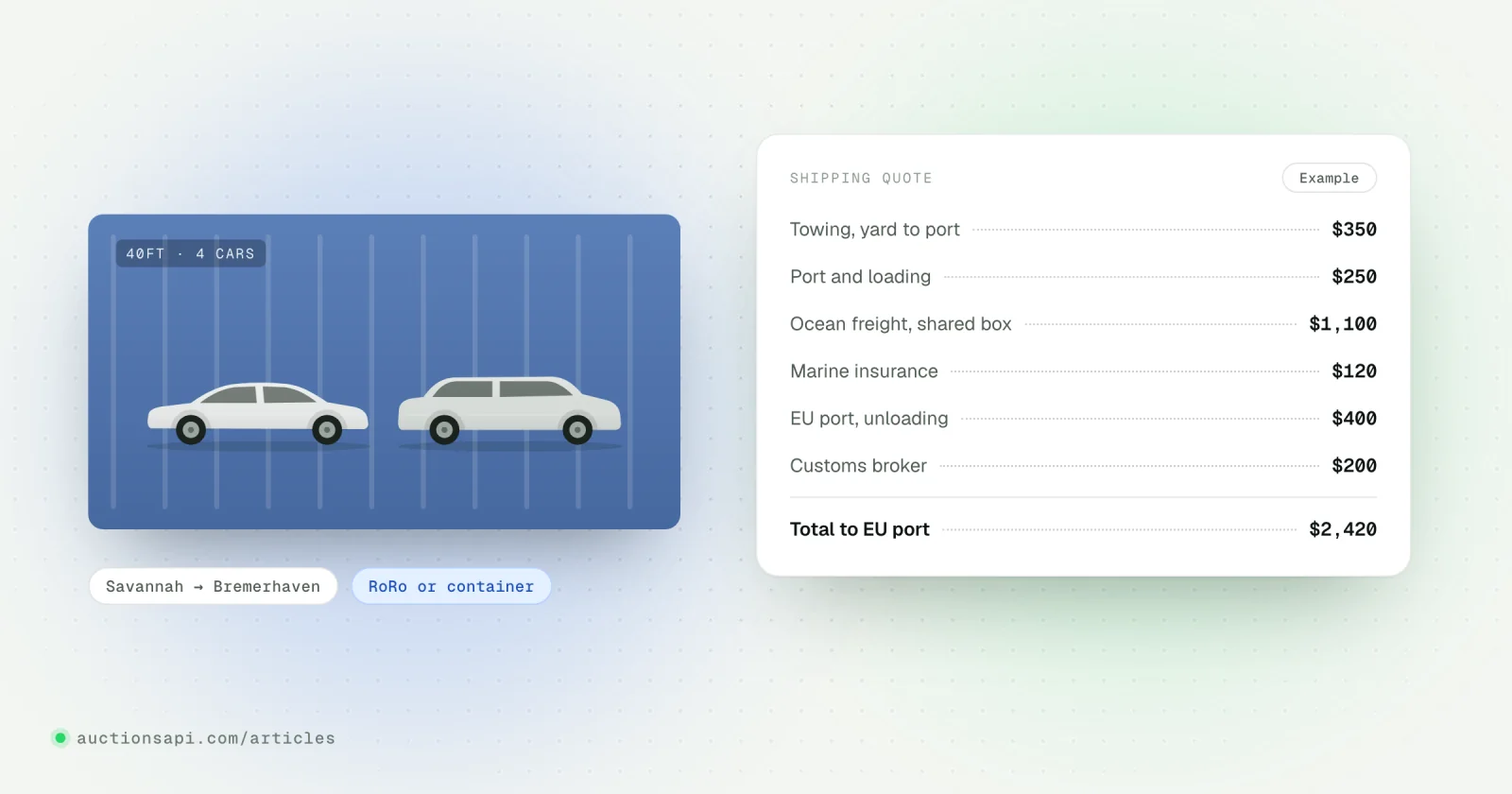
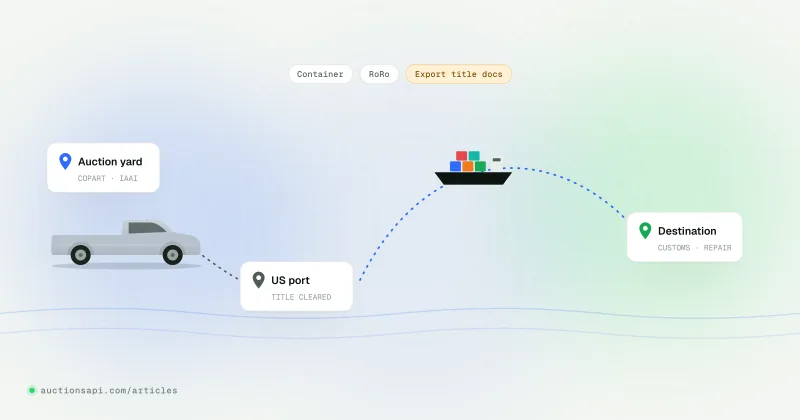
To ship a car from the USA to Europe you pay for a chain of separate services: a truck from the auction yard to a US export port, handling and loading at that port, ocean freight in a shared 40-foot container or on a RoRo vessel, marine insurance, and then unloading, terminal fees, a customs broker and a truck home on the European side. From the yard to a European port, four to eight weeks is a common range for an auction car, and the two things that move the bill most are how far the yard is from the port and whether the car rolls and steers.
Each of those lines is priced by a different company, so two quotes for the same car can look very different. Below we take a quote apart line by line, list what pushes each line up, go through the ports most US-to-Europe car traffic uses, and finish with a worked example in which every number is an assumption you replace with your own quotes.
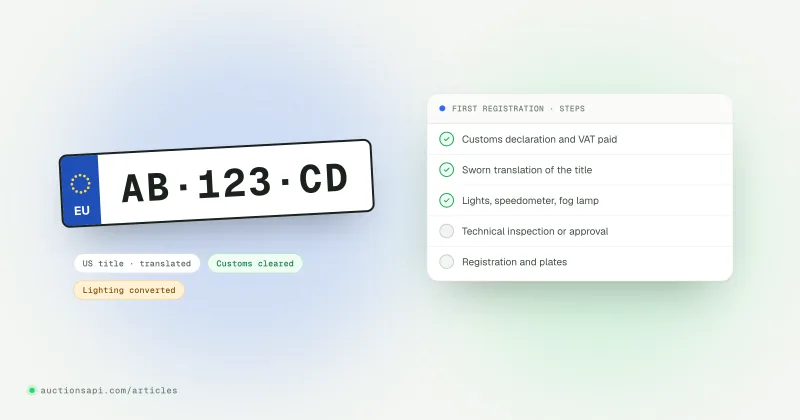
Buying the car, brokers and the US title rules are covered in our step-by-step import article. Duty and VAT on arrival have their own article.
Key takeaways
- A shipping quote is a stack of separate lines: inland towing, export handling, ocean freight, insurance and destination costs, each from a different provider.
- Distance from the yard to the port and a car that does not roll or steer change the price more than the choice of European port.
- A shared 40-foot container is the usual way to move damaged auction cars; RoRo needs a car that drives on and off.
- Ocean transit is only part of the time: inland pickup, the wait for the title and the next sailing often add as much again.
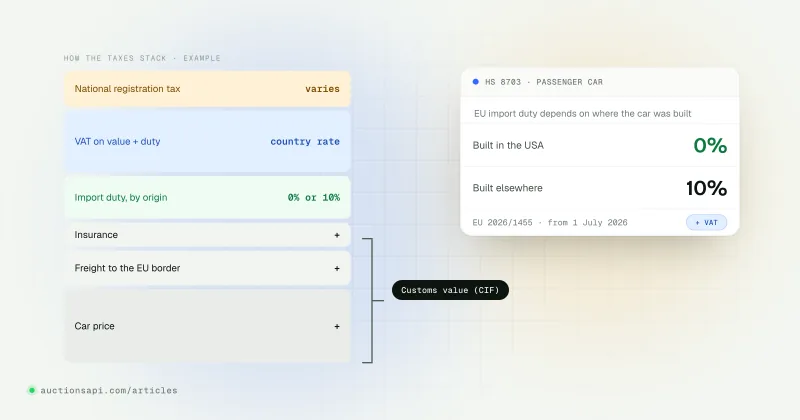
- Freight and insurance up to the EU border count towards the customs value, so they also raise the duty and VAT you pay.
What it costs to ship a car from the USA to Europe
There is no single price to ship a car from the USA to Europe, because nobody sells the whole trip as one product. Your forwarder (the company that books the container and handles the export paperwork) adds its own margin to the parts it buys from others and passes on the rest. A complete quote has these parts, roughly in the order the car meets them:
- Inland transport in the US: a car carrier truck, or a tow truck for a car that does not move, from the yard to the forwarder's export warehouse near the port.
- Export handling: receiving the car, photos, loading and strapping it into a container (or delivering it to the RoRo terminal), and the US export filing.
- Ocean freight: your share of a container, or the RoRo rate for the car, from the US port to the European port.
- Marine insurance: optional but sensible, priced as a percentage of the value you insure.
- Destination port costs: unloading the container, terminal handling and any storage after the free days.
- Customs clearance: the broker's fee for the import declaration, plus the duty and VAT themselves, which are taxes, not shipping.
- Transport home: a truck from the port to your town, or to another country if the car continues by road.
When you compare offers, ask every forwarder to fill in the same lines, and ask which ones are fixed and which ones are "estimated". Destination costs and inland towing are the lines most often left vague, and the ones that grow later.
The lines on a shipping quote, one by one
| Line | Who charges it | What moves it |
|---|---|---|
| Towing to the export warehouse | US carrier booked by the broker or forwarder | Distance, a car that does not roll or steer, remote yards, how soon you want pickup |
| Yard storage | The auction | Late payment or late pickup after the free storage days end |
| Export handling and loading | Forwarder or its warehouse | Container or RoRo, size of the car, extra photos, removing personal items or loose parts |
| Export filing | Forwarder | Usually a fixed fee; a missing title stops everything here |
| Ocean freight | Shipping line, through the forwarder | Route, direct or transhipped, season, fuel and emissions surcharges, how many cars share the box |
| Marine insurance | Insurer, through the forwarder | Insured value and cover type (total loss only or wider) |
| Unloading and terminal handling | Port terminal and the forwarder's agent | Port, container or RoRo, storage after free days |
| Customs broker | Broker in the country where you clear | Clearing at the port or after a transit, complexity of the declaration |
| Truck home | European carrier | Distance, a car that does not drive, a border to cross |
Two lines are not shipping at all but sit on the same invoice: the auction's storage fees, which keep running while a car waits for a truck or a title, and the taxes paid at import. Keep them apart in your own spreadsheet, so a cheap freight rate does not hide an expensive delay.
What makes one quote higher than another
Distance from the yard to the port
Copart and IAAI have yards across the whole country, and the car has to reach a port your forwarder loads from. A yard a short drive from New Jersey or Savannah costs little to clear; a yard in the middle of the country can cost several times as much and take a week or two longer, because the truck has to fill a load going in the right direction. When two similar lots are on offer, the one closer to a good export port is often the cheaper car once it is in Europe.
A car that does not move
A car that rolls, steers and brakes can be driven or pushed onto a carrier. One that does not (seized wheels, a broken suspension arm, no key for a steering lock) needs a winch, a forklift or a flatbed, both at the yard and at the warehouse. Carriers charge for that, and some refuse. The lot's condition label (run and drive, engine starts, not checked) and its damage photos tell you what to expect; our article on damage types explains what the labels really mean.
Size of the car
Freight is priced per container or per cubic metre, so size matters more than weight. A 40-foot container usually takes three or four cars, sometimes more with loading racks; a full-size pickup or a long van takes the space of more than one sedan. Expect a large SUV or pickup to carry a higher share of the container, and for RoRo, a rate based on the car's dimensions.
Route, season and surcharges
A direct sailing from the US East Coast to a North Sea port is the simplest route. Cars for the Baltic or the Black Sea are often transhipped in a hub such as Bremerhaven, Rotterdam or Antwerp, which adds a handling step and time. Ocean rates also move with the container market, and many quotes carry separate fuel surcharges, peak-season surcharges and, for shipments to Europe since the EU emissions trading system was extended to shipping in 2024, an emissions surcharge from some carriers. Ask whether the ocean rate you are given includes them.
Waiting
The cheapest freight rate is worth little if the car waits. A car cannot be exported without its original title, so a slow title from an insurance seller means storage at the yard or at the warehouse. A forwarder that ships from your port once a week will also make a car wait less than one that consolidates a container every two or three weeks.
US export ports for cars going to Europe
Forwarders that ship auction cars to Europe consolidate in a handful of ports. Which one your car goes to depends mostly on the yard's location and on the routes your forwarder runs:
- New Jersey (Newark and Elizabeth) and the wider New York area: the main gateway for the Northeast and a large share of transatlantic sailings.
- Baltimore: a large RoRo port, used for cars from the Mid-Atlantic.
- Savannah, and Charleston for some forwarders: the Southeast, with a dense network of Copart and IAAI yards nearby.
- Houston: Texas and the South Central states.
- Los Angeles and Long Beach: California and the West. Ships to Europe go through the Panama Canal, so transit is longer.
- Miami and other ports: used by some forwarders for Florida yards.
Before export, US Customs and Border Protection wants the original title (or a certified copy) plus two copies, and for ocean shipments the documents and the vehicle must be presented at least 72 hours before export, as set out on the CBP motor vehicle export page. Your forwarder handles this, but the title has to reach them first.
Arrival ports in Europe and where the cars go next
The European port is often not in the buyer's country. The choice depends on sailings, transhipment, port costs and where the car will be cleared through customs:
| Port | Country | Commonly used for |
|---|---|---|
| Bremerhaven | Germany | One of Europe's largest car ports; Germany and onward trucking east and south |
| Rotterdam | Netherlands | Direct transatlantic container sailings; trucking across the EU |
| Antwerp-Bruges | Belgium | Container and RoRo; trucking across the EU |
| Hamburg | Germany | Container sailings and feeders to the Baltic |
| Klaipėda | Lithuania | Baltic states, Poland, and onward to Ukraine and further east |
| Gdynia and Gdańsk | Poland | Poland, often via a feeder from a North Sea hub |
| Constanța | Romania | Romania, Moldova, Bulgaria and Ukraine |
| Koper and Mediterranean ports | Slovenia and others | Some Balkan destinations, depending on the forwarder |
If you clear customs in a different country from the port, the car travels under a transit procedure (the forwarder or broker opens a transit declaration, usually T1, with a guarantee) to a customs office near you. This is common for buyers in Poland who use Klaipėda or Bremerhaven, and for Ukraine and Moldova, which are outside the EU and have their own import rules. A transit adds a fee and paperwork but keeps the car in the customs system until you are ready to pay the import taxes where you live.
How long shipping takes, step by step
- Days 0–3Payment and dispatchThe broker pays the auction and orders a truck; storage days are counting.
- Days 2–20Inland towingA few days from a yard near the port, two to three weeks from far inland or for a car that does not move.
- Days 5–30+Title in handNothing is exported without it. Insurance sellers are the usual source of delays.
- 1–2 weeksLoading and the next sailingThe container fills up, documents go to CBP at least 72 hours before export, the ship leaves.
- 2–6 weeksOcean transitShorter on direct East Coast sailings to the North Sea, longer with transhipment to the Baltic or Black Sea, or from the West Coast.
- 3–10 daysUnloading and customsThe container is unloaded, the car is declared, taxes are paid, the car is released or sent on in transit.
- 2–7 daysTruck homeFrom the port to your town, longer across a non-EU border.
The ocean leg is the part people ask about, and often the most predictable one. Ask your forwarder for the scheduled transit time of the specific route and the cut-off date of the next sailing. Then add the time you cannot control: the title and the truck.
A worked example: one sedan from a Copart yard to Klaipėda
The table below shows how the lines add up for one hypothetical car: a mid-size sedan that rolls and steers, bought at a yard about 150 km from the New Jersey port, shipped in a shared 40-foot container to Klaipėda and trucked to a town in Lithuania. Every amount is an assumption chosen to show the arithmetic, not a market price or a quote. Replace each one with the figures from your forwarder before you decide anything.
| Line | Assumed amount | What would change it |
|---|---|---|
| Towing, yard to export warehouse | $400 (assumption) | A yard far inland or a car that does not move |
| Export handling, loading, export filing | $350 (assumption) | RoRo instead of container; extra services |
| Ocean freight, a quarter of a 40-ft container | $1,100 (assumption) | Route, season, surcharges, fewer cars in the box |
| Marine insurance, 1.5% of $7,000 insured | $105 (assumption) | Insured value and type of cover |
| Unloading and terminal handling in Klaipėda | $300 (assumption) | Storage after free days |
| Customs broker | $150 (assumption) | Clearing in another country after a transit |
| Truck from the port to the buyer | $450 (assumption) | Distance, a border, a car that does not drive |
| Shipping total in this example | $2,855 | The sum of the assumed lines above |
Two things are worth noticing even with made-up numbers. First, the ocean freight is less than half of the total; the towing and the European side together are larger. Second, change one assumption, a car that does not steer in a yard 1,500 km from the port, and the towing line alone could become the largest item.
The freight and insurance up to the EU border also become part of the car's customs value, so they are taxed again at import: duty (where it applies) and VAT are calculated on the price of the car plus those costs. The truck from the port onward is not part of the customs value. The customs duty article shows that calculation with the same kind of stated assumptions.
Marine insurance and what it really covers
Forwarders usually offer cargo insurance as a percentage of the value you declare. Two questions matter more than the rate. Is the cover "total loss only" (the container goes overboard or the ship burns) or does it include damage in handling? And how does the policy treat a car that was already damaged when it was loaded? Many policies for salvage cars cover total loss only, and none will pay for damage that was there before.
That is why the photos taken at the export warehouse matter. Ask for them before the container is closed, keep the auction's lot photos, and compare both with the car when it is unloaded. A missing mirror or a new dent is far easier to claim with dated photos from both ends. Report anything at unloading, in writing, before you sign the delivery receipt.
Before you ask for shipping quotes
Get two or three forwarders to price the same car on the same lines, and give them what they need to answer properly:
- The yard's location and the lot's condition label (does it roll, steer and brake, is there a key).
- The car's make, model and size, and whether anything is loose or stored inside it.
- The European port you prefer, the country where you want to clear customs, and your final address.
- Whether the title is already with the auction or still pending from the seller.
- The value you want insured and the cover you want.
Then do the sum before sale day, not after: the price you expect to pay, the auction's fees, the full shipping stack, duty and VAT on the customs value, and the repair. If you set your price from what similar cars actually sold for (our article on Copart sold prices explains where final bids come from), the shipping lines are what decide whether the deal still works. Once the car has landed, the remaining steps are paperwork and inspection, covered in registering a US car in Europe.
Questions people ask
How much does it cost to ship a car from the USA to Europe?
It depends on the yard's distance from the port, whether the car runs, its size, the route and the destination port. A quote is a sum of inland towing, export handling, ocean freight, insurance and destination costs such as unloading, a customs broker and a truck home. Ask two or three forwarders to price the same car line by line before the sale.
How long does it take to ship a car from the US to Germany?
Ocean transit from the US East Coast to Bremerhaven or another North Sea port is usually around two to three weeks on a direct sailing, longer with transhipment or from the West Coast. Add inland towing in the US, the wait for the title and the next sailing, and unloading and customs in Germany: four to eight weeks from the auction yard is a common range.
Is it cheaper to ship a car in a container or by RoRo?
For a single car that runs, RoRo can be simpler, but it is only offered on some routes and needs a car that drives on and off. For damaged auction cars, a shared 40-foot container is usually the practical choice: three or four cars split the box, non-runners can be loaded with a forklift, and the car is protected on the way.
Which European port is best for cars from the USA?
The best port is the one with frequent sailings from your US port and the lowest total cost to your door. Bremerhaven, Rotterdam and Antwerp-Bruges have the most transatlantic traffic; Klaipėda, Gdynia and Constanța are common for the Baltic states, Poland, Romania, Moldova and Ukraine, often via a transhipment. Compare the full cost including the truck home.
Do I pay customs duty on the shipping cost?
In the EU, yes indirectly. The customs value of the car includes transport and insurance up to the point where it enters the EU, so duty, where it applies, and import VAT are calculated on the car's price plus those costs. Transport after the car has entered the EU, such as the truck from the port to your home, is not part of the customs value.