 English
How to register a US car in Europe: the process step by step
How to register a US car in Europe step by step: customs papers, the title and its translation, individual approval, lighting and km/h changes, salvage cars.
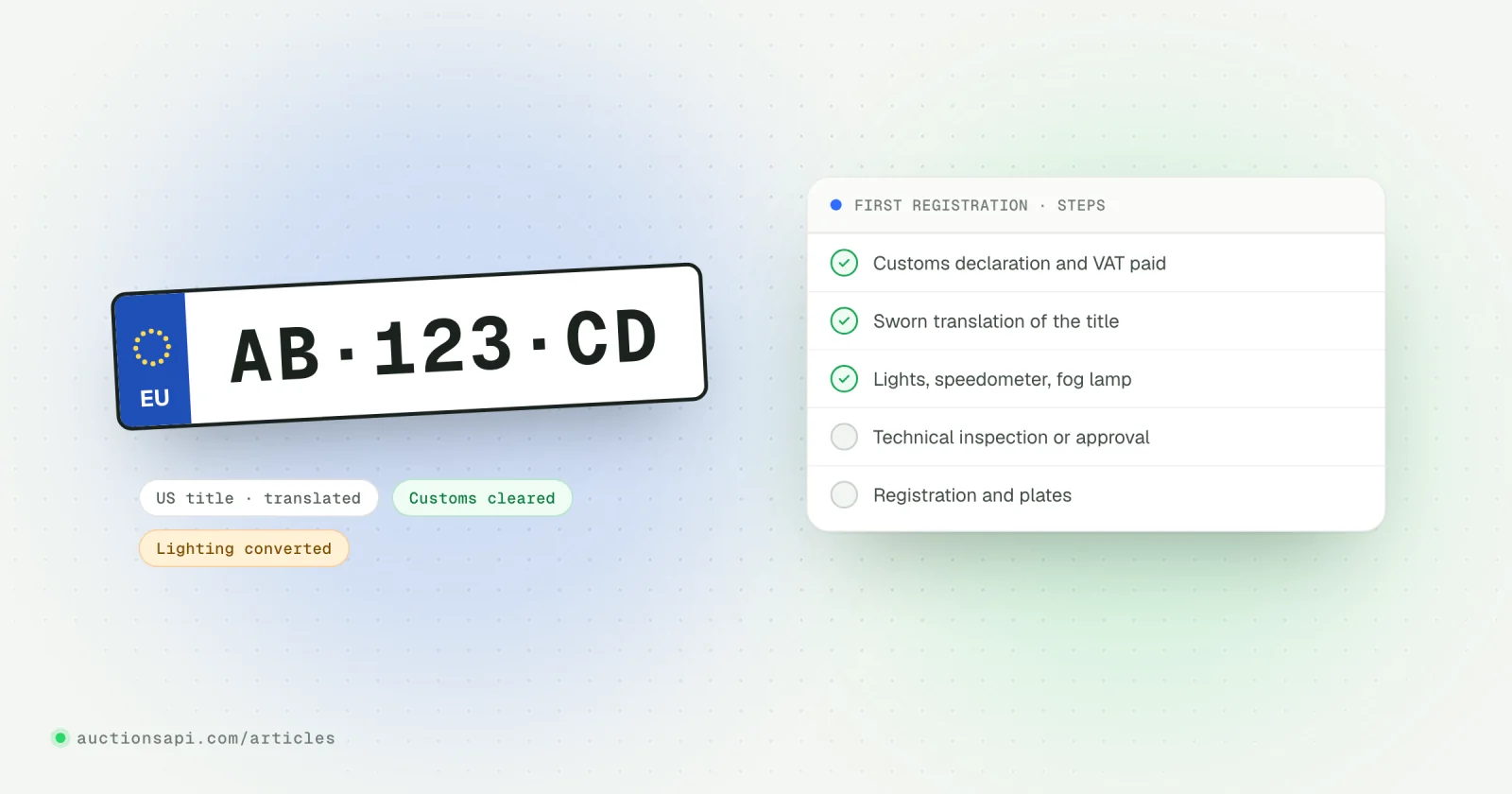
To register a US car in Europe you need, in this order: proof that customs released the car and the import taxes were paid, the original US title (with a sworn translation in many countries), a technical inspection or individual approval showing the car meets EU requirements, and then the first registration itself with insurance and plates. A car built for the US market almost never comes with an EU certificate of conformity, so the inspection is where the work sits: amber rear indicators, a rear fog light, headlights, a speedometer in km/h, emissions and a VIN check are the usual items.
The structure is the same across the EU because vehicle approval is harmonised; the forms, offices, deadlines and fees are national. Below is the general path, the documents, what inspectors look at on a US-spec car, how a repaired salvage car changes things, and where countries differ.
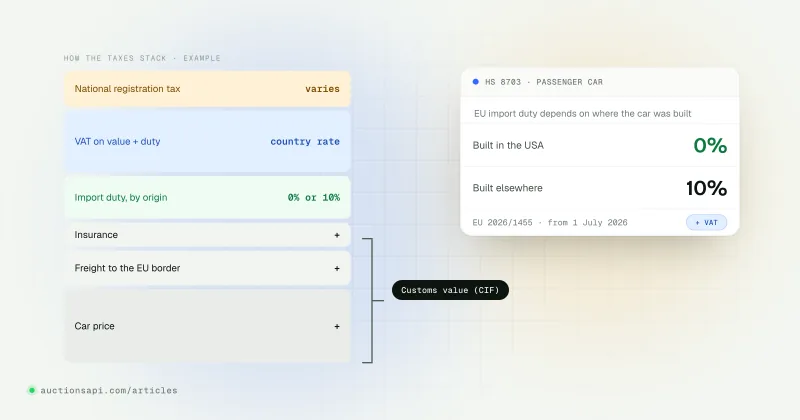
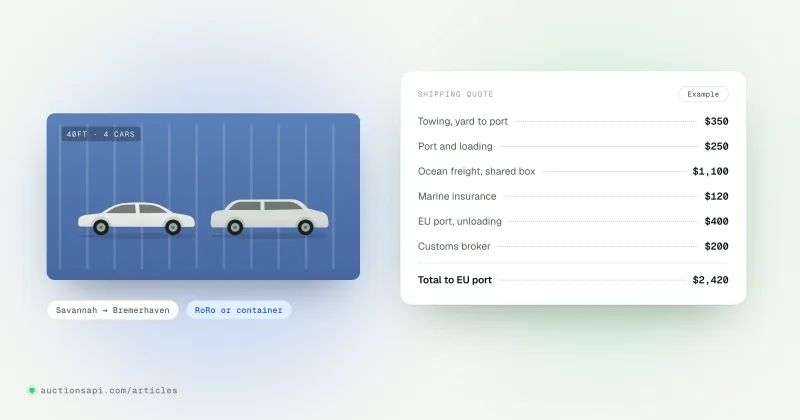
Taxes are covered in customs duty and VAT on a car from the USA, and getting the car across the ocean in shipping a car from the USA to Europe.
Key takeaways
- Registration starts with customs: without proof of release and paid taxes, no registration office will accept the car.
- A US-market car normally has no EU certificate of conformity, so it goes through an individual approval or an extended technical inspection instead.
- Lighting is the most common adaptation: amber rear indicators, a rear fog light and headlights that meet European rules.
- A repaired salvage car must pass on the quality of the repair; some countries add a separate inspection after structural, brake or steering damage.
- Ask an approval station what your exact model will need before you buy it, not after it arrives.
How to register a US car in Europe: the steps
Whatever the country, a car bought at a US auction goes through the same stages between the port and its first number plates in Europe:
- 1Customs releaseImport declaration, duty, VAT and any import excise paid; you get the release document.
- 2DocumentsOriginal US title, auction invoice, customs papers; sworn translations where required.
- 3AdaptationLighting, speedometer and other changes to meet EU rules; repairs finished.
- 4Approval or inspectionIndividual approval or an extended technical inspection, VIN check, technical data recorded.
- 5RegistrationInsurance, registration tax where it exists, the application at the registration office.
- 6PlatesRegistration certificate and plates; the car can be used on the road.
Steps two and three overlap in practice, and in some countries the inspection happens at the registration authority itself. The order that never changes is the first one: customs before everything else.
The documents you need
| Document | Where it comes from | Notes |
|---|---|---|
| Original US title | The seller, via the auction and your broker | Needed for US export and again for registration; make sure the forwarder sends you the original |
| Auction invoice or bill of sale | The auction or your broker | Proof of purchase and price; customs and registration offices both ask for it |
| Customs release document | Your customs broker | Shows the car was declared and duty and VAT were paid |
| Proof of national excise or registration tax | Tax office, where such a tax exists | In Poland, for example, proof of excise payment is required at registration |
| Sworn translations | A sworn translator | Many countries want the title and the invoice translated |
| Approval or inspection certificate | Approval authority or inspection station | Records the technical data the registration needs |
| Insurance | An insurer in your country | Usually needed before or at registration |
| Your ID, and company papers for a business | You | Some countries also ask for proof of address |
The EU's Your Europe page on registration formalities lists the same families of documents for any registration: proof of roadworthiness, proof of ownership, proof of VAT payment, insurance and, where available, a certificate of conformity. National offices add their own forms on top.
The US title and its translation
The US title is the car's ownership document, issued by a state. It is not a registration certificate in the European sense, but registration offices treat it as the previous registration and ownership record. Keep the original: US Customs needs to see it before export, and your registration office will usually want it afterwards. Ask the forwarder to return it with the export papers rather than leave it in a warehouse file.
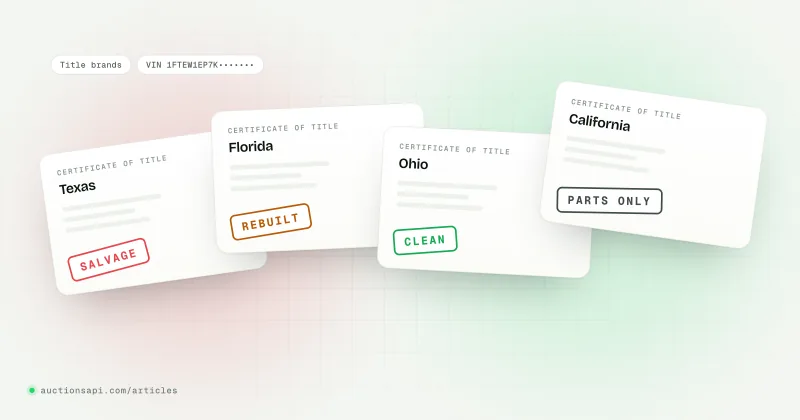
Many countries accept foreign documents only with a certified translation. Poland's government portal, for example, says documents must be translated by a sworn translator, and gives 30 days from bringing the car into the country to register it (gov.pl: register a vehicle). The translation will show the title brand too: a car with a salvage title arrives with that word on its papers, in your language.
EU type approval, the CoC and US-only models
A certificate of conformity (CoC) is issued by the manufacturer and states that the vehicle matches a type approved for the EU. It is the shortcut to registration, because the approval work was already done for the whole model. The catch is that a car built for the US market was approved against US federal rules, not EU type approval, so manufacturers normally do not issue a CoC for it, even when the same model is sold in Europe.
That leaves individual vehicle approval: an approval authority, or a technical service acting for it, checks the single car against the requirements and records its data. EU law (Regulation (EU) 2018/858) provides for EU individual approval and lets member states run national individual approvals; in practice you meet it as the approval or extended inspection your country uses for imported cars. In Germany, for instance, it is the individual approval done by TÜV, DEKRA and similar organisations.
A model that is also sold in Europe
When a European version of the model exists (a BMW X5, a Tesla Model 3, a Ford Mustang), the inspector has reference data, parts for the adaptation are easy to find and the work is mostly lighting and settings. Some manufacturers or importers can also issue a technical data confirmation that helps the inspector, even without a CoC. Electric cars add one practical difference: US models charge through a CCS1 or NACS inlet, while European public chargers use Type 2 and CCS2. That is rarely a registration question, but it decides how easy the car is to live with.
A US-only model
Full-size pickups such as the Ford F-150 or the Chevrolet Silverado, and many large American SUVs and muscle cars, were never type-approved in the EU. They can often still be registered, but the approval takes more work: emissions and noise may need to be measured, weights and dimensions documented, and some countries apply extra rules to heavier vehicles. Ask an approval station for a written list of what your model needs before you buy one.
What the inspection checks on a US-spec car
Lighting
Lighting causes the most adaptations, because US and European rules differ on several points (our US-spec vs EU-spec comparison covers the wider differences between the two versions of a car):
- Rear indicators must be amber. Many US cars flash the red brake light as the turn signal. The usual fix is a European tail light unit, or an approved conversion that adds a separate amber indicator.
- A rear fog light is required. Most US cars have none. One is fitted on the driver's side or in the centre, switched from the dashboard with a warning light.
- Headlights must meet European rules. US headlights use a different beam pattern. Some countries accept adjusted US units, others want headlights with European approval; high-output xenon or LED units can also call for automatic levelling and headlight washers.
- Side markers and reflectors. Amber front and red rear side markers are tolerated by some inspectors and must be disconnected or replaced for others.
Speedometer and instruments
The speedometer has to read in km/h. A dial with both scales is often accepted; a digital cluster is switched to metric in the settings or by coding. Inspectors also look at warning lights: an airbag light that stays on fails the car, which matters for anything that had its airbags deployed.
Emissions, noise and the technical data
A US car has no Euro emissions class on paper. Depending on the country, the inspector measures emissions, accepts the manufacturer's data, or classifies the car using a national method. The same problem shows up in taxes based on CO2: without an EU figure, the office needs another way to set one, so ask how your country handles it.
Identity and the VIN
Every inspection checks the VIN on the car against the title, the customs documents and the invoice. A VIN plate that is loose, repainted or repaired near the stamping is a serious problem, and so is a mismatch of a single character. Check the VIN in the lot photos and on the title before you buy, not at the inspection station.
Tyres, towbars and smaller items
Tyres without European approval markings are rejected in some countries, so budget for a set if the car runs on US-only tyres. A towbar usually needs European approval to stay on the car. Mirrors, seat belts and glass rarely cause trouble on recent cars, but older or modified ones get a closer look.
Salvage-title cars: getting a repaired car through inspection
Most cars from Copart and IAAI are sold with salvage or other branded titles. A European registration office does not apply US state rules, but it sees the brand on the translated title, and the inspector will look at the repair. What matters is whether the car is now roadworthy: straight structure, working brakes and steering, airbags and seat belts restored, no warning lights.
Some countries add a specific step for repaired cars. Polish rules, for example, call for an additional technical inspection when a car was damaged in its load-bearing structure, brakes or steering. Keep the repair invoices, parts receipts and photos of the work; they shorten the conversation at the station. Cars sold as non-repairable, certificate of destruction or parts only are a different matter: our guide to salvage title brands explains why you should not count on registering them anywhere.
Before you buy, look at what the car looked like at earlier sales. Many salvage cars have been through an auction before, and earlier photos show damage that a fresh repair can hide. Our article on auction history by VIN explains where to look; AuctionsAPI's Pay per VIN record returns the earlier Copart and IAAI lots of a VIN with their photos, damage and final bids.
First registration, insurance and plates
Once the car has its approval or inspection certificate, the registration itself is administrative: you bring the documents, pay the registration fees and any registration tax, show insurance, and receive the registration certificate and plates. Countries set deadlines from the import date, 30 days in Poland, and an unregistered car cannot be driven on public roads.
Plan how the car gets from the port or the workshop to the inspection station. Many countries issue temporary or transit plates for this, with short-term insurance; otherwise the car moves on a trailer. One small detail surprises people: the plate recess on a US car is shaped for the US plate (about 30 by 15 cm), so a long European plate may need an adapter or, where your country offers one, a shorter plate format.
How the process differs between countries
The approval rules are harmonised; the way countries run them is not. Expect differences in:
- Who does the approval: a state authority, a national vehicle register, or private technical services such as TÜV and DEKRA in Germany.
- How strict the lighting rules are: some countries accept converted US headlights, others want European-approved units.
- Translations: sworn translation required, or a plain translation accepted.
- Deadlines and taxes: how long you have to register, and whether a one-off registration or excise tax is due first.
- Repaired cars: whether there is a separate inspection after structural damage.
Ukraine, Moldova and the non-EU Balkan countries have their own certification and registration rules, which can differ a lot from the EU path described here, even when the car arrives through an EU port and travels on in transit. If you are importing there, ask a local certification centre before the car is bought.
Checks to make before you buy the car
- Find out whether a European version of the model exists, and ask an approval station what your exact car would need.
- Check the title brand and make sure your country registers cars with that history.
- Look at the VIN in the lot photos and on the title, and look up the car's earlier auction lots.
- Price the adaptation: tail lights, rear fog light, headlights, tyres, any coding.
- Get the tax calculation for the car in writing from a customs broker.
Then the registration is paperwork. Done in that order, the car you choose at the auction is one you already know you can put on the road.
Questions people ask
Can I register a car from the USA in the EU?
Yes, in most cases. After customs clearance, a US-market car goes through an individual approval or an extended technical inspection, because it normally has no EU certificate of conformity. Lighting, the speedometer, emissions data and the VIN are checked, and some parts may need changing. Once approved, it is registered like any other car in that country.
Do I need a certificate of conformity for a car imported from the USA?
Usually you cannot get one. A certificate of conformity confirms that a car matches a type approved for the EU, and cars built for the US market were approved against US rules. Instead, the car goes through an individual approval or the extended inspection your country uses, which records its technical data for registration.
Do US cars need amber turn signals in Europe?
Yes. European rules require amber rear direction indicators, while many US cars use the red brake light as the turn signal. The usual fix is a European tail light unit or an approved conversion. A rear fog light is also required and is missing on most US cars, and headlights must meet European rules.
Can a salvage title car be registered in Europe?
Often yes, if it has been properly repaired and passes the inspection. European offices do not apply US title rules, but they see the brand on the translated title and inspect the repair closely; some countries require an extra inspection after structural, brake or steering damage. Cars sold as non-repairable or for parts are a poor bet.
How long do I have to register an imported car in Poland?
Poland's government portal gives 30 days from bringing the vehicle into the country. You need the customs clearance document, proof of excise payment, sworn translations of foreign documents and a certificate of a positive technical inspection. An unregistered car cannot be driven on public roads, so plan transport to the inspection.