 English
Importing a motorcycle from a US auction: titles, shipping and registration
How to import a motorcycle from the USA: Copart and IAAI titles, what to check in photos, crate or shared container, export papers, EU duty and registration.
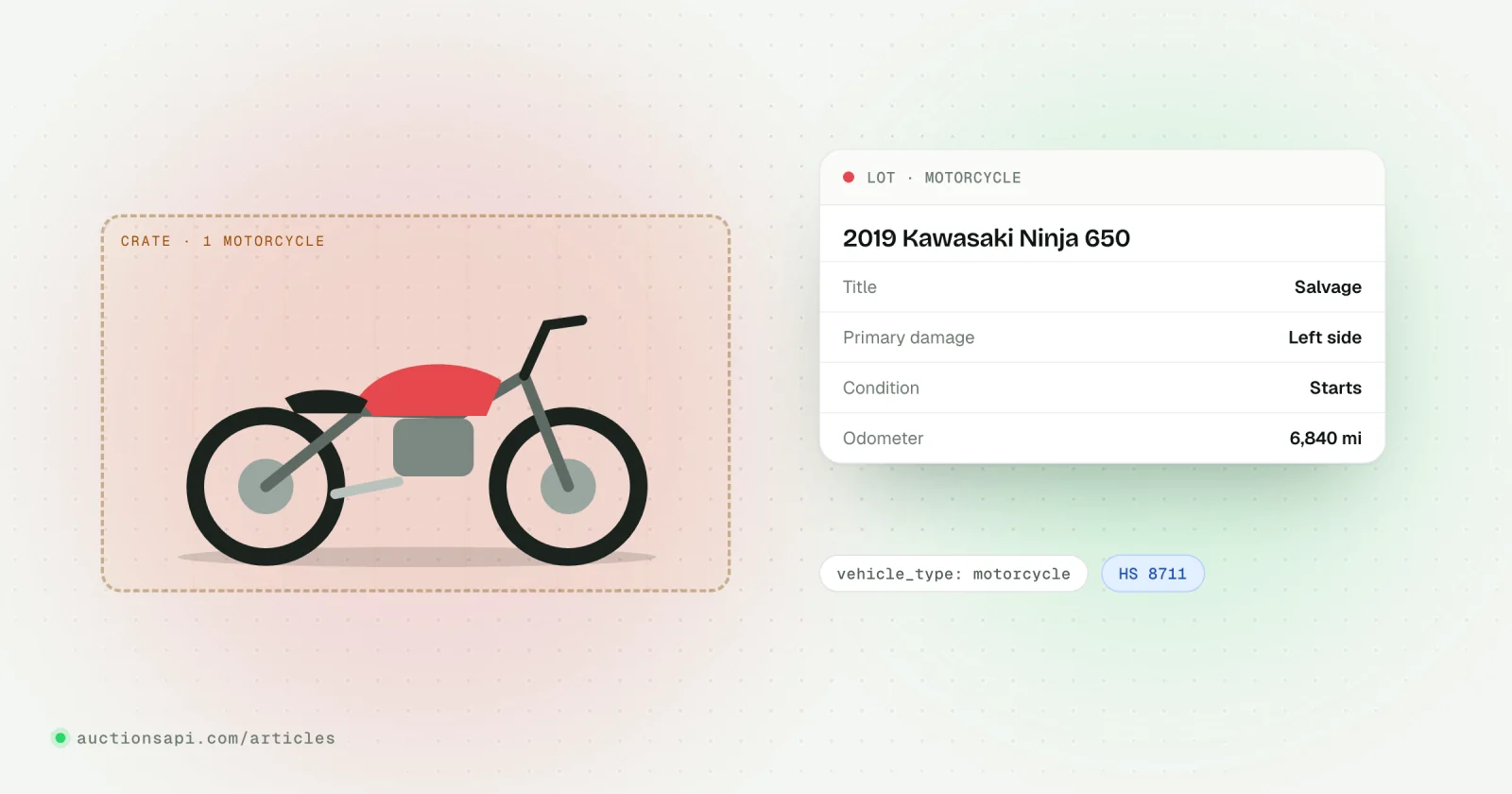
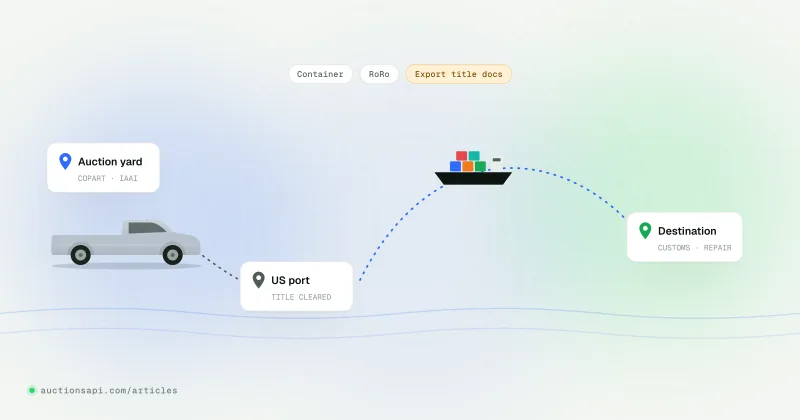
To import a motorcycle from the USA after buying it at Copart or IAAI, you follow the same route as a car, on a smaller scale: a broker buys the lot for you, the bike is collected from the yard, crated or strapped into a container shared with cars, cleared for export with its original title at least 72 hours before sailing, and declared at an EU port, where you pay import duty (if any applies) and VAT before it can go through registration. A bike is cheap to ship compared with a car; the risk sits in hidden frame and fork damage and in the lighting and noise rules at home.
Duty is the part that changed recently. Motorcycles normally carry 6% or 8% EU duty depending on engine size, but since 1 July 2026 the EU applies a zero rate to many goods of proven US origin, vehicles included. A Harley-Davidson built in the US is treated differently from a Japanese bike that happened to be sold in Florida.
This guide covers what is sold, what to look for in the photos, the shipping options, the paperwork and the rules that tend to catch first-time importers. Rates and registration rules change and differ by country, so confirm the numbers with your customs broker and inspection body.
Key takeaways
- Copart and IAAI sell motorcycles with clean, salvage and other title types, and many are theft recoveries or low-speed drops rather than crashes.
- Judge a bike by its forks, steering head, frame and engine cases in the photos; scratched plastics are the cheap part.
- Shipping a bike in a crate or on the floor of a shared car container usually costs a fraction of a car, but the title rules and the 72-hour export notice are the same.
- EU duty on motorcycles is normally 6% or 8%, and US-origin bikes can now enter at 0% with proof of origin; VAT applies either way.
- Expect an individual approval at home, with lighting, plate mounting, mirrors and exhaust noise checked.
Motorcycles at Copart and IAAI: what gets sold
Both auctions sell motorcycles alongside cars, mostly from the same sources: insurance companies, finance companies, rental and fleet owners, and dealers. On a typical day you will find sport bikes, cruisers, touring bikes, dual-sport and dirt bikes, scooters and the occasional three-wheeler, from Harley-Davidson and Indian to Honda, Yamaha, Kawasaki, Suzuki, BMW, Ducati, KTM and Triumph.
The reasons a bike ends up at auction are different from cars, and they matter for price and risk:
- Low-speed drops and slides. The bike went down on its side: scraped fairing, broken lever, bent bar or footpeg, cracked mirror. Often light, sometimes with a bent fork or a cracked engine cover hidden behind the plastics.
- Frontal impacts. Hitting a car or a kerb head-on bends forks, triple clamps and wheels, and can crack the frame at the steering head. These are the expensive ones.
- Theft recoveries. The insurer paid the owner, then the bike was found. Expect a broken ignition, cut or bypassed wiring, missing parts and sometimes no damage beyond that.
- Flood, fire and vandalism. Same categories as cars. A flooded bike is rarely worth importing; electrical problems appear months later.
- Repossessions and dealer trade-ins. Often clean titles, with wear rather than crash damage.
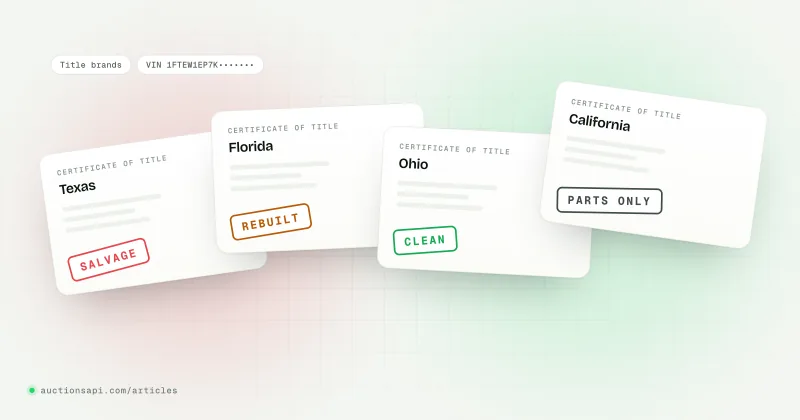
Titles follow state law, like cars. A bike can carry a clean title, a salvage certificate, or a brand such as rebuilt, flood or non-repairable. Read the title type before anything else: some brands mean the bike can never be road-registered again in the US, and several European registration offices treat them with suspicion too. The car-focused guide to salvage title brands applies to motorcycles as well.
What to check in the photos before you commit
Auction photos of motorcycles are taken quickly and from a few standard angles. You will rarely get a clear shot of everything, so look for what the photos do show and treat the missing angles as unknowns in your price.
| Area | What to look for in the photos | Why it matters |
|---|---|---|
| Forks and front wheel | Wheel not in line with the bars, fork tubes at different heights or angles, scraped fork legs | Bent forks and triple clamps are common after a frontal hit and are costly to replace |
| Steering head and frame | Cracked paint or creases near the steering head, bent frame rails, a twisted subframe | Frame damage usually ends the deal: repairs are hard to certify and may not pass inspection |
| Fuel tank | Dents, scrapes, a missing cap or tank | A tank is an expensive cosmetic part, and a damaged one may leak |
| Ignition and wiring | Broken ignition barrel, wires hanging under the tank or seat, missing key | Typical of theft recoveries: needs a new lock set and keys coded to the bike |
| Engine cases | Cracks, oil on the ground or on the case, ground-off covers | A cracked case can mean an engine out of the frame |
| Rear end | Swingarm scrapes, bent rear brake pedal or subframe, damaged exhaust | An exhaust with a hole or an aftermarket can will be checked for noise at home |
| Dash and odometer | Cluster photo with mileage, warning lights, broken display | Confirms mileage and whether the bike was powered up at the yard |
Read the condition label as well. "Run and drive" or "engine starts" describes what the yard saw on one day; a bike that "does not start" may need a battery or may have a seized engine. And check the VIN on the title against the one in the listing. On most motorcycles it is stamped on the steering head, and a theft-recovered bike with an unreadable or altered stamp is a problem you do not want to discover at customs.
Look at the bike's history
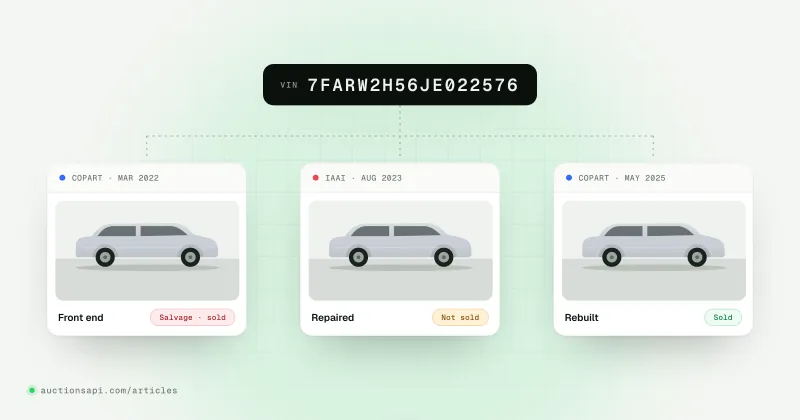
Bikes come back to auction like cars do. Searching the VIN often shows an earlier lot with different photos, sometimes before the damage, sometimes after a cheap repair. A bike that was sold, patched and sold again with a new set of scrapes is a common sight. Auction history by VIN explains where those records come from.
Shipping a motorcycle: crate or shared container
There are two common ways to get a bike across the Atlantic, and the forwarder's routes usually decide between them.
- Crated. The bike is strapped to a pallet and boxed in wood or a steel frame. It then travels as cargo, alone or in a consolidated container. Crating protects the bike well and is the norm when it ships without cars, but the crate itself costs money and adds a step at both ends.
- Loaded with cars. Forwarders that ship auction cars in 40-foot containers often fit one or two motorcycles on the floor between or in front of the cars, strapped down or on a small rack. For an import business already sending cars, this is usually the cheapest option per bike.
- RoRo is possible for a running bike on some routes, usually crated or on a cargo platform, but container shipping is far more common for auction motorcycles.
Most forwarders want the fuel tank close to empty and the battery disconnected or removed before loading, and they will not take loose parts unless they are packed and declared. Ask what they need before the bike leaves the yard, because pickup trucks from the auction will not drain tanks for you.
From the yard to the port, motorcycles travel on car carriers or smaller trucks. A bike that does not roll (a locked front wheel or a bent fork) needs to be lifted, which narrows the choice of carriers. Copart and IAAI yards also charge storage once the free days run out, so line up transport before the sale.
- Day 0SaleA 2019 sport bike with left-side scrapes and a clean title is bought through a broker.
- Days 1–3PaymentAuction price, buyer fees and the broker fee are paid.
- Days 3–14PickupA truck takes the bike to the forwarder, which loads it with cars bound for Europe.
- Days 5–25Title receivedThe title reaches the forwarder; CBP gets the documents at least 72 hours before sailing.
- 3–6 weeksOcean transitContainer to a European port such as Bremerhaven or Rotterdam.
- Days after arrivalCustomsDeclaration, duty if due and VAT, release from the terminal.
- WeeksRepair and approvalParts, lighting and exhaust changes, inspection and registration.
Documents for export and import
US export rules make no exception for motorcycles. US Customs and Border Protection counts motorcycles among self-propelled vehicles and asks for the original title (or a certified copy) plus two copies, presented with the vehicle at least 72 hours before export by sea. The forwarder also files the export information in the Automated Export System. The requirements are on the CBP vehicle export page.
Keep these papers together, because you will need most of them twice, once for US export and once for EU import and registration:
- the original title, signed over as the auction and your broker instruct;
- the auction invoice and the broker's invoice (customs will want the price paid);
- the freight and insurance invoices, which go into the customs value;
- the bill of lading from the forwarder;
- for a US-built bike, anything that supports its US origin (more on that below);
- photos of the bike as delivered, in case the inspector asks about the repair.
EU import duty and VAT on a motorcycle from the USA
Motorcycles fall under tariff heading 8711. The standard EU third-country duty is 8% for engines up to 250 cc and 6% above 250 cc, charged on the customs value: the price paid plus freight and insurance to the EU border. Import VAT at your country's rate is then charged on the customs value plus the duty. Electric motorcycles have their own subheading, so check the code for those too.
Since 1 July 2026 the EU applies a 0% duty to a broad list of industrial goods originating in the United States, vehicles included, under Regulation (EU) 2026/1455. To use it, the importer has to prove the non-preferential US origin of the goods and that they came directly from the US. The Commission's notice on EU tariff duties for US goods lists what counts as evidence. For motorcycles this mainly concerns bikes built in the US, such as most Harley-Davidson and Indian models; a Japanese, European or Thai-built bike bought in the US normally pays the standard rate. VAT is due in both cases.
A worked example of the structure, with made-up round numbers: a Japanese 600 cc bike bought for $4,000 with $700 of freight and insurance has a customs value of about $4,700 (converted to euros at the customs rate). At 6% duty that adds about $282, and VAT is then charged on roughly $4,982. The same bike built in the US, with accepted proof of origin, would pay no duty and VAT on $4,700. Registration fees and any national taxes come on top.
Registering a US motorcycle in Europe
A US-market motorcycle has no EU certificate of conformity, so most countries register it through an individual approval, as with cars. Motorcycles are L-category vehicles, type-approved in the EU under Regulation (EU) No 168/2013, and an individual approval checks the bike against those requirements as far as they apply to a used import. What the inspector looks at, in practice:
- Front indicators used as running lights. Many US bikes keep the front indicators lit as position lamps. That is not allowed in Europe and has to be rewired.
- Rear indicators and tail lamp. Some US bikes, cruisers especially, flash the red tail lamp or use red rear indicators; EU rules want amber indicators.
- Headlamp. The beam pattern must suit traffic on the right and, on some older US bikes, the headlamp unit has no E-mark.
- Number plate mount. European plates are larger than US ones; the bracket, angle and plate light have to suit.
- Exhaust noise. US bikes often wear aftermarket exhausts without EU approval marks. Expect a noise measurement or a demand for an approved silencer.
- Speedometer. It must show km/h; many bikes have a setting, older ones need a dual-scale dial.
- Mirrors, reflectors and horn. Small items that fail inspections when missing after a crash.
Some countries also look at emissions, especially for recent bikes, and some ask for a manufacturer's data sheet for the model. Ask your inspection body what they require for the exact model and year before you buy; for a bike that was never sold in Europe, the answer can change the whole calculation. The car version of these rules is in US spec vs EU spec cars, and most of it applies to bikes as well.
Finding motorcycles in auction data
On the auction websites, motorcycles sit in their own vehicle category. If you track lots in bulk, as an import business or a parts reseller would, the same split exists in structured data. In our Copart and IAAI API the vehicle_type filter takes 2 for motorcycles, and the catalog endpoints take a type, so /manufacturers/motorcycles returns only the makes that have motorcycles. The full list of ids is on the enums page.
Each record carries the same fields as a car: title type, primary and secondary damage, condition, odometer status, photos and, once the sale is over, the final bid. That is enough to shortlist bikes by damage and title and to compare prices with similar bikes that already sold, before anyone looks at a single listing by hand. See /cars in the documentation for every filter.
Before you buy your first bike
- Pick a broker and a forwarder that already ship motorcycles, and ask how they load them.
- Ask your inspection body what a US bike of this model needs, and get a rough quote for the lighting and exhaust work.
- Check where the bike was built and what duty and VAT apply on your import date.
- Shortlist lots with front-end photos and a title type your country accepts, and check each VIN's earlier lots.
- Set your price from final bids of similar bikes, then add fees, shipping, taxes and repairs.
A motorcycle is a good first import: small money, simple shipping, quick repairs. Most of the trouble comes from a bent front end that the photos did not show and from lighting and exhaust rules nobody checked. Price both in and the rest is paperwork.
Questions people ask
Can I buy a motorcycle from Copart and ship it to Europe?
Yes. Copart and IAAI sell motorcycles to foreign buyers, usually through a registered broker because many salvage lots are restricted to licensed buyers. After payment the bike is trucked to a port, cleared for export with its original title at least 72 hours before sailing, and shipped in a crate or in a container with cars. You then pay any duty and VAT and register it at home.
How much is import duty on a motorcycle from the USA to the EU?
The standard EU duty is 8% for motorcycles up to 250 cc and 6% above 250 cc, charged on the price plus freight and insurance. Since 1 July 2026 bikes of proven US origin can enter at 0% under the EU-US tariff arrangement, while bikes built elsewhere pay the standard rate. Import VAT is added in both cases. Check the current rate before you buy.
How do you ship a motorcycle from the USA?
Either crated, strapped to a pallet in a wooden or steel crate and shipped as cargo, or loaded on the floor of a 40-foot container together with cars, which import businesses often do. Most forwarders want the tank nearly empty and the battery disconnected. RoRo exists on some routes but is less common for auction bikes.
Is a salvage title motorcycle worth importing?
It can be, when the damage is a low-speed drop or a theft recovery and the frame, steering head and forks are straight. Avoid bikes with frame damage, flood history or a title brand your country refuses. Check the VIN's earlier auction lots, price the repair and the registration work, and compare with final bids of similar bikes before deciding.
What changes are needed to register a US motorcycle in Europe?
Usually lighting and small items: front indicators that stay lit as running lights must be rewired, rear indicators must be amber, the headlamp must suit European traffic, and the plate bracket must fit a European plate. An aftermarket exhaust may fail a noise check, and the speedometer must show km/h. Most countries handle this through an individual approval.