 English
Copart seller reserve: what it means and why it isn't the sale price
Seller reserve at Copart and IAAI: Pure Sale, Minimum Bid and On Approval, what happens when the reserve is not met, and why it is never the sale price.
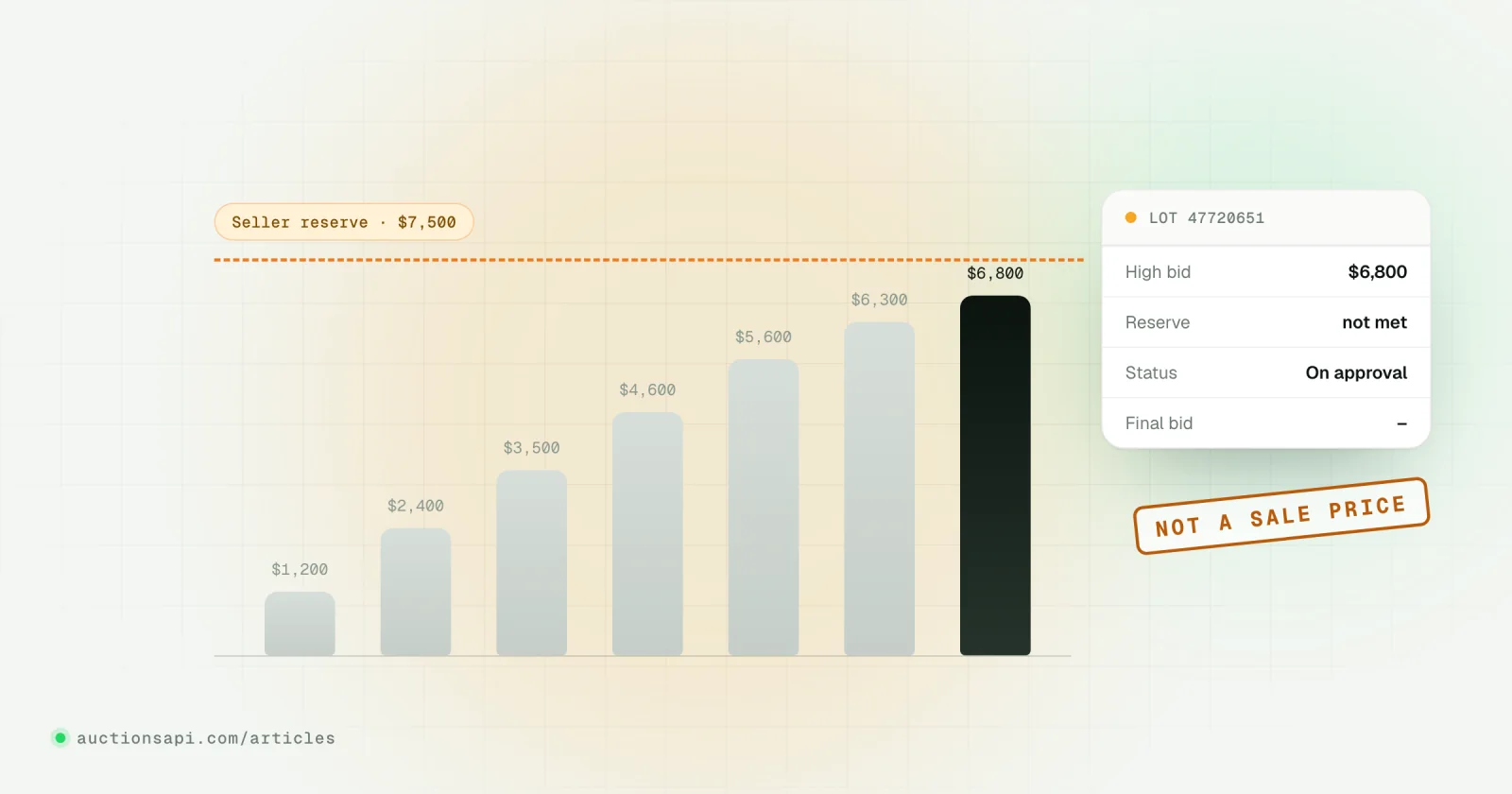
A seller reserve at Copart is the lowest price the seller has agreed to accept for a lot. If bidding closes above it, the lot sells to the high bidder; if it closes below, the lot does not sell automatically: the seller can accept the high bid anyway, make a counter-offer or reject it, and a rejected car often returns in a later sale. The reserve is a floor the seller set, not the price the car sold for.
Copart shows the sale type on the lot page (Pure Sale, Minimum Bid, On Approval) rather than the reserve amount. IAAI works on the same principle. When a reserve figure is known in auction data, it is easy to mistake it for a price, and that mistake shows up on a lot of catalog sites.
This article explains the sale types, what happens when the reserve is not met, why a reserve must never be shown as a sale price, and how the four price numbers on a lot (current bid, Buy Now, final bid, reserve) relate.
Key takeaways
- A seller reserve is the seller's minimum; it says what the seller hoped for, not what anyone paid.
- At Copart, Pure Sale lots have no reserve, Minimum Bid lots have one, and On Approval lots need the seller to approve the high bid.
- When the reserve is not met, the high bid goes to the seller for approval; a rejected lot often comes back in a later sale.
- Only a final bid on a lot with a sold status is a sale price; the reserve, the current bid and the Buy Now price are other numbers.
- In our API data, lots[].seller_reserve is an optional object with price and updated_at, and null means no reserve in our data, not a zero reserve.
What a seller reserve is at Copart and IAAI
Sellers at salvage auctions are mostly insurance companies, followed by dealers, rental fleets, banks and finance companies. An insurer that paid out a total-loss claim wants to recover as much as it can from the wreck, and it usually has a figure in mind from its own valuation. The reserve is that figure turned into a rule: below it, the seller keeps the right to say no.
Two points are easy to miss. The reserve belongs to the seller, not to the auction, so two similar cars from two sellers can have very different reserves. And it can change: a seller who sees no interest at one price often lowers it for the next sale, while a seller in no hurry keeps it high and lets the car sit.
Copart and IAAI do not usually display the reserve amount on the lot page; buyers see the sale type and the current bid. Some data sources do capture a reserve figure, which is why you will meet it on research sites and in APIs. Read it as the seller's expectation at a point in time, with the date it was recorded.
Pure Sale, Minimum Bid and On Approval at Copart
Copart describes how each lot will be sold with a sale type. The names below are the ones Copart uses in the US; the exact rules, deadlines and wording are on copart.com and can change, so treat the table as an overview.
| Sale type | Is there a reserve? | What happens when bidding closes | In the API data |
|---|---|---|---|
| Pure Sale | No. | The lot goes to the highest bidder, whatever the amount. | auction_type pure_sale (1) |
| Minimum Bid | Yes, a minimum the seller set. | Above the minimum: sold. Below it: the high bid goes to the seller, who can accept, counter or reject. | auction_type minimum_bid (2) |
| On Approval | The seller approves every result. | The seller reviews the high bid within a short window and accepts, counters or rejects. | auction_type on_approval (3); a lot waiting for the decision can show status on_approval (4) |
| Live / timed | Describes the format, not the reserve. | A live online sale or a timed listing; a reserve can still apply. | auction_type live (4) or timed (5) |
IAAI works the same way in substance: a seller can set a reserve, and a high bid below it goes to the seller for approval before the sale is confirmed. The labels on the lot page differ, so check iaai.com for the current wording rather than assuming the Copart names.
What happens when the reserve is not met
When bidding stops below the reserve, the lot enters an approval step. Copart gives the seller a short window after the sale, measured in business days, to decide. The seller can accept the high bid as it is, come back with a counter-offer to the high bidder, or reject it. If it is rejected, the car usually goes back into a later sale, sometimes with a lower reserve.
Here is a typical path for one lot, with example numbers. The car is a 2018 Honda CR-V with rear-end damage, sold by an insurer.
- Day 1Listed with a minimumThe insurer lists the CR-V as a Minimum Bid lot. A seller reserve of $7,500 is recorded for it.
- Day 8Sale day: bidding ends at $6,200The high bid is $1,300 below the reserve, so the lot does not sell automatically.
- Days 8–10On approvalThe seller reviews the $6,200 high bid and has a short window to accept, counter or reject.
- Day 10Rejected, not soldThe seller rejects it. The $6,200 is the last bid of that sale, not a sale price.
- Day 18Back in a new saleThe car is relisted. The seller lowers the reserve to $6,800 after the first result.
- Day 25Sold for $7,050Bidding closes above the new reserve. The final bid of $7,050 is the sale price, before buyer fees.
Look at what a careless catalog would show for this car. If it displayed the first reserve as the price, the car would appear to have sold for $7,500. If it displayed the first sale's last bid, it would show $6,200 with a sold badge. The real sale was $7,050, in a different sale, recorded later. This is why the history of every sale of a VIN matters; our auction history by VIN guide shows how to read it.
Why a seller reserve is never the sale price
We see reserves shown as prices often enough that it is worth spelling out the reasons it is wrong:
- Nobody paid it. The reserve is the seller's ask; the sale price is what the high bidder paid. They are rarely the same number.
- The car can sell below it. A seller who accepts a high bid on approval sells under the reserve, sometimes well under.
- The car can sell far above it. On a popular car the bidding can pass the reserve easily, so the reserve says little about the result.
- It changes. A reserve recorded three weeks before the sale may have been lowered since. Always read its date.
- It is missing on many lots. No reserve in the data does not mean a no-reserve sale; it only means the figure is not known.
- It excludes fees. Even the final bid is not what the buyer paid in total: auction, gate and other fees, transport and taxes come on top.
The honest use of a reserve is as a signal. A reserve far above the sold prices of similar cars tells you the seller is likely to reject a normal result and the car may come back. A reserve close to the current bid tells you the lot is near the point where it sells without approval. For sold prices of comparable cars, see Copart sold prices.
Seller reserve vs actual cash value and repair estimate
Lots often carry other numbers that look like prices too: the actual cash value (ACV, the seller's estimate of what the car was worth before the damage), the estimated repair cost, and sometimes a clean wholesale value. None of them is a sale price either, and none of them is the reserve.
They are still useful next to a reserve. Take a car with an ACV of $18,000 and a repair estimate of $11,000. An insurer that paid out the claim is trying to recover part of the $18,000, and a reserve somewhere well below the ACV is normal. A reserve close to the ACV on a heavily damaged car is unusual and tells you the seller is in no hurry. A reserve far below sold prices of similar cars usually means the lot will clear easily.
Treat every one of these figures as the source published it: an estimate made by someone with an interest in the outcome, at a point in time. In our records they arrive as actual_cash_value, estimate_repair_price, pre_accident_price and clean_wholesale_price where the source provides them, separate from seller_reserve.
Different sellers, different habits
Insurers sell large volumes and tend to clear cars rather than store them for months, so their reserves usually move toward the market after a rejected sale. Dealers, rental fleets and finance companies selling clean-title or lightly damaged cars more often have a firm number tied to what the car is worth to them on a lot, and they reject more often. That is a pattern, not a rule; the seller name on the lot and the history of the VIN tell you more about a specific car.
Final bid, current bid, Buy Now and seller reserve: four different numbers
A lot can carry up to four price fields at once, and each needs its own label. This is how they are defined in our records, which follow the auctions' own meanings; the full rules are on the prices and reserve page of the docs.
| Field | What it is | When it is set | How to label it |
|---|---|---|---|
| bid | The current high bid. Once a final bid is recorded, this field returns the final bid too. | During the sale and after it. | “Current bid” while the lot is active. |
| final_bid | The closing high bid of the sale. | After bidding closes; null until known. | “Sold for” only when the status is sold; otherwise “Last bid”. |
| buy_now | A fixed price the seller offers before the sale, when available (above 0). | Before the sale. | “Buy Now”. |
| seller_reserve | The seller's minimum, where available: an object with price and updated_at. | Whenever a reserve is recorded; can change. | “Seller reserve” with its date, never as a price paid. |
Because bid takes the final value after the sale, bid alone never tells you whether a lot sold. Read final_bid together with the lot status: sold (6) means the final bid is the sale price; not_sold (8) or failed (7) means it was only the last bid. Amounts have no currency field; US lots are in US dollars and Canadian lots in Canadian dollars, so take the currency from the lot's country.
How lots[].seller_reserve appears in AuctionsAPI data
Every lot in /cars, /search-vin and /search-lot responses can carry seller_reserve, with no extra parameter (the search by VIN endpoint also returns archived lots, so you see the reserve of earlier sales too). It is either an object or null:
null means no nonzero reserve is available in our data; it does not mean a zero reserve or a no-reserve auction. Some sources serialise numbers as strings, so parse price defensively, and compare updated_at with the sale date before you rely on it. A small function that labels each number correctly:
Note that the function never falls back to the reserve when other prices are missing: a lot with no bids and a known reserve shows “No bids yet” plus the reserve line, never a price built from the reserve. Hiding the reserve once a sold price is on screen is a deliberate choice too: next to “Sold for $7,050”, a “Seller reserve $7,500” line only confuses people. While the lot is active, the reserve on its own line, with its date, is useful context.
Using seller reserves when you research a car
- Check the sale type first. A Pure Sale lot has no reserve to worry about; a Minimum Bid or On Approval lot may not sell at the closing bid.
- Compare the reserve, where known, with sold prices of the same model, year and damage. A large gap suggests the car will come back.
- Read the date of the reserve. An old figure may have been lowered.
- Look up earlier sales of the VIN. A car rejected twice tells you about the seller's expectations.
- Never budget from the reserve. Budget from comparable final bids on sold lots, plus fees, transport and import costs.
If you display auction data on your own site, the Copart and IAAI API returns the sale type, status, current bid, Buy Now, final bid and seller reserve for each lot, each with its own update time, so every number can carry the right label.
Questions people ask
What does seller reserve mean on Copart?
It is the minimum price the seller is willing to accept for the lot. If bidding closes above it, the lot sells. If it closes below, the high bid goes to the seller, who can accept it, counter or reject it. The reserve is the seller's expectation, not the price the car sold for, and it can change between sales.
What does Minimum Bid mean at Copart?
Minimum Bid means the seller has set a reserve. When bidding ends above that minimum, the lot sells to the high bidder. When it ends below, the sale is not automatic: the seller has a short window to accept the high bid, make a counter-offer or reject it. Copart publishes the exact deadlines on its site.
What does On Approval mean at Copart?
On Approval means the seller has kept the right to approve the final high bid, whatever the amount. After bidding closes, the seller reviews the result and accepts, counters or rejects it within a short period. Until then the lot is not confirmed as sold, and a rejected lot often returns in a later sale.
Is the seller reserve the price the car sold for?
No. The reserve is what the seller asked for as a minimum. A car can sell below it when the seller approves a lower bid, or well above it when bidding is strong. The sale price is the final bid on a lot whose status is sold, and even that excludes buyer fees, transport and taxes.
Can a Copart car sell below the seller reserve?
Yes. When bidding ends under the reserve, the seller can still accept the high bid during the approval step, so the car sells below the reserve. The seller can also counter or reject. That is one reason a reserve figure must never be shown as a sale price or used as a valuation.