 English
Best cars to import from USA auctions, and how to run the numbers
Best cars to import from USA auctions: the landed-cost formula, what makes a model a good candidate, a worked example and how to price it from sold lots.
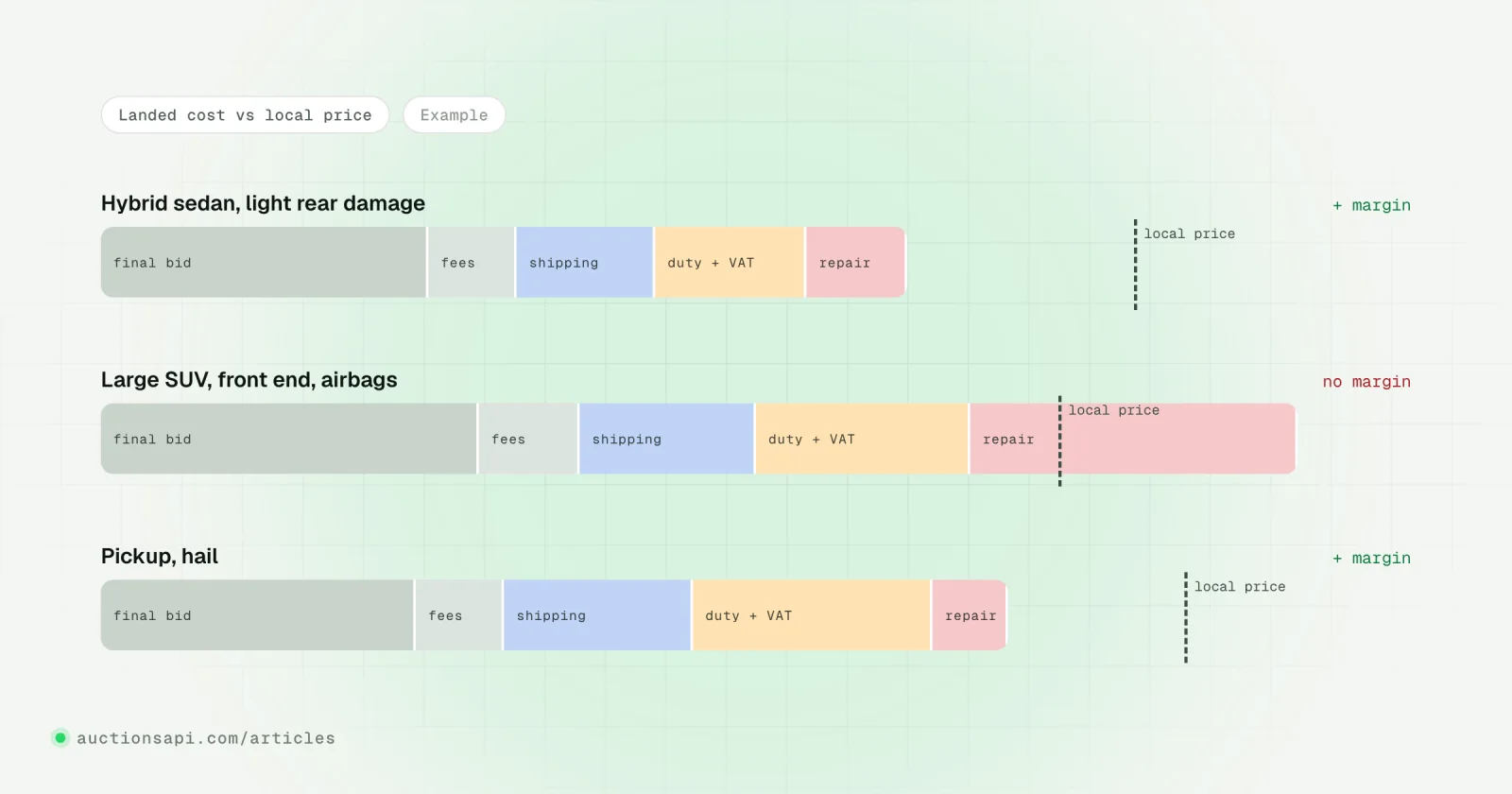
The best cars to import from USA auctions are the ones whose landed cost (final bid, auction and broker fees, transport, duty and VAT, repair and registration) stays well below what the same car sells for at home, with room left for surprises. In practice that means models also sold in your country, so parts and type approval are easy; a local price that is high compared with the US; damage that is cheap to fix; and an engine that does not land in a punishing tax band.
There is no list that works for every buyer. A V8 pickup that makes sense in one country is taxed out of reach in the next, and a model that paid off last year can stop paying when local prices fall. What does carry over is the method: run the full cost stack for one specific lot, compare it with a realistic local sale price, and keep only the cars where the gap survives pessimistic assumptions.
This article walks through that method, the traits that make a model a good candidate, a worked example with every number labelled as an assumption, and how to price candidates from cars that already sold.
Key takeaways
- A car is worth importing only when its landed cost, with a repair buffer, sits clearly below a realistic local sale price for a car with its history.
- Good candidates are sold in your country too, have cheap and available parts, carry damage you can price from the photos and sit in a mild tax band.
- Since 1 July 2026 the EU charges no duty on many goods of proven US origin, vehicles included, so where the car was built can change the sum.
- Price the purchase from final bids of comparable sold lots, never from the current bid of the lot you are watching.
- Repair cost is the line that most often turns a margin into a loss; put a contingency on it before you decide.
What makes a car worth importing from the USA
Every import decision comes down to one comparison. On one side, what the car will cost you once it is repaired and registered at home. On the other, what a buyer in your country will pay for it, knowing it is an ex-US car with an auction history. If the second number is not clearly higher, the car is not worth the months of waiting and the risk.
Two mistakes skew that comparison more than any other. The first is pricing the purchase from the current bid a week before the sale; current bids climb, and the lot you are watching tells you nothing about what similar cars actually fetch. The second is comparing your landed cost with local asking prices for cars with a clean local history. A repaired US salvage car does not sell for the same money, because buyers check VINs and find the auction photos.
So the job is to estimate both sides honestly, for one specific car, before sale day. A model can be a good candidate in general and a bad buy in a particular lot because of its damage, its title or where it was built.
The landed-cost formula
Write the stack out line by line for each candidate. Most of these lines are in our full guide to importing from a US auction; here is how they combine:
- Final bid: what you expect to pay at the hammer, estimated from comparable sold lots.
- Auction fees: the buyer fee (stepped by price), the online bidding fee, gate and documentation fees. Both auctions publish current tables; they change.
- Broker fee: fixed or a percentage, plus any payment or transfer fee.
- US transport: yard to export port by truck, more for a car that does not roll.
- Ocean freight and insurance: a share of a container, or RoRo for a car that drives.
- Import duty: a percentage of the customs value, which in the EU includes the price paid plus freight and insurance to the border.
- VAT: charged on the customs value plus the duty, at your country's rate.
- Local taxes and fees: excise or registration tax based on engine size, CO2 or age where your country has one, port handling and the customs broker.
- Repair: parts, labour, paint, calibration, plus a contingency.
- Conversion and registration: lighting changes, technical inspection, individual approval where needed, translation of documents, plates.
Landed cost is the sum. Margin is the realistic local sale price minus the landed cost. If you import for yourself rather than to resell, replace the sale price with what a comparable car would cost you locally, and the logic is the same.
The 2026 change in EU duty for US-built cars
For years the usual EU duty on a passenger car from the US was 10%. Under Regulation (EU) 2026/1455, applied from 1 July 2026 as part of the EU-US joint statement, many goods originating in the United States, vehicles among them, enter the EU at 0% duty. The European Commission's notice on the new duties describes the conditions: the goods must be of US origin, transported directly or kept under customs supervision in transit, and the importer must be able to prove the origin. The preference can be suspended, and the regulation is set to apply until the end of 2029.
Origin is about where the car was made, not where it was sold. A BMW X5 assembled in South Carolina can qualify; a Japanese-built Lexus bought at a Texas auction does not. A VIN that starts with 1, 4 or 5 belongs to a manufacturer in the US, which is a useful first hint, but customs wants proof, and for a used car bought at auction collecting it is not always simple. Ask your customs broker what they will accept before you count on 0%, and see customs duty on cars imported to the EU for the wider picture. VAT is still due either way.
Best cars to import from USA auctions: what a good candidate looks like
Instead of a ranking, use a checklist. The more of these a model ticks, the more often individual lots of it will survive the formula.
It is sold in your country too
A model with a European twin is easier on every front. Parts are on the shelf at local suppliers, workshops know it, diagnostic tools read it, and registration is a matter of converting a few details rather than proving the whole car is safe. US-only models can still work, but they go through individual approval in many countries, parts come from the US with shipping and duty of their own, and the pool of local buyers is smaller. The usual differences between US and European versions are lighting, mirrors, emissions equipment, the charging connector on electric cars and region-coded software.
It is expensive at home compared with the US
The price gap is the raw material of the margin. It tends to be largest on mid-size and large SUVs, premium brands and performance models, where European list prices and local taxes push used prices up. Small economy cars rarely pay: they are cheap in Europe already, and the fixed costs of shipping and registration eat a far larger share of their value.
Its damage can be priced from the photos
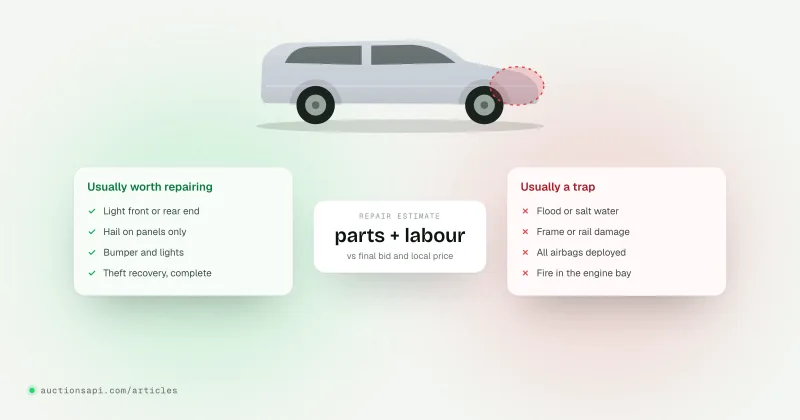
Light front or rear impacts with intact airbags, cosmetic hail and minor side damage are the classic import lots, because a body shop can list most of the parts from the pictures. Flood, fire, deployed airbags with a broken dashboard, structural damage and "mechanical" lots with no start code are where estimates go wrong. We cover each damage type in which damage is worth repairing.
Its engine lands in a mild tax band
Several European countries tax cars at registration or import by engine size, CO2 or both, and the steps can be steep. Poland's excise, for example, has long charged a much higher rate on engines above two litres than below. That can make a 2.0-litre four-cylinder and a 3.0-litre six of the same model two different business cases. Hybrids are treated more gently in some countries. Check your country's current bands for the exact engine before you shortlist a model.
Its title can be registered at home
Salvage certificates are the normal export product; certificates of destruction, non-repairable and parts-only documents often are not registrable abroad either. Read the title types guide and ask your registration authority before you buy anything below a salvage title.
Model families importers commonly look at
These are examples of model families that come up again and again in import conversations, with the reason people look at them and the catch. They are not a ranking and not a recommendation; whether a given lot works depends on the formula above.
| Model family | Why importers look at it | Watch out for |
|---|---|---|
| BMW X3, X5 (US-market cars largely built in South Carolina) | European equivalent exists, high used prices in Europe, possible US origin for duty | Matrix or adaptive headlights, front radar and camera calibration, region coding |
| Mercedes-Benz GLE, GLS (built in Alabama) | Same as above: European twin, strong prices at home, possible US origin | Air suspension, expensive lighting and sensors, large engines in engine-size tax countries |
| Ford Mustang | Sold officially in Europe, steady enthusiast demand, plenty of US parts | V8 tax bands, lighting conversion, insurance; many lots are heavily modified or raced |
| Jeep Wrangler, Grand Cherokee | Sold in Europe in some years and versions, popular with off-road buyers | US-only engines and trims, rust from salted roads, mismatched European versions |
| Toyota RAV4 and Camry hybrids | European versions exist, hybrids get milder treatment in some tax systems | Plant of assembly varies (US, Canada, Japan), hybrid battery checks after water damage |
| Tesla Model 3, Model Y | Sold in Europe, large supply of light-damage lots | US charging connector, salvage policies for service and fast charging, battery and structural damage |
| Full-size pickups and SUVs (Ram 1500, Ford F-150, Chevrolet Tahoe) | No direct European equivalent, a niche of buyers who want exactly that | Individual approval, size and weight rules, very large engines, parts shipped from the US |
Notice the pattern: the families that tick most boxes are European-sold premium SUVs that happen to be built in the US. Popularity has its own cost, though. Lots that every importer wants attract more bidders, and their final bids reflect that.
How to price a candidate from sold lots
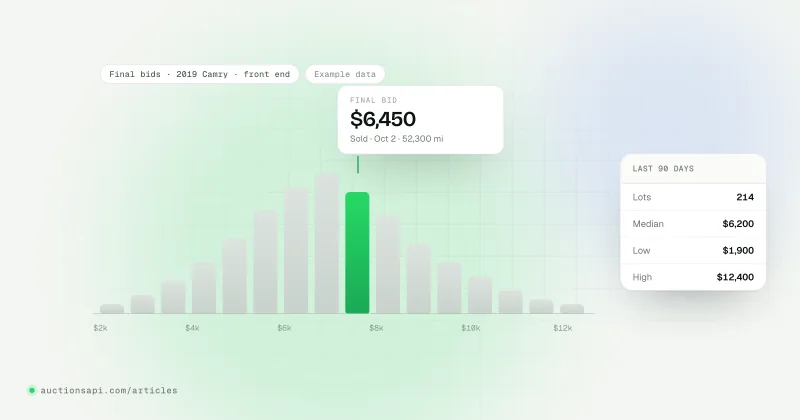
The first line of the formula is the one you can measure best, because thousands of comparable lots have already sold. Collect 15 to 30 that match on model, engine, year range (one year either side), primary damage, title type, run status and odometer band, sold in the last few months. Use the median final bid of lots whose status is sold, not the average, and look at the spread: if the cheapest and dearest differ a lot, open their photos and find out why.
Two cautions. Lots that ended without a sale carry a last bid, not a price, and relisted cars appear more than once, so count each VIN once. And a seller reserve is the seller's hope, never a sale price. Copart sold prices explains these rules in detail.
If you check candidates every week, doing this by hand gets old quickly. Our Copart and IAAI API keeps the final bid and status of finished lots, with stored aggregates by make, model, engine and year, so the comparables can sit in a spreadsheet or your own tool instead of browser tabs.
The other side: a realistic local price
For the local side, search your national classifieds for the same model, engine, year and mileage band, and note asking prices of cars with ordinary local history. Then be honest about the discount an ex-US car with a salvage record carries in your market. It varies by country and segment, so ask a dealer who sells such cars or look at how long similar imports stay listed. Asking prices are also higher than sale prices; we would knock something off before treating them as revenue.
A worked example: every number is an assumption
Here is the formula applied to one imaginary lot: a 2020 BMW X3 xDrive30i, US-built, front-end damage with intact airbags, salvage certificate, run and drive, about 40,000 miles, bound for an EU country with a 21% VAT rate. The amounts below are made up for the example and converted at an assumed 1 USD = 0.90 EUR. Two columns show the effect of proving US origin.
| Line | US origin proven (0% duty) | Origin not proven (10% duty) |
|---|---|---|
| Final bid, median of comparables (assumed $14,000) | €12,600 | €12,600 |
| Auction and online fees (assumed $1,300) | €1,170 | €1,170 |
| Broker fee (assumed $400) | €360 | €360 |
| Yard to port transport (assumed $600) | €540 | €540 |
| Container share and insurance (assumed $1,400) | €1,260 | €1,260 |
| Customs value | €15,930 | €15,930 |
| Import duty | €0 | €1,593 |
| VAT at 21% on value plus duty | €3,345 | €3,680 |
| Port handling and customs broker (assumed) | €700 | €700 |
| Repair: parts, labour, paint, calibration (assumed) | €4,500 | €4,500 |
| Inspection, conversion, registration (assumed) | €1,000 | €1,000 |
| Landed cost | €25,475 | €27,403 |
| Realistic local sale price as an ex-US car (assumed) | €30,000 | €30,000 |
| Margin before contingency | €4,525 | €2,597 |
Now stress it. Add a 20% contingency to the repair (€900): the margins fall to about €3,600 and €1,700. Suppose the car turns out to need a headlight with an adaptive module that was not visible in the photos, and the second column is close to break-even. Suppose the final bid lands in the top quarter of comparables rather than at the median, and it is a loss. That is the normal shape of this business: a margin that looks comfortable on paper and depends on two or three lines you cannot know exactly.
Three things to take from the example. The repair line moves the result most, so spend your effort estimating it. Proof of origin can be worth more than haggling over the broker fee. And a car that only works at the median final bid is a car you should set a firm ceiling on, then let go if the bidding passes it.
Cars that rarely pay off
Some lots look cheap and almost never survive the formula. We would pass on these unless you have a specific reason:
- Small economy cars: the fixed costs of freight, port and registration are a large share of their value, and the local price is low already.
- Flood and fire lots: wiring and electronics fail months later, some countries refuse them, and resale buyers walk away when they see the history.
- Cars with deployed airbags and a damaged dashboard: the restraint system parts add up fast, before any bodywork.
- US-only models with very large engines, bound for a country with steep engine-size or CO2 taxes.
- Premium cars with front damage in the sensor zone, when you cannot see whether radar, cameras or adaptive headlights survived.
- Lots without a registrable title at your destination, however tempting the price.
None of this is absolute. A specialist with cheap access to used parts can make a deployed-airbag car work. But if you are building the habit, start with lots where most of the cost is visible.
Where to start
Pick two or three model families that tick most boxes for your country, and build a one-page cost sheet with the lines of the formula. For each lot you consider, fill in the final-bid estimate from comparable sold lots, get the repair priced from the photos by a body shop you trust, ask your customs broker about origin and taxes, and compare the result with a realistic local price. Do it for ten lots before you buy one: you will learn more about your market from the ones you reject than from any list.
Questions people ask
Is it worth importing a car from the USA?
It can be, when the car's landed cost (final bid, fees, transport, duty, VAT, repair and registration) stays clearly below what the same car sells for in your country, after a discount for its US history. Premium SUVs sold in Europe and built in the US often work; cheap economy cars and flood or fire lots rarely do. Run the numbers for each specific lot.
What is the best car to import from the USA?
There is no single best car, because taxes, local prices and registration rules differ by country. Good candidates share traits: an equivalent model is sold in your country, local prices are high, parts are easy to get, the damage can be priced from the photos and the engine falls in a mild tax band. Check each lot against those.
Do I pay import duty on a car from the USA to the EU?
Since 1 July 2026 the EU applies 0% duty to many goods of proven US origin, including vehicles, under Regulation (EU) 2026/1455, which can be suspended and runs to the end of 2029. A car built outside the US does not qualify, and you must prove origin. VAT is due in either case. Confirm the current rules with your customs broker.
How do I calculate the total cost of importing a car from a US auction?
Add the expected final bid, auction and broker fees, US transport, freight and insurance, then import duty on the customs value, VAT on value plus duty, local excise or registration tax, port and broker fees, the repair with a contingency, and conversion and registration. Compare the total with a realistic local sale price, not with asking prices for cars with clean local history.
Which cars should I avoid importing from US auctions?
Small economy cars, because fixed costs eat their value; flood and fire lots; cars with deployed airbags and a broken dashboard; very large engines bound for countries with steep engine-size taxes; and any lot whose title cannot be registered at your destination. Front damage on premium cars with radar and adaptive lights also deserves extra caution.