 English
How to buy a damaged car from auction: which damage is worth repairing
Before you buy a damaged car from auction: which damage types are usually worth repairing, the hidden costs behind them and which titles can be registered.
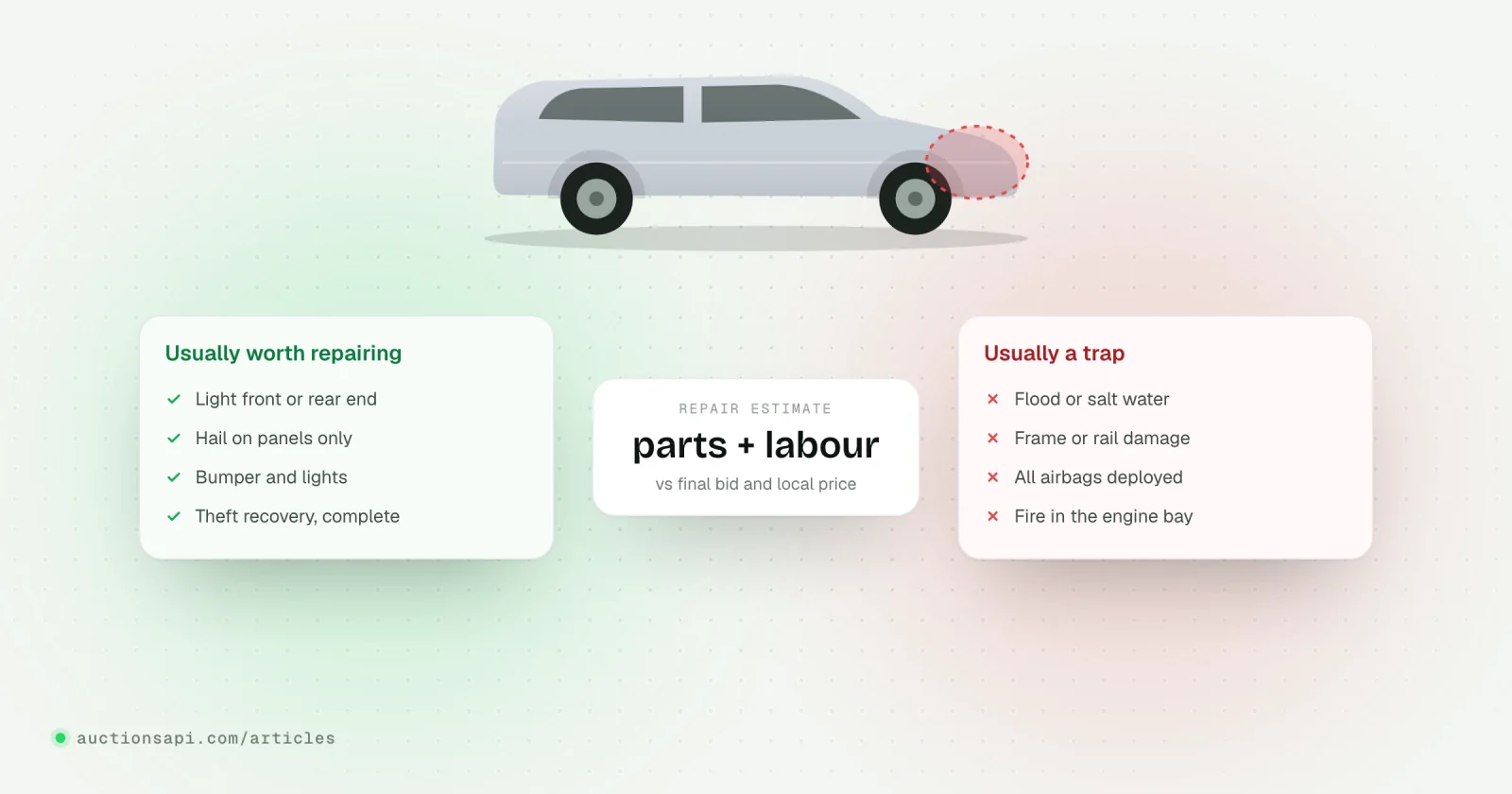
When you buy a damaged car from auction, the damage worth repairing is the damage you can price from the photos: light front or rear impacts with the airbags intact, cosmetic hail, scrapes and dents on bolt-on panels. Flood, fire, structural or frame damage, rollovers and deployed airbags with a broken dashboard are where repair estimates fail, and where cheap lots most often end up costing more than a clean car.
The reason is simple. A repair is profitable when its cost is predictable, and the auction listing shows the outside of the car. Every damage type hides something different behind the panel you can see, and the expensive parts of a modern car (airbag modules, radar, cameras, adaptive headlights, structural steel) are rarely in the picture.
Below we go through the common damage types one by one, the hidden costs that turn a good lot into a bad one, which titles can be registered after repair, and a way to estimate a repair before sale day. We give no repair prices: parts and labour vary too much between countries and workshops. Get your own quotes.
Key takeaways
- Buy damage you can price from the photos; avoid damage whose cost is hidden behind panels, in wiring or in the structure.
- Light front and rear impacts with intact airbags are the classic repairable lots, until radar, cameras or adaptive headlights are involved.
- Flood, fire, rollover and structural damage rarely pay off, and some countries refuse to register such cars at all.
- The auction's repair estimate and actual cash value come from the seller side, in US prices, and are not your repair budget.
- The title decides whether the repaired car can be registered at all, so read it before you price the repair.
How the numbers work when you buy a damaged car from auction
The sum is short: the value of the repaired car, minus the purchase (final bid and fees), transport, taxes, the repair and a contingency. What makes it hard is that the repair line is an estimate made from 15 or 20 photos of a car you will not see until weeks after you paid for it.
Two lots with the same label can be a day's work and a month's work. Our list of Copart damage types explains what each label means; this article is about what each label tends to cost you. The useful question for any lot is not "how bad does it look" but "how much of the cost can I see".
The value side has a trap of its own. A repaired car with a salvage history sells for less than the same car with a clean local history, and the gap grows with the severity of the original damage. A buyer who finds photos of a burned interior will not pay full price, however good the repair. Our landed-cost method shows how to set that value for an imported car.
The auction's own repair estimate is not your budget
Many lots show an estimated repair cost and an actual cash value. Both come from the seller side, usually the insurer, and both are in US terms: US labour rates, new original parts, a US idea of what the car was worth before the accident. An insurer totals a car when the repair would cost a large share of its value, so the estimate on a salvage lot is often close to or above the value. That tells you the insurer gave up on it, not what a repair will cost you with used parts and your local labour rate. Treat both numbers as context, never as a budget.
Which damage is usually worth repairing
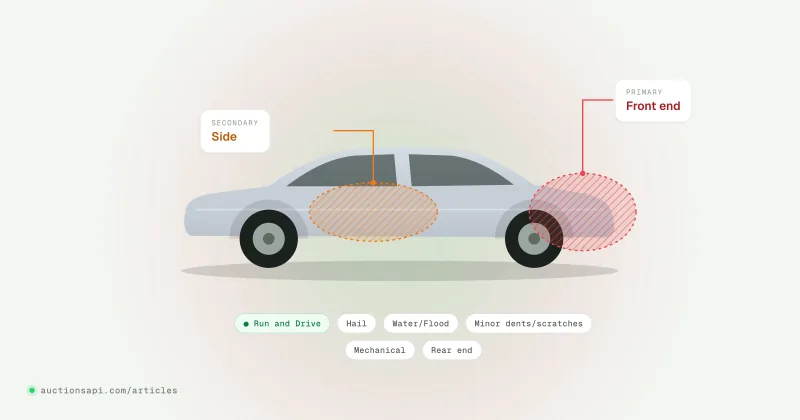
The table is our rule of thumb from looking at lots and their later histories. "Often" means the cost is usually visible; it does not mean every lot of that type is a good buy.
| Damage | Usually worth repairing? | What drives the cost | What tends to hide |
|---|---|---|---|
| Light front end, airbags intact | Often | Bumper, grille, headlights, hood, cooling stack | Radar behind the bumper or badge, A/C condenser, headlight brackets, calibration |
| Heavy front end | Rarely | Radiator support, aprons, rails, engine mounts | Bent rails, airbag sensors, engine and gearbox damage |
| Rear end | Often, if the trunk floor is straight | Bumper, tailgate or trunk lid, lights | Trunk floor, rear rails, blind-spot radars, exhaust |
| Side | Depends on the pillar | Doors, fenders, mirrors | B-pillar and sill (welded structure), curtain and seat airbags |
| Hail | Often, when light | Dent repair hours, panels that need replacing | Roof replacement, sunroof, broken glass and water inside |
| Water / flood | Rarely | Electronics, wiring, interior | Corrosion that appears months later, refusal to register |
| Burn | Almost never | Wiring, plastics, interior | Heat damage behind the firewall, smoke in every surface |
| Mechanical | A gamble | Engine or transmission | Could be a dead battery, could be a seized engine |
| Airbags deployed | Depends on how many | Airbags, control unit, belts, dashboard | Seat and curtain airbags, wiring, dashboard replacement |
| Frame / structural | Rarely, for import | Rails, pillars, floor | Jig time, welding to factory procedures, inspection failure |
| Rollover | Almost never | Roof, every pillar, glass | Airbags, alignment of the whole body |
| Theft recovery | Depends on the parts list | Missing wheels, seats, electronics | Ignition damage, keys and module programming |
| Undercarriage | Depends | Subframe, suspension, fuel lines | Battery pack damage on electric and hybrid cars |
Front and rear impacts
A front hit that stopped at the bumper reinforcement is the bread and butter of the import trade: bumper cover, grille, a headlight or two, maybe the hood and the radiator. The line between that and a bad buy is the radiator support and the rails behind it. If the photos show the headlights pushed back towards the wheels, the hood buckled in the middle, or the gap between hood and fenders different on each side, the energy went into the structure.
Rear impacts are cheaper on average because there is less behind the bumper, but look at the trunk floor and the spare wheel well. A rippled floor means the rear rails took the hit, and that is a structural repair.
Side damage
Doors and front fenders bolt on. The B-pillar and the sill below it do not: they are welded into the body, and replacing them properly takes time and skill. A side hit also fires side and curtain airbags on many cars. Look for a pillar that bows inwards in the door opening photo, and for a curtain airbag hanging along the roof lining.
Hail
Light hail on steel panels is often a paintless dent repair job, and hail lots usually run and drive with no mechanical issues. It becomes expensive when the dents are large and dense enough that the roof has to be replaced, when panels are aluminium (harder to repair without paint), or when glass and the sunroof broke and rain got in. Angled photos of the roof tell you more than the label.
Flood and fire
Water and fire do their damage in places you cannot photograph: connectors, control units, the wiring loom, insulation. A flooded car can run perfectly on delivery and develop electrical faults for a year. Salt water is worse than fresh. Fire spreads heat and smoke well beyond the visible burn. Both also hurt resale more than any dent, because the history follows the VIN. Some countries refuse to register cars with a flood history altogether. We would buy these only for parts.
Mechanical
A "Mechanical" label with no visible damage can be anything. Read the start code: at IAAI, Run & Drive, Starts and Stationary are defined on its start codes page, and Copart uses similar labels. A car that runs and drives with a mechanical label might have a warning light or a noise; a car that does not start might need a battery or an engine. Price it as an engine or gearbox unless you have a reason not to.
Deployed airbags
A deployed driver airbag in a light front hit is a known, bounded cost. Several deployed airbags are a different story: each one is a part, the passenger airbag often takes the dashboard with it, seat belts with pretensioners fire as well, and the control unit usually has to be replaced or reset. Buy new or certified restraint parts only. NHTSA has warned about counterfeit replacement airbags, and you can check a VIN for open safety recalls on its recalls page.
Frame, structural and rollover damage
Modern cars are unibody: the "frame" is the body itself, designed to fold in a crash in a specific way. Straightening it needs a bench, measurements against the manufacturer's data and welding to the factory procedure. Done well, it is expensive. Done badly, the car fails inspection or, worse, passes and does not protect anyone the next time. For import buyers we would leave these to specialists.
Hidden costs that sink the budget
Most repair overruns come from the same few groups of parts. None of them shows clearly in auction photos, and on a modern premium car any one of them can cost more than the panels around it.
- Restraint system: airbags, the airbag control unit, seat belt pretensioners, the clock spring in the steering column, seat occupancy sensors.
- Sensors and calibration: front radar (behind the bumper or the badge), the camera behind the windshield, parking sensors, blind-spot radars in the rear bumper. Replacing or even moving them needs a calibration with the right equipment.
- Lighting: adaptive, matrix and laser headlights are electronic units with control modules, not lamps. On some cars a single headlight costs as much as the rest of the front end.
- The cooling stack: radiator, A/C condenser, intercooler, fans and their shroud sit right behind the bumper and are often damaged together.
- Suspension and alignment: a wheel strike bends arms, knuckles and sometimes the subframe. A wheel leaning in or out in the photos means more than a tyre.
- Structure: aprons, rails, pillars and floor sections, plus the time on a bench to measure and pull them.
- Coding, keys and modules: replacement control units and keys often need programming with dealer-level access, and US cars can need region settings changed.
- Paint: three-coat pearl and matte finishes cost far more than a solid colour, and blending into adjacent panels adds hours.
- Small parts: clips, brackets, one-time bolts, labels and seals. Individually cheap, together a surprising line on every invoice.
Usually worth it, usually a trap
- Light front or rear damage with airbags intact
- Light hail on steel panels, glass intact
- Minor dents and scratches on bolt-on panels
- Door damage with a straight pillar and sill
- Theft recovery with every part still on the car
- Run and drive lots whose damage you can list part by part
- Flood, especially salt water
- Interior or engine-bay fire
- Structural damage combined with deployed airbags
- Rollover and roof damage
- Mechanical with no start code on an expensive engine
- Underbody damage on an electric or hybrid car
Which titles can be registered after repair
Before you price a repair, read the title, because some documents end the discussion. A salvage certificate is the normal starting point for a repairable car: in the US it becomes a rebuilt title after repair and inspection in most states. Certificates of destruction, non-repairable and parts-only documents mean the state has decided the car will never be registered again, and many importing countries will not register it either. The title types guide covers each document and its export notes.
Abroad, the US brand is only part of the check. Many European countries register an imported car after their own technical inspection, and some add an individual approval for a car with a salvage history. Some refuse cars with flood brands or a destroyed status. These rules differ by country and change, so ask your registration authority or broker what they will require for this title and this damage, in writing, before the sale.
How to estimate a repair before you buy
A repair estimate from photos will never be exact, but a disciplined one is much better than a guess. This is the routine we would follow for each shortlisted lot:
- Read the labels: primary and secondary damage, start code, airbag status, keys and title. Discard lots whose title will not register at home.
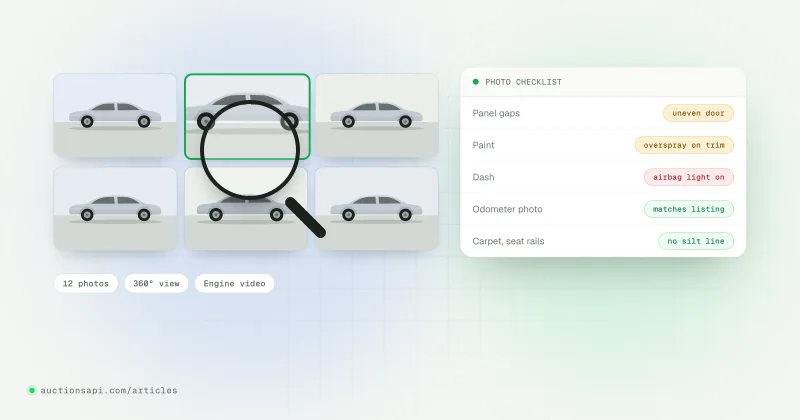
- Go through every photo and write a parts list: each panel, lamp, sensor and trim piece you can see is damaged. Our photo inspection guide explains what to look for in each shot.
- Decode the VIN to get the exact trim and equipment, so you price the right headlight and the right bumper (with or without sensors).
- Price the parts from your usual sources (new, used or aftermarket), then ask a body shop for the labour, paint and calibration hours.
- Add a contingency for what you could not see. The worse the visibility, the larger it should be; on a heavy front hit we would add more than on a scratched door.
- Check the car's earlier auction lots. A VIN that was sold damaged before, repaired and came back is telling you something about the last repair.
The last step is often skipped and often the most revealing. The same car can turn up with "Front End" damage two years ago and "Rear End" now, with a front end that looks too new in the photos. Auction history by VIN shows how to read earlier lots, and AuctionsAPI's Pay per VIN returns every Copart and IAAI lot of a VIN we have, with photos and results, if you check cars one at a time.
Then compare the total with the value of the repaired car in your market, discounted for its history. If the margin depends on the contingency not being used, pass.
What to do next
Pick one or two damage types you can price confidently, usually light front or rear impacts on a model whose parts you know, and stick to them until your estimates match your invoices. Keep a record of each estimate and the real repair cost. After ten cars you will know your own contingency better than any rule of thumb, and you will see which lots you should have skipped.
Questions people ask
Is it worth buying a damaged car from an auction?
It can be, when the damage is visible and bounded: a light front or rear hit with intact airbags, light hail or cosmetic dents on a model whose parts you can get easily. It rarely pays for flood, fire, structural or rollover damage, where the real cost is hidden. Always compare the full cost with the value of the repaired car with its history.
What damage should you avoid on a salvage car?
Flood damage (especially salt water), interior or engine fires, structural damage combined with deployed airbags, rollovers, mechanical damage with no start code on an expensive engine, and underbody damage on electric or hybrid cars. These hide most of their cost in wiring, electronics or the body structure, and they also hurt resale value more than other damage.
Is hail damage worth repairing?
Often, when the hail was light and fell on steel panels: paintless dent repair can fix many dents without repainting, and hail lots usually run and drive. It gets expensive when dents are large and dense enough to need a new roof, when panels are aluminium, or when broken glass let water inside. Look at angled photos of the roof and hood.
How do I estimate repair costs for a car from Copart?
List every damaged part you can see in the photos, decode the VIN for the exact trim and equipment, price the parts from your suppliers and ask a body shop for labour, paint and calibration hours. Add a contingency for hidden damage, larger for heavy impacts. Do not use the auction's estimated repair cost as your budget: it reflects US insurer pricing.
Can a salvage car be registered after repair?
In most US states a salvage-title car can be registered again as rebuilt after repair and an inspection. Certificates of destruction, non-repairable and parts-only documents usually cannot. Abroad the rules depend on the country: many register imported salvage cars after their own inspection, some refuse certain brands such as flood. Confirm with your registration authority before you buy.