 English
US car auction sites: where cars for export really come from
US car auction sites compared: Copart, IAAI, Manheim, OPENLANE, ACV, Bring a Trailer, government sales and classifieds, who can buy and what each publishes.
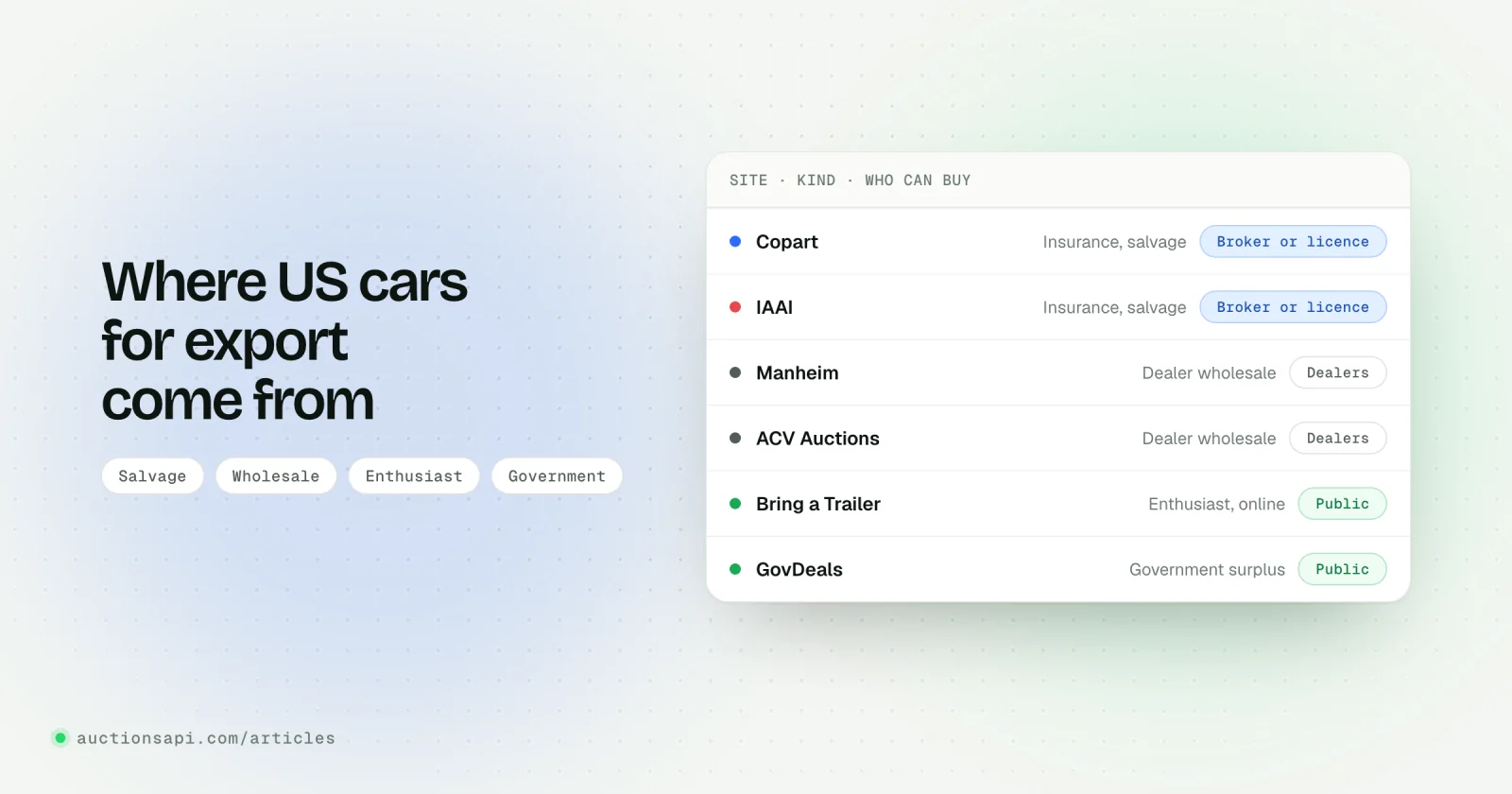
The US car auction sites that matter for export fall into five groups: the salvage and insurance auctions Copart and IAAI, where most damaged cars bound for Europe, the Caucasus and the Middle East are bought; the dealer-only wholesale auctions Manheim, OPENLANE and ACV; online enthusiast auctions such as Bring a Trailer and Cars & Bids; government and police surplus sales; and classified sites, which are not auctions at all. On top of these sit aggregator and broker sites that republish Copart and IAAI lots.
They differ in three ways that decide whether you can use them from abroad: who is allowed to buy, how easy it is to get the car and its title out of the country, and how much information the site shows before and after a sale.
Below is what each group sells, who can buy there, how export-friendly it is, and what data it publishes. Company names and ownership in this market change; we note the changes we are sure of and suggest you check the rest on each company's own site.
Key takeaways
- Copart and IAAI supply most cars exported from US auctions; many of their lots need a business licence, so foreign buyers usually go through a broker.
- Manheim, OPENLANE and ACV are dealer-to-dealer marketplaces: you need a US dealer licence, or a dealer or exporter buying for you.
- Bring a Trailer and Cars & Bids are open to the public and publish their results, but sellers are mostly private and the buyer arranges everything after the sale.
- Government auctions are public and cheap to enter, but cars are sold as-is with few photos and must be collected in person within days.
- Aggregator sites mirror Copart and IAAI lots and keep results; some are also brokers, and none of them is the auction itself.
US car auction sites compared
The table is the short version. Access rules depend on the state, the lot and your account type, so read "who can buy" as the usual case, not a rule for every car.
| Site or group | What it is | Who can buy | Export | What it publishes |
|---|---|---|---|---|
| Copart | Online salvage and used-car auction; insurers, rental fleets, banks, dealers | Members; many lots need a business licence, so foreign buyers often use a broker | The main source of exported auction cars | Photos, damage, title, odometer, start code; results to members |
| IAAI | Online salvage and used-car auction, owned by RB Global since 2023 | Same pattern as Copart | The other main source | Similar to Copart, with its own labels |
| Manheim | Wholesale dealer auction, part of Cox Automotive; physical lanes and online | Licensed dealers, typically registered through AuctionACCESS | Through a US dealer or exporter | Condition reports and results to members only |
| OPENLANE | Online dealer marketplace (KAR Global until 2023) | Licensed dealers | Through a US dealer or exporter | Members only |
| ACV Auctions | Online dealer marketplace for trade-ins | Licensed dealers | Through a US dealer or exporter | Members only |
| Bring a Trailer, Cars & Bids | Online enthusiast auctions | The public, after registration | Possible; the buyer arranges collection and shipping | Listings, comments and results with sold prices, publicly |
| GovDeals, GSA Auctions, police and city sales | Government surplus and impound sales | The public, after registration | Possible with an agent; pickup in person within days | Short listings, few photos, little history |
| Autotrader, Cars.com, CarGurus, Craigslist | Classifieds, not auctions | Anyone | Depends on the seller; some dealers avoid export sales | Asking prices, never sold prices |
| Aggregators and broker sites | Sites built on Copart and IAAI lots | Depends; many offer to buy through their licence | Often export-focused | Mirrored lots, archives of results |
Copart and IAAI: the salvage auctions behind most export cars
Copart and IAAI sell cars that insurers have written off after collisions, floods, hail, fire or theft, alongside rental fleet cars, bank repossessions and dealer trade-ins. Both sell online: bidding opens before sale day and the lot then goes through a live online auction, with some lots sold at a fixed Buy Now price and some sales subject to the seller's approval. IAAI also runs timed auctions. Our Copart vs IAAI comparison covers the differences in detail.
Ownership is worth knowing for context. IAAI has belonged to RB Global (the former Ritchie Bros.) since March 2023. Copart is an independent public company and also runs auctions outside the US, the UK and Canada among them. In September 2026 Copart announced an agreement to buy ACV Auctions, the dealer marketplace, with closing expected by the end of 2026 and ACV to run as an independent subsidiary, according to the announcement filed with the SEC. Check whether that deal has closed before relying on it.
Who can buy
Both auctions accept members from abroad. What membership opens depends on the lot: in many states, salvage and other branded-title cars can only be sold to licensed dealers, dismantlers or rebuilders, and the lot page says which licence is needed. That is why most European buyers use a broker who is registered with the auction and buys under its licence. The full route from lot to registered car is in importing a car from a US auction.
Why exporters start here
Volume and information. Copart and IAAI put a very large number of cars through their sales every week, each with a dozen or more photos, a damage label, title type, odometer with its status, start code, keys and location. Damaged cars are priced for the US repair market, where labour is expensive, which leaves room for buyers in countries where repairs cost less. And the export routine (title, US Customs, container from a port near the yard) is well worn: brokers and forwarders do it every day.
Manheim, OPENLANE and ACV: dealer-only wholesale
Dealer auctions are where US dealers buy and sell the bulk of used stock: off-lease cars, trade-ins, rental and fleet returns. The cars are generally in better condition than at salvage auctions and are priced for retail resale in the US.
- Manheim belongs to Cox Automotive and runs physical auction lanes across the US alongside its online channels.
- OPENLANE is the name KAR Global took in 2023. KAR had sold its ADESA US physical auction sites to Carvana in 2022; OPENLANE now focuses on online dealer-to-dealer and off-lease sales in the US, Canada and Europe.
- ACV Auctions runs online auctions where dealers sell trade-ins to other dealers, with inspection reports for each car.
Access is the catch: all three are for licensed dealers, typically registered through AuctionACCESS, the shared credential system for US dealer auctions. A buyer abroad can still get cars from them, but only through a US dealer or exporter who holds the licence and charges for the service. For an importer that is often worth it for late-model cars with clean titles, where the condition report replaces the photo guesswork of salvage auctions.
Data is closed. Condition reports and sale results are visible to members only, which is why sold prices from dealer auctions rarely appear in public.
Bring a Trailer and Cars & Bids: open to the public
Bring a Trailer (owned by Hearst Autos since 2020) and Cars & Bids (launched in 2020, focused on enthusiast cars from the 1980s onwards) are online auctions where mostly private sellers list one car each, with long photo galleries, videos and a public comment thread where the seller answers questions. Anyone can register, typically with a payment card on file, and the buyer pays a buyer's fee to the site.
For export they are a different world from Copart. Cars are usually undamaged, often well documented and priced for collectors. The sale is between buyer and seller, so after the auction you arrange payment, collection, transport, the title and the export yourself or through an agent. That suits classic and enthusiast imports; our guide to importing a classic car from the USA covers that route.
Their data is the most open of any group: listings stay online after the sale with the result, so you can see what comparable cars sold for. Other enthusiast sites follow similar models, and new ones appear regularly.
Government, police and fleet auctions
Federal, state and local agencies sell retired vehicles: police cruisers, utility trucks, fleet sedans, sometimes impounded and seized cars. Federal surplus goes through GSA Auctions; many states, counties, cities and universities use GovDeals (part of Liquidity Services) or similar platforms; police impound lots often hold their own sales.
They are public: anyone who registers can buy. Prices can be low, and titles are usually clean. The downsides for an exporter are practical. Listings are short, with few photos and little history. Cars are sold as-is, often with high mileage or idle hours, and many fleet vehicles are US-only trucks and SUVs. Payment and pickup windows are short and pickup is in person at the agency's yard, so a foreign buyer needs someone local. They work best for an importer with a US partner who can inspect and collect.
Classified sites: Autotrader, Cars.com, CarGurus, Craigslist
Autotrader, Cars.com, CarGurus, Craigslist and Facebook Marketplace are listing sites, not auctions: dealers and private sellers post cars at an asking price and you negotiate. They hold the largest choice of undamaged used cars in the US, which makes them useful for specific models in specific condition, and as a reference for US retail prices.
For export they bring friction. A private sale means arranging inspection, payment, title transfer and collection from a stranger, usually through an agent. Dealers handle paperwork better, but some are wary of export sales, and for new or nearly new cars some manufacturers discourage their dealers from selling to exporters. Prices are retail, so the margin that makes salvage imports work is mostly absent. And they publish asking prices only: a classified ad never tells you what a car actually sold for.
Aggregator and broker sites built on Copart and IAAI data
Search for almost any Copart or IAAI VIN and you will find it on several other sites. These aggregators show the same lots, often with a cleaner search, translations, a history of earlier sales and the final bids of finished lots. bid.cars is one well-known example; it is an independent site with no connection to AuctionsAPI.
Their business models differ, and it is worth knowing which one you are dealing with:
- Archive and history sites keep finished lots and their photos, searchable by VIN or lot number, and usually earn from advertising or paid reports.
- Broker sites show the lots and offer to buy them for you under their auction licence, adding their own fee, and often arrange transport and export.
- Mixed sites do both, and some also sell shipping and customs services to buyers in particular countries.
None of them is the auction. The sale happens at Copart or IAAI, under the auction's rules and fees, and an aggregator's page can lag behind the live lot. If something matters (the current status, a title note, a changed sale date), check it on the auction or with your broker. Companies that want to run such a site themselves usually take the lot data from a provider rather than scraping it; that is what our Copart and IAAI API is for, and the bid.cars API page explains what a site like that is built from.
What data each site shows, before and after the sale
For an importer the information around a sale matters as much as the sale itself, and the groups differ most here. Before the sale you need enough to judge the car; after it you need results to price the next one.
Before the sale, salvage auctions give the most structured picture of a damaged car: fixed labels for damage, title, odometer status and start code, plus photos and sometimes a 360-degree view or an engine video. Dealer auctions give condition reports written for dealers, often more detailed about mechanical condition but closed to outsiders. Enthusiast sites give the richest story (documents, service records, the seller's answers in public) but no standard labels. Government listings and classifieds give the least, and you fill the gaps with your own inspection.
After the sale, the picture flips. Bring a Trailer and Cars & Bids leave their results public. Copart and IAAI show results to members, and the lot page loses its value soon after the car is collected, which is why archives and data providers keep final bids. Dealer auctions keep results inside the member area. Classifieds never show a sold price at all; an ad that disappears tells you only that the car is gone.
That gap explains why so much export pricing is done from Copart and IAAI results: they are the largest set of comparable sold cars with consistent labels. Read them carefully, though. A final bid is a sale price only when the lot actually sold, and a seller reserve is never one; Copart sold prices explains how to read them.
Which site fits which buyer
- Importing repairable cars for resale abroad: Copart and IAAI through a broker. This is where volume, information and export routines meet.
- Importing late-model cars with clean titles: dealer auctions through a US dealer or exporter, or Copart and IAAI lots from rental and finance sellers.
- A classic or enthusiast car: Bring a Trailer, Cars & Bids and similar sites, with an agent for inspection and collection.
- Cheap fleet vehicles and trucks: government auctions, if you have someone on the ground.
- A specific undamaged car for yourself: classifieds, with an inspection and an agent who handles the title.
Whichever site you use, price the car from what comparable cars actually sold for, not from asking prices or current bids, and check the VIN's earlier sales before you commit. Then run the full cost of transport, duty, taxes, repair and registration in your country before you decide that a cheap US car is cheap.
Questions people ask
What are the main car auction sites in the USA?
For export buyers the main ones are Copart and IAAI (salvage and insurance cars), Manheim, OPENLANE and ACV (dealer-only wholesale), Bring a Trailer and Cars & Bids (online enthusiast auctions), and government sales such as GSA Auctions and GovDeals. Classifieds like Autotrader and Cars.com sell cars too, but at asking prices rather than by auction.
Can a foreigner buy a car at a US auction?
Yes. Copart and IAAI accept members from abroad, but many lots need a business licence, so most foreign buyers use a broker registered with the auction. Dealer auctions such as Manheim require a US dealer licence, so you buy through a dealer or exporter. Enthusiast and government auctions are open to the public, but you need someone to collect the car.
Is Manheim open to the public?
No. Manheim is a wholesale auction for licensed dealers, who usually register through AuctionACCESS. Members of the public and foreign buyers without a US dealer licence can only get Manheim cars through a licensed dealer or exporter buying on their behalf, who charges a fee for the service. Condition reports and results are also visible to members only.
What is the difference between Copart and Manheim?
Copart is a salvage and used-car auction where insurers, fleets and banks sell damaged and undamaged cars online, with many lots open to brokers and some to the public. Manheim is a dealer-to-dealer wholesale auction for licensed dealers, selling mostly undamaged off-lease, fleet and trade-in cars. Exporters of damaged cars mostly use Copart and IAAI.
Are sites like bid.cars official Copart or IAAI websites?
No. Aggregator sites republish Copart and IAAI lots, often with an archive of results, and some also act as brokers that buy on your behalf. They are separate companies, not the auctions. The sale itself happens at Copart or IAAI under their rules and fees, so check important details such as status and title on the auction or with your broker.